
The nationwide local elections held on June 3, 2026, signify more than just a reshuffling of local power. This election was the first major political event since the inauguration of the Lee Jae-myung administration, marking a pivotal moment for the direction of national governance and the evolution of South Korea's political landscape. Based on the results, the Democratic Party appears to have gained an advantage.
The party secured dominance across both metropolitan and local governments, successfully expanding its influence significantly beyond the central government and the National Assembly. However, interpreting this solely as a victory for the Democratic Party does not fully capture the reality. The People Power Party managed to retain key symbolic regions such as Seoul, Daegu, and Gyeongnam, maintaining a minimal foundation as a national party. Ultimately, this election represented both a victory for the Democratic Party and a survival moment for the People Power Party, indicating that South Korean politics is entering a new phase.
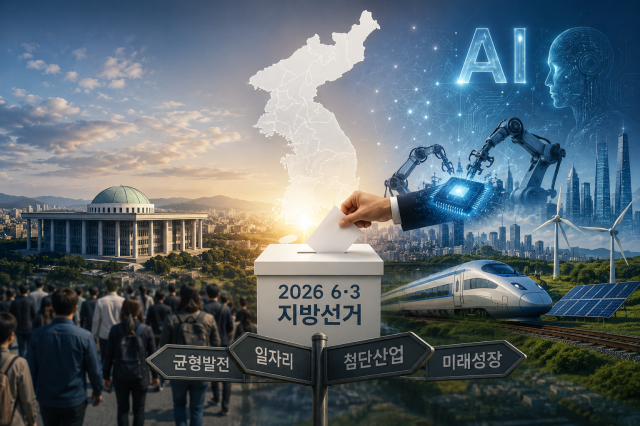
One of the most notable aspects of this election is the shift in voter priorities. While past local elections were heavily influenced by regime judgment and regionalism, this election brought economic issues, industry, job creation, housing, AI, advanced industries, regional extinction, and balanced development to the forefront.
In the capital region, housing, transportation, and youth employment emerged as key issues, while the Chungcheong region focused on building a semiconductor and advanced industry belt. The Yeongnam region emphasized manufacturing competitiveness and local economic recovery, whereas the Honam region discussed physical AI, future industries, and balanced development. This shift indicates that South Korean politics is gradually moving from an ideology-centered competition to a future growth strategy competition.
Seoul was the most critical battleground in this election. The outcome in Seoul, the center of South Korea's political and economic landscape, serves as an important benchmark for future political dynamics. The Democratic Party launched a full-scale effort to reclaim Seoul, but the result was a retention of the mayoralty by Oh Se-hoon. This outcome cannot be simply interpreted as a victory for conservatism. Seoul's citizens demonstrated a tendency to separate their evaluations of the central government from those of the city administration. Many analysts suggest that practical factors such as community-focused policies, urban competitiveness, transportation infrastructure, and real estate issues played significant roles. Notably, real estate concerns seem to have influenced the middle class's voting behavior. Seoul remains a region where the centrist influence is paramount, with a strong preference for pragmatism over ideology. Therefore, the results in Seoul signal a broader shift in South Korean politics toward a performance-oriented approach.
Mayor Oh Se-hoon has further solidified his presence as a prominent figure in the conservative camp through this election. His experience in city governance, regional competitiveness, stable image, and ability to appeal to centrist voters are seen as strengths. However, there are still challenges regarding the cohesion of his strong support base and the organizational foundation within his party. Considering that the key battleground in South Korean politics is currently among centrist voters, Oh's political value may have increased.
Daegu and North Gyeongsang Province remain strongholds of conservative politics. However, the political landscape is not as monolithic as in the past. Political diversity is gradually expanding, particularly among younger voters, with new industrial issues such as AI, robotics, and future manufacturing gaining traction. Nevertheless, the Democratic Party did not manage to make significant inroads in these areas, indicating that political culture, organizational strength, and historical identity continue to exert strong influence. Gyeongnam exhibited similar trends, with a manufacturing-based industrial structure and a solid base of conservative voters allowing the People Power Party to successfully defend its core regions. However, the previously overwhelming dominance is showing signs of gradual decline.
Within the Democratic Party, evaluations of the leadership of Jeong Cheong-rae following this election are mixed. Jeong is known for his strong political combativeness, clear messaging, and high support among party members. However, succeeding in a nationwide election requires not only consolidating the support base but also expanding appeal to centrist and non-supportive voters. Some analyses suggest that the limitations observed in certain regions are related to this issue. While this cannot be definitively attributed as the sole cause of the election results, it highlights the importance of balancing support consolidation with centrist expansion for the Democratic Party's long-term competitiveness.
Prime Minister Kim Min-seok is also regarded as a significant political asset within the Democratic Party. He has built a stable image based on extensive political experience, policy expertise, and administrative experience, and is recognized for his understanding of economic, diplomatic, and security issues. Former party leader Song Young-gil, despite experiencing political ups and downs, still maintains a certain level of political influence. Ultimately, the Democratic Party faces the dual challenge of maintaining its current power while preparing for the post-Lee Jae-myung era.
The People Power Party is also entering a new leadership competition. Former leader Han Dong-hoon is still considered a prominent politician, bolstered by high recognition and a strong support base. He is particularly noted for his political potential among younger voters and in certain areas of the capital region. However, a key challenge will be how convincingly he can present visions for national governance, economic, diplomatic, and industrial policies. Lawmaker Ahn Cheol-soo possesses strengths in science, technology, and innovation in the context of the AI era, while former lawmaker Yoo Seung-min retains symbolic significance in economic and reform conservatism. Former Minister Won Hee-ryong is also recognized for his strong drive and execution capabilities. However, it is difficult to definitively state that any one individual will lead the next political order at this time, as the political environment, economic conditions, and public sentiment can shift, potentially forming new dynamics.
One of the most significant implications of this election is the change at the local level. While past local elections often reflected central politics, regions are now presenting diverse future strategies competitively. Chungcheong discusses semiconductor and advanced industry belts, Busan aims to become a global financial hub, and Ulsan focuses on future mobility industries. Daegu emphasizes robotics, while Gwangju discusses future mobility and AI industries. North Jeolla is also seeking new growth strategies centered around physical AI and renewable energy in the Saemangeum area. This indicates that local governments are evolving from passive entities waiting for central government support to active agents designing their own futures.
Jeolla North Province is particularly noteworthy. Historically viewed as relatively marginalized during South Korea's industrialization, it now faces new opportunities in the era of the AI revolution and energy transition. The expansive industrial land and renewable energy infrastructure in Saemangeum, along with a relatively low cost structure, are seen as favorable conditions for data centers, advanced manufacturing, and physical AI industries. However, this does not guarantee immediate success. If a national AI strategy is combined with local balanced development policies, there is significant potential for Jeolla North Province to emerge as a new industrial hub.
Future political schedules will also be crucial variables. The 2028 general election is likely to serve as a midterm evaluation of the Lee Jae-myung administration. If policies promoting AI, semiconductors, and advanced industries yield results and regional balanced development produces visible outcomes, the ruling party may find itself in a favorable position. Conversely, if economic conditions worsen or public livelihood issues intensify, the opposition may seize opportunities for counterattacks. At this point, it is prudent to keep various possibilities open rather than definitively asserting one side's advantage.
The next presidential election in 2030 will likely follow a similar pattern. Given the nature of South Korean politics, presidential elections often culminate in discussions about the economy, public livelihood, and national competitiveness. Key evaluation criteria will likely include achievements in the AI industry, job creation for young people, stability in real estate, and revitalization of local economies. Citizens tend to assess governments based on tangible changes in their lives rather than political rhetoric.
If 1987 marked the era of democratization, and 1997 the era of structural reform, the 2000s were characterized by the information and internet revolution. The period following 2026 is likely to be defined by AI, advanced industries, energy transition, and local transformation. The June 3 local elections may be recorded as the starting point of that change. This election was not merely about how many metropolitan leaders each party secured; it was a political milestone indicating the direction South Korea is headed.
The Lee Jae-myung administration has secured a strong political foundation. However, what the public has conferred is not privilege but responsibility. It is now time to demonstrate economic and national achievements beyond political justifications. The public is no longer swayed by mere slogans; they are looking for jobs, income, housing, education, and hope for the future. Ultimately, the success or failure of South Korean politics in the future is likely to be evaluated based on performance rather than ideology.
History records the aftermath of elections as more significant than the results themselves. Future historians may view the June 3, 2026, local elections not simply as a local election but as the moment South Korea began its transition toward becoming a center for the AI revolution and advanced industries, a time when local regions began to emerge as new pillars of national growth, and a period when politics shifted from ideological competition to a focus on national competitiveness.
The election is over. However, the competition surrounding South Korea's future is just beginning.
* This article has been translated by AI.
Copyright ⓒ Aju Press All rights reserved.