
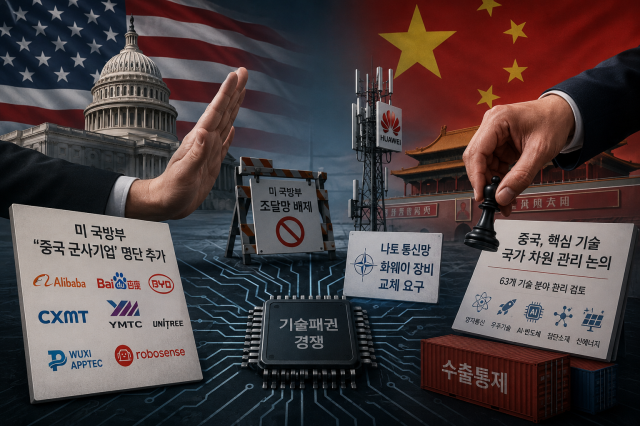
The United States is intensifying its technology pressure on China. The US Department of Defense has excluded major Chinese tech companies from its procurement network and has demanded NATO member countries replace Huawei equipment still in their communications networks. In China, discussions are emerging about the need to manage key domestic technologies at the national level, indicating that the US-China technology conflict is evolving into a long-term security competition.
On June 9, Reuters, Bloomberg, and the South China Morning Post reported that the US Department of Defense has added Alibaba, Baidu, BYD, Changxin Memory Technologies (CXMT), Yangtze Memory Technologies (YMTC), Wuxi Apptec, Unitree, and Robosense to its list of 'Chinese military companies.'
This list includes companies deemed to contribute to the modernization of the People's Liberation Army, known under US law as the 1260H list.
While this action is not an official sanction, it imposes significant practical restrictions. The listed companies will be unable to enter into direct contracts with the Department of Defense starting at the end of June, and by 2027, their ability to supply products and services through third parties will also be limited. This effectively phases out major Chinese tech companies from the US Department of Defense procurement network.
Notably, the scope of this action has expanded. Previous regulations focused primarily on semiconductors and telecommunications equipment, but now include companies in e-commerce, search and artificial intelligence (AI), electric vehicles, robotics, and biotechnology. This suggests that the US views Chinese private tech firms as linked to military and industrial capabilities.
Pressure on allied nations has also increased. Bloomberg reported that the Trump administration had urged NATO member countries to use part of their defense budgets to replace Huawei equipment in their communications networks and critical infrastructure. The US believes that replacing Huawei equipment is a matter of network security and should be included in NATO's defense spending goals.
The US is framing the issue of Chinese telecommunications equipment not as a trade concern but as an alliance security issue. While it has not publicly named specific countries, foreign media suggest that Germany is a primary target. Germany and Spain have previously expressed caution, stating that EU-level restrictions on related equipment could provoke retaliation from China.
In China, discussions are emerging about limiting the overseas transfer of technologies where the country holds an advantage. According to the South China Morning Post, Chinese researchers have identified 63 strategically sensitive sectors that are competitive in the global market. They have also proposed criteria for determining which sectors might be subject to future export restrictions.
Potential candidates include satellite quantum communication, electromagnetic propulsion systems, space robotics, quantum device manufacturing, ultra-small AI edge computing, perovskite solar cells, and BeiDou satellite autonomous positioning technology. This reflects a recognition that not only areas where China needs to catch up but also those where it already has strengths should be managed at the national level.
However, this list has not been formalized as official policy. Researchers have clarified that their study is still under academic review and has not yet reached the stage of being adopted as an actual export control system. Nonetheless, it is evident that China is beginning to discuss its own technology protection measures, drawing inspiration from the US export control framework.
* This article has been translated by AI.
Copyright ⓒ Aju Press All rights reserved.