

Taiwan's economy is attracting global attention as the island nation of just over 23 million people has become a key production hub in the age of artificial intelligence (AI). Taiwan Semiconductor Manufacturing Company (TSMC) has emerged as the heart of the global advanced semiconductor supply chain. Major companies like Nvidia, Apple, AMD, Qualcomm, Microsoft, and Amazon rely on Taiwan's semiconductor production capabilities to sustain the pace of the AI revolution.
Taiwan is no longer just a manufacturing powerhouse; it has become a strategic nation supporting AI civilization. The world refers to this as the "Silicon Shield." Even amid military pressure from China, Taiwan's strategic value in the international community is largely due to its semiconductor competitiveness.
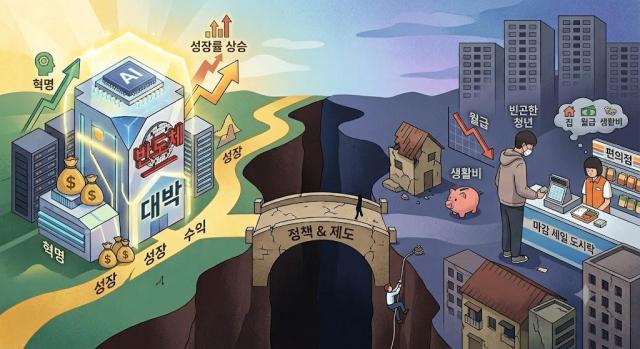
On the surface, Taiwan's economy appears dazzling. In the first quarter of 2026, the country's economic growth rate reached 13.69%, an explosive growth rate rarely seen in advanced economies. The annual growth rate for 2025 was also recorded in the 8% range. Exports surged due to demand for AI semiconductors, servers, and cloud infrastructure, while the stock market continued to hit record highs.
Per capita GDP has surpassed $40,000, reportedly surpassing South Korea. From an external perspective, Taiwan seems to be the biggest beneficiary of the AI era. The national economy is thriving, corporate profits are increasing, and global investors are starting to take a renewed interest in Taiwan.
However, the economy is not solely defined by numbers. High growth rates do not guarantee happiness for all citizens, and increased exports do not necessarily improve the living conditions of every household. The real issue facing Taiwan's economy lies here. While the national economy is experiencing unprecedented prosperity, the majority of citizens do not feel the benefits.
Although TSMC has become the world's leading company, many young people in Taiwan claim they cannot afford to buy homes. While stock prices rise, wages have not seen significant increases. Despite the rise in per capita GDP, the lives of ordinary workers remain challenging. While the world envies Taiwan, many citizens view their economic reality with anxiety.
This represents the greatest paradox of Taiwan's economy today. Semiconductors can save the nation, but they cannot make all citizens wealthy. Advanced industries create immense added value, but their job creation potential is limited. The semiconductor industry constitutes a significant portion of Taiwan's GDP, yet it employs only a small fraction of the total workforce.
A small number of highly skilled workers and major corporate shareholders reap enormous benefits, while workers in general service sectors, small businesses, rural residents, and youth are left far from the fruits of this growth. The engine of growth is powerful, but the warmth of that growth does not spread throughout society.
The frustrations felt by Taiwan's youth vividly illustrate this structural imbalance. While the semiconductor industry has reached world-class levels, wages in non-semiconductor sectors remain low. Starting salaries for college graduates are woefully inadequate to cope with high housing prices and rents. The cost of living in metropolitan areas like Taipei and New Taipei puts pressure on the futures of young people.
After spending a significant portion of their salaries on rent, saving for marriage, childbirth, or homeownership becomes a distant dream. Surveys revealing that many young people in Taiwan consider themselves "failures in life" are shocking because they highlight how the success of the national economy has not translated into personal hope.
The term "beggar Superman," which has emerged in Taiwan, symbolically represents this reality. It refers to young people rushing to convenience stores at closing time to buy discounted food nearing its expiration date. They move quickly like Superman, yet their reality is one of poverty. This expression is not just a trend; it serves as a social metaphor illustrating how young people are struggling under the glamorous national brand of an AI semiconductor powerhouse.
While the nation appears wealthy, many citizens are living day-to-day on discounted meals and near-expiration products. The housing crisis in Taiwan is even more severe. The ratio of housing prices to median income in the capital, Taipei, is among the highest in Asia. Young people find it nearly impossible to purchase homes solely on normal wages. Rising housing costs delay marriage and reduce birth rates. Taiwan's extremely low birth rate is not merely a result of changing values.
It is a complex outcome of low wages, high housing prices, an uncertain future, and excessive working hours. If an economy is growing but unable to support childbearing, it is difficult to claim that growth is sustainable.
A deeper examination reveals issues with policy. Taiwanese economists and foreign analysts point to the prolonged low exchange rate and low-interest rate structure as one of the causes of economic polarization in Taiwan. Maintaining a low value for the New Taiwan Dollar benefits large exporting companies by enhancing export price competitiveness and increasing the local currency value of overseas earnings.
However, the same policies present a different face to ordinary citizens. A low currency value raises import prices and increases the burden of living costs. While it acts like a subsidy for export companies, it functions as an invisible tax on consumers.
Similarly, ultra-low interest rates favor corporate investment but, if sustained over a long period, can flood the real estate market with excessive liquidity. If money flows not only into productive investments but also into housing, land, and financial assets, asset prices skyrocket. Those who own assets become wealthier, while young people and the working class without assets drift further away from opportunities to build wealth.
This has been a significant backdrop to the polarization of Taiwan's real estate market. Ultimately, monetary and industrial policies have combined to favor large exporting companies and asset holders while disadvantaging wage earners and the youth.
Some foreign media have criticized this contradiction in Taiwan as "Formosan Flu," referring to Taiwan's old name. It highlights a pathological structure where the entire nation grows in advanced industries, yet citizens' living conditions do not improve, and while large corporations succeed in the global market, ordinary workers suffer from low wages and high housing prices. The economy may appear healthy on the surface, but it harbors deep fatigue within, representing the greatest risk facing Taiwan's economy.
Of course, Taiwan's semiconductor success should not be downplayed. TSMC is a great company that will be remembered in the history of human industry. Without the long-term strategies and dedication of the Taiwanese government, businesses, and engineers, today's Taiwan would not exist. Taiwan serves as a prime example of how a small country can create a significant global advantage in a specific field.
South Korea can learn much from Taiwan's strategic focus, talent development, and ability to secure global customer trust. The issue lies not in the success itself but in the distribution and diffusion that follow. If the achievements of advanced industries do not connect to the lives of the entire population, that success breeds social tension.
This is why South Korea must pay attention to Taiwan. South Korea is also betting its future on the semiconductor and AI industries. Samsung Electronics and SK Hynix are key players in the global memory semiconductor market, and as demand for AI servers and data centers grows, the strategic value of South Korean semiconductors will increase. However, South Korea cannot avoid the same questions faced by Taiwan.
When semiconductor companies make significant profits, does that mean everyone in the country will prosper? When stock prices rise, does that reduce the rent burden for young people? When exports increase, do jobs in rural areas revive? When large corporations profit, do wages for small business workers also rise?
To conclude, the answer is not automatic. The fruits of growth require systems, policies, industrial ecosystems, and social consensus to be widely distributed. Even if a few large semiconductor companies achieve record profits, if that wealth does not translate into small businesses, local economies, service sectors, youth employment, and housing stability, citizens will not feel the economic boom. Taiwan's experience starkly reminds us that becoming a semiconductor powerhouse is not synonymous with a prosperous populace.
Therefore, South Korea's strategy for the AI era should not stop at merely increasing semiconductor production capacity. The value added from semiconductors must be spread to physical AI, robotics, smart factories, autonomous driving, biotechnology, energy, agricultural life, logistics, and content industries. Semiconductors are the brain of AI, but a brain alone cannot move a body. AI must enter factories, farms, hospitals, schools, ports, logistics centers, cars, and robots to create jobs and income that citizens can feel. This is where South Korea must differentiate itself from Taiwan.
Particularly, connecting with local economies is crucial. Taiwan's hyper-concentrated model may boost growth rates but can exacerbate regional disparities. South Korea must guard against a structure where the achievements of AI semiconductors are concentrated only in the capital region and certain industrial complexes. The agricultural life and physical AI in North Jeolla, the automotive and robotics sectors in Ulsan, mobility in Gwangju, electronics and materials in North Gyeongsang, semiconductors and biotechnology in Chungcheong, and shipbuilding and logistics in Busan and South Gyeongsang must organically combine with AI. Only then can the semiconductor boom transform into a boom for the entire national economy.
True national competitiveness in the AI era does not end with possessing a few world-class companies. It depends on how much opportunity the technologies and wealth created by those companies provide to the populace. While TSMC has made Taiwan a strategic nation, if it has not sufficiently changed the lives of Taiwan's youth, that serves as a critical warning for South Korea. While Samsung Electronics and SK Hynix are blessings as the backbone of the South Korean economy, if their achievements do not spread to the lives of citizens, South Korea too could walk the path of polarization seen in Taiwan.
Confucius said, "The people worry more about inequality than about scarcity," and Mencius stated, "A stable livelihood leads to a stable heart." This means that a stable means of living and livelihood is necessary for people to feel secure. This wisdom from classical texts remains unchanged in the age of AI. If citizens do not have stable income, housing, healthy working conditions, and future hopes, it is difficult to call a nation with high GDP a good country. The purpose of economic growth is not the growth rate itself but to support the lives of the people.
Taiwan stands as both the most glamorous success story and the deepest warning of the AI era. Semiconductors can make a nation wealthy, but to make citizens wealthy, a broader industrial ecosystem, a fairer distribution structure, more stable housing policies, more quality jobs, and balanced regional development are necessary. Semiconductors are the starting point, not the destination. AI is a tool, not a goal. Technology must exist for humanity, and the economy must exist for the people.
South Korea must learn from Taiwan's success, but it must also see the shadows that accompany it. It should not only focus on the glory of TSMC but also confront the self-deprecation of the "beggar Superman" among the youth. It should not only celebrate record growth rates but also acknowledge the world's lowest birth rates. It should not only hear the cheers of the stock market but also listen to the sighs of young people burdened by rent and living costs.
South Korea's goal in the AI era should not simply be to become a semiconductor powerhouse. It must strive to be an AI powerhouse that citizens can feel, a semiconductor powerhouse where youth can dream of the future, and a physical AI powerhouse that grows alongside local economies, creating a civilization where technology and humanity coexist. This is the path to an economy in the AI era viewed through the lens of truth, justice, and freedom. The truth of growth lies in technology, the justice of distribution lies with the people, and the freedom of life emerges from economic stability felt by citizens.
A nation where citizens feel poor despite semiconductor success should not exist. A country with the world's best companies should not become a place that produces the most anxious youth. South Korea must ask itself in front of the mirror of Taiwan: Who will we make wealthy with AI semiconductors? A few companies or the entire populace? The answer to this question will determine the fate of South Korea's economy over the next decade.
※ This article was generated using generative AI and has been reviewed by an editor.
* This article has been translated by AI.
Copyright ⓒ Aju Press All rights reserved.