
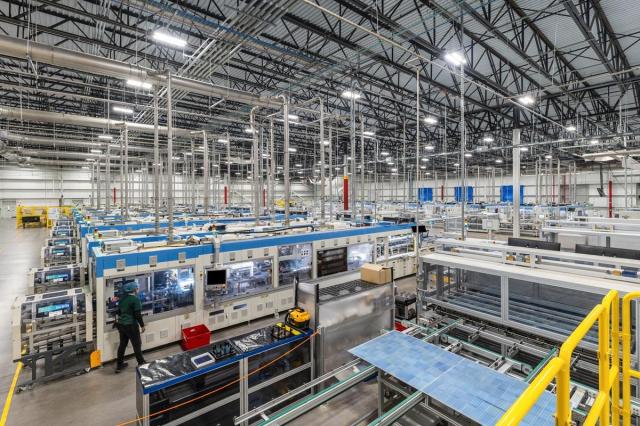
According to industry sources on June 10, Hanwha Solutions' Q CELLS division has completed the cell production line at its Cartersville, Georgia, factory and will begin mass production in July. The addition of the cell process to the existing ingot, wafer, and module production lines has completed the establishment of the integrated solar production hub, known as the 'Solar Hub.'
Hanwha Q CELLS' production capacity in the U.S. has expanded to 3.3 GW each for ingots, wafers, and cells, and 8.6 GW for modules, making it the largest manufacturer of silicon solar cell-based modules in North America.
In May, the company completed inspections of key equipment needed for cell production and is currently in the testing phase. Starting in July, it will begin producing U.S.-made modules using cells manufactured at the Cartersville facility, marking the full operational launch of its value chain.
With the completion of the Solar Hub, Hanwha Q CELLS is poised to improve its profitability. The establishment of a solar manufacturing value chain in the U.S. will expand its benefits from the Advanced Manufacturing Production Credit (AMPC). Additional AMPC credits will also be received for cells and wafers produced at the Cartersville plant.
This year, Hanwha Q CELLS expects to receive approximately $675 million (about 1 trillion won) in AMPC credits. By 2027, when the Cartersville plant is fully operational, this amount is projected to increase to $879 million, reaching $929 million in 2028, and $1.1 billion by 2029.
The company also anticipates premium benefits from an increased share of U.S.-made components. The Investment Tax Credit (ITC) under the U.S. Inflation Reduction Act (IRA) offers additional tax credit benefits for projects that meet domestic component usage requirements.
Hanwha Q CELLS is also accelerating its efforts to secure next-generation solar technology.
Recently, Hanwha Q CELLS' German subsidiary agreed to supply tandem cell samples for a space technology demonstration project (SSTEF-1) involving Georgia Tech. This program is funded by NASA and overseen by Aegis Aerospace.
Researchers at Georgia Tech will install Hanwha Q CELLS' tandem cell samples on the surface of a lunar lander to collect performance data in a space environment. Tandem cells are next-generation solar cells that enhance efficiency by adding a perovskite layer on top of traditional silicon cells, with commercialization targeted for 2029.
"Hanwha Q CELLS will leverage its technological expertise and market competitiveness, built from its origins in solar manufacturing, to become a global renewable energy solutions provider that opens the era of space solar power," said CEO Park Seung-deok. "This project will be a significant turning point in extending the possibilities of sustainable energy to outer space."
* This article has been translated by AI.
Copyright ⓒ Aju Press All rights reserved.