
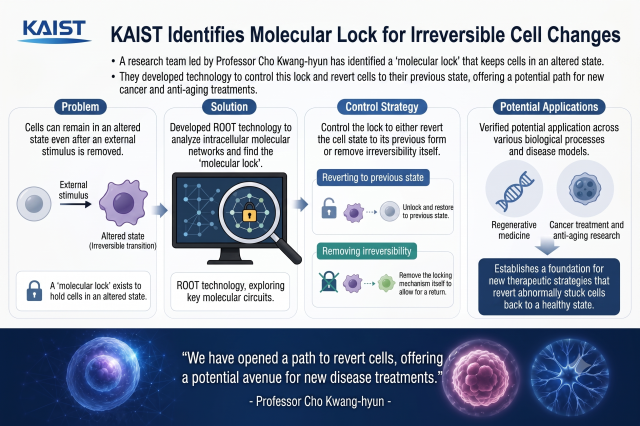
SEOUL, August 21 (AJP) - A cell that turns cancer-like tends to stay that way long after whatever triggered the change has gone. Researchers in South Korea say they have identified which molecular circuits hold it there and have shown in computer models how to release them.
The method is called ROOT, short for Revelation Of the Original circuit of irreversible Transition. It was developed by a team led by Cho Kwang-hyun, a professor in the Department of Bio and Brain Engineering at Korea Advanced Institute of Science and Technology (KAIST), and published online Aug. 18 in Proceedings of the National Academy of Sciences. The university announced the work Friday.
Cells constantly change their properties and functions in response to signals from outside. Sometimes the change reverses when the signal stops. Sometimes it does not. Biologists call that second case irreversibility.
An ordinary switch springs back when the finger comes off it. Some cellular switches stay on. The molecules that drove the original change keep activating one another after the outside signal has vanished, and the new state holds.
That property is not a defect. Cells rely on it to become and remain specialized, which is why a liver cell stays a liver cell. It also drives disease. In epithelial-mesenchymal transition, cells that normally sit fixed in a tissue layer acquire the ability to detach, move and invade what surrounds them. Cancer uses that transition to spread, and once a tumor cell has made it, the cell does not go back.
The obstacle has been sorting out which circuits do the holding. A cell's molecular network contains thousands of positive feedback loops, arrangements in which one molecule activates another that in turn reactivates the first. Only some of them lock a cell into a state it cannot leave, and there was no way to tell which.
ROOT represents those interactions as a computational logic model and simulates the full arc of a stimulus arriving and then being withdrawn. Circuits that keep the cell in its altered state after withdrawal are flagged. The team calls the resulting set an irreversibility kernel.
The team compares the exercise to picking out, from thousands of tangled wires, the few that are actually keeping a door locked.
Finding the lock suggested two ways to work on it. The first, resetting control, leaves the cell's capacity for irreversible change intact and returns the individual cell to its earlier state, the equivalent of opening the door without touching the lock. The second, reversing control, removes the source of irreversibility altogether, so the cell can move between states more freely afterward.
The researchers ran ROOT on B cell differentiation, epithelial-mesenchymal transition in lung cancer, and the development of enterocytes and beta cells, the intestinal absorptive cells and the insulin-producing cells of the pancreas, using data on which genes are switched on in individual cells. In each case the circuits ROOT identified matched regulators already known from earlier laboratory work to govern those transitions.
Nothing in the study reversed a cell in a laboratory. The work is computational throughout, tested against networks built from published experimental data, and the applications to cancer and aging that the university describes are prospective rather than demonstrated.
What the study offers, KAIST said, is an answer to a question that precedes treatment. Not how to bring a cell back, but why it cannot come back by itself.
Kim Jong-wan and Jang Seong-hoon were co-first authors. Lee Jong-hoon and doctoral student Corbin Hopper were co-authors. The work was funded by the National Research Foundation of Korea, the Ministry of Science and ICT, and the Korea Dementia Research Center.
"The core of this study is that we identified the circuits that make a cell unable to return once it has changed, and developed a technology that controls them to bring the cell back to its previous state," Cho said.
Copyright ⓒ Aju Press All rights reserved.
