

Throughout the history of human civilization, great cultures have always left behind significant scriptures. India had the Vedas, China had the Analects and the Tao Te Ching, and Korea had the Cheonbu Gyeong and the Samil Sin Go. A monumental beacon illuminating the spiritual world of East Asia for thousands of years is the Buddhist scriptures. Buddhism is not merely a religion; it is a vast spiritual civilization that explores human suffering and happiness, life and death, desire and freedom, ignorance and enlightenment. Therefore, even today, as AI begins to mimic human intelligence, Buddhist scriptures remain a living repository of wisdom.
Today, humanity lives in the most prosperous era in history. With a smartphone in hand, one can search for information from around the world, AI can draft documents faster than humans, and science and technology are advancing at an unprecedented pace. Paradoxically, however, human minds are becoming increasingly anxious. Depression and anxiety disorders are on the rise, loneliness has become a common affliction of modern life, and many feel empty despite material abundance. While information has increased, wisdom has diminished; connections have grown, but relationships have become superficial. At this juncture, Buddhist scriptures pose profound questions to modern individuals: What is the purpose of human life? Where does true freedom lie? Does happiness come from outside, or does it arise from within?
Among Buddhist scriptures, the Heart Sutra is undoubtedly the most widely read. This brief text, consisting of just over 260 characters, encapsulates the essence of Mahayana Buddhism. The core of the Heart Sutra is condensed in the phrase, "Form is emptiness; emptiness is form." At first glance, it may seem like an abstract philosophy, but it conveys a very practical teaching. Humans tend to perceive visible things as reality. They believe their possessions are theirs, that power is eternal, and that youth will last forever. However, the Heart Sutra teaches that nothing in this world is permanent. Flowers wilt, seasons change, and people age and depart. All existence is in constant flux. Thus, the more one clings, the greater the suffering; the more one lets go, the more freedom begins.
The final part of the Heart Sutra is even more famous: "Gate, gate, paragate, parasamgate, bodhi svaha." This phrase, familiar to many Koreans, is not merely a mantra. It means, "Go, go, go beyond, go to the other shore. Let us go to the world of enlightenment." It is a grand declaration of the human spirit to transition from ignorance to wisdom, from desire to freedom, and from suffering to liberation. I believe this message is one of the most essential for modern individuals living in the age of AI. We are crossing the river of technology, yet we are failing to cross the river of the heart.
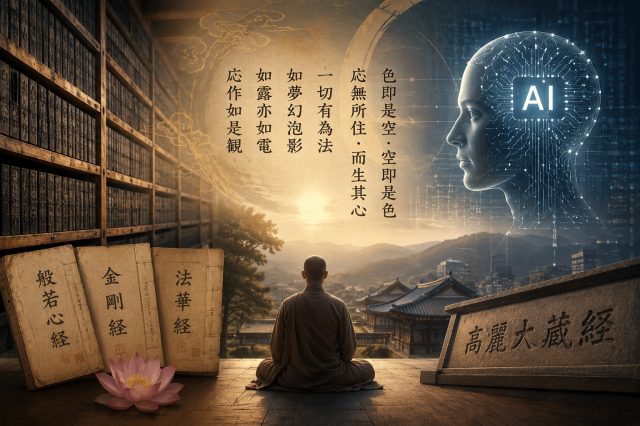
The Diamond Sutra offers another dimension of wisdom. Named for its ability to shatter human ignorance with diamond-like clarity, the Diamond Sutra's core message is encapsulated in the phrase, "One should give rise to a mind that does not dwell anywhere." Most people remain stuck in the past. Some cling to past glories, while others are trapped by past failures. Still, others lose the present in anxiety about the future. However, the Diamond Sutra instructs us not to dwell. Live like flowing water. Observe thoughts as clouds drift by. Do not grasp; let go, and your mind will find freedom.
Another notable line from the Diamond Sutra states, "All phenomena are like a dream, an illusion, a bubble, a shadow, like dew or lightning; one should view them this way." This passage teaches humility. There is no reason to be arrogant in success or despair in failure. Current wealth is not eternal, nor is current suffering. Change is the essence of the universe. The Diamond Sutra teaches us to find unshakable freedom amidst change.
The Lotus Sutra embodies the grandest ideals among Buddhist scriptures. It asserts that all humans possess Buddha-nature. Kings can become Buddhas, farmers can become Buddhas, children can become Buddhas, and the elderly can become Buddhas. The core message of the Lotus Sutra is a declaration of human dignity. No one is a discarded being, and everyone has the potential for enlightenment. In today's AI era, there is a strong tendency to evaluate human value based on productivity and efficiency. However, the Lotus Sutra teaches that human value lies not in ability but in existence itself. Every being is precious, and every being harbors the potential for enlightenment.
If the Heart Sutra teaches us to let go of attachment, the Diamond Sutra instructs us not to dwell, and the Lotus Sutra speaks of human dignity, then the Tripitaka is the great cultural heritage that consolidates all these teachings for future generations.
The Tripitaka, preserved at Haeinsa Temple in Hapcheon, Gyeongsangnam-do, South Korea, is not merely a collection of Buddhist scriptures. It embodies the spirit of the Goryeo people and the pride of Korean civilization. During the national crisis of the Mongol invasions, Goryeo sought to protect the nation through the teachings of Buddha. From 1236 to 1251, they created the Tripitaka over 16 years. Specifically, it consists of 81,258 wooden blocks inscribed with Buddhist scriptures and treatises, making it the largest woodblock print in the world, with over 52 million characters. Today, it can be likened to a vast knowledge repository created by humanity in the medieval era.
Even more astonishing is its accuracy. Scholars worldwide have marveled at the fact that almost no errors have been found in the Tripitaka. The artisans and monks of Goryeo meticulously compared various scriptures from China, the Khitan, and the Song dynasty to create the most accurate texts. This was not a simple copying process but a world-class scholarly compilation project. As a result, the Tripitaka is still regarded as one of the most complete Buddhist canons today.
The woodblock production technology is also remarkable. High-quality timber from the southern coast was soaked in seawater, boiled in saltwater, and dried for years to prevent warping. Each character was carefully carved. The reason most of the woodblocks have retained their original form even after 800 years is due to this meticulous process. The Jangyeong Panjeon at Haeinsa Temple is also a marvel of science. Its natural ventilation structure regulates humidity and maintains temperature, impressing even modern architects. UNESCO designated the Tripitaka and the Jangyeong Panjeon as World Documentary Heritage and World Cultural Heritage for these reasons.
Every time I see the Tripitaka, I am reminded of one thought. Today, humanity is constructing massive data centers for AI. Countless servers store data, train algorithms, and accumulate knowledge. However, the Goryeo people created the largest knowledge repository for humanity 800 years ago. The difference is that while today's data centers are warehouses of information, the Tripitaka is a warehouse of wisdom.
Information can make humans smarter, but wisdom can set them free. AI can process information but cannot attain enlightenment. AI can calculate but cannot practice compassion. AI can analyze but cannot achieve liberation. Thus, as technology advances, spirituality becomes increasingly important.
The Heart Sutra teaches us to let go of attachment. The Diamond Sutra tells us not to dwell anywhere. The Lotus Sutra asserts that there is Buddha-nature within all beings. And the Tripitaka preserves all this wisdom, passing it down to us over 800 years.
Ultimately, what the Buddhist scriptures convey is singular: humans are not beings born to possess but beings living to attain enlightenment. Even in the age of AI, the last territory of humanity is the heart, and one of the oldest mirrors reflecting that heart is the Buddhist scriptures. The Heart Sutra, the Diamond Sutra, the Lotus Sutra, and the Tripitaka are not stories from 2,000 years ago; they may be even more urgent messages for modern individuals living in the age of artificial intelligence.
※ This article was generated using generative AI and has undergone editorial review.
* This article has been translated by AI.
Copyright ⓒ Aju Press All rights reserved.