
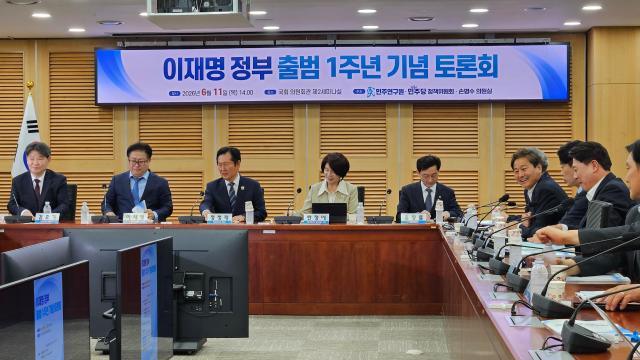
At a forum at the National Assembly in Yeouido, hosted by the office of Rep. Sohn Myung-soo of the ruling Democratic Party (DP) Thursday, persistent challenges such as demographic decline and economic uncertainty as well as a widening wealth gap and inequality were highlighted, although self-congratulatory reflections dominated the talk.
DP leader Jung Chung-rae under scrutiny over election accountability had only praises for the president.
"The country has entered an era of a 'Korea Premium,'" Jung said, citing rising international confidence in the country and improvements in economic indicators. He argued that Lee's leadership had strengthened the country's global standing and positioned South Korea among advanced nations.
Jung also described the Lee government as the product of a "revolution of light," referring to the public movement that led to the ouster of disgraced former President Yoon Suk Yeol over his botched martial law debacle. He added the Lee administration was committed to democratic governance and improving citizens' lives.
Rep. Han Jeoung-ae said the government had navigated a series of challenges over the past year, including political instability, a presidential election, U.S. tariff negotiations and regional security tensions.
She said South Korea had demonstrated the resilience of its democracy and achieved strong economic growth, but noted that many households had yet to feel the benefits. "High inflation and a weak currency continue to put pressure on people's livelihoods," Han said.
Yoon Chang-ryeol, the minister of government policy coordination, said the administration had focused on restoring growth, improving public safety and expanding communication with citizens. He pointed to economic growth that reached its highest level in more than five years, a rebound in the stock market, the restoration of research and development spending and stronger measures against crimes affecting ordinary citizens.
"Of course, we cannot be satisfied with the achievements of just one year," Yoon said, citing low birth rates, regional decline and widening inequality as long-term challenges.
Several speakers stressed that the administration's second year should focus on structural reforms rather than short-term achievements.
Hong Sung-kook, an adviser to the ruling party, said Korea was facing a rare opportunity to strengthen its economic position through growing exports and advances in key industries such as semiconductors and artificial intelligence.
However, he warned that the country continued to face a "K-shaped" economic structure in which gains are unevenly distributed across society. "If we fail to make structural changes over the next year, it will be difficult to do so in the future," Hong said.
Lee Chul-hee, a professor of economics at Seoul National University said the government had made notable progress in labor policy, public safety and social welfare but had fallen short on long-term issues such as education reform and population policy.
He called for stronger monitoring of government policy implementation and greater attention to emerging challenges including artificial intelligence, immigration policy and wealth inequality.
Jung Sung-eun, a professor at Konkuk University's Graduate School of Public Administration, said the first year of the administration had focused on restoring democracy and constitutional order.
The next four years, he said, should be devoted to institutionalizing "popular sovereignty" through reforms including changes to the prosecution and police systems, expanded public participation and constitutional revision.
On foreign policy, Rep. Kim Young-bae said the administration had pursued a "pragmatic diplomacy centered on national interests" while seeking to normalize relations with major powers including the United States, China and Japan.
Kim said Seoul had successfully managed pressure from Washington over tariffs and economic security issues while rebuilding ties with Beijing and advancing cooperation with Tokyo.
He also cited the administration's efforts to strengthen the U.S.-South Korea alliance, including discussions on revising the bilateral nuclear cooperation agreement and introducing nuclear-powered submarines.
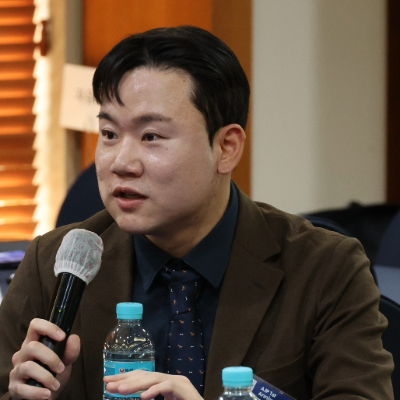
Asked by AJP how South Korea planned to address potential U.S. concerns about nuclear proliferation related to its pursuit of nuclear-powered submarines, Kim said securing the support of U.S. President Donald Trump would be a key factor in the process.
He said discussions were underway within the U.S. government and argued that a stronger South Korean military operating within the framework of the alliance would ultimately benefit both countries and align with broader U.S. strategic interests.
Kim added that building trust with Washington across a range of issues, not only security matters, would be essential to advancing the discussions.
DP leader Jung declined to comment when asked by reporters about recent calls within the DP for his resignation to account for some major losses including Seoul mayorship in local elections.
Copyright ⓒ Aju Press All rights reserved.
