

The Vietnam U19 national team faced elimination from the 2026 Southeast Asia U19 Championship after a penalty kick loss in stoppage time against Indonesia and a draw between Australia and Cambodia. This outcome dashed their hopes of advancing to the semifinals. The situation has sparked discussions not only about performance but also about attitudes and competition culture at the youth level.
According to the Vietnamese daily newspaper Người Lao Động on June 10, the Vietnam U19 team started strong with two consecutive wins in the group stage but suffered a 1-2 defeat to host Indonesia, with the decisive goal coming from a penalty awarded in stoppage time.
Following this match, Vietnam closely monitored the results of the Thailand and Malaysia game. A draw in that match could have put Vietnam at a disadvantage, but Thailand won 3-2, keeping Vietnam's semifinal hopes alive. However, the final twist came in the match between Australia and Cambodia. Australia led 2-0, but Cambodia fought back to equalize at 2-2. Consequently, Cambodia advanced to the semifinals, leaving Vietnam out of the tournament.
Some observers have pointed to bad luck as a factor in Vietnam's exit, citing the controversial penalty decision in the Indonesia match and the tournament's format, which required the second-place team to rely on results from other groups. Nonetheless, there are concerns that in youth football, the process is often more important than the outcome.
Losses are a natural part of growth in sports, and young players often experience mistakes in passing, lack of decisiveness, defensive inexperience, and hasty reactions in the penalty area. These issues can be addressed through training and experience, but this tournament also highlighted controversies regarding game attitudes. Notably, a member of the Vietnamese coaching staff received a red card for what was deemed unsportsmanlike behavior, which was seen as a reflection of the leadership's approach rather than just tactical decisions.
In professional sports, there are instances of players pulling on opponents' jerseys or disrupting the flow of the game, as well as psychological tactics to pressure referees. However, there is a clear line between tactical cleverness and unsportsmanlike conduct. It is important to distinguish between maintaining composure and resorting to unfair tactics, as well as between legitimate time management and intentional delays.
Voices have emerged calling for stricter standards at the youth level. U19 players are at a stage where they develop their playing habits, style, and professional identity. They learn how to receive the ball under pressure, engage in legal physical confrontations, manage emotions in the face of unfavorable calls, and refocus after collisions.
Concerns have been raised that excessive time-wasting or showing such behavior by coaches could send the wrong message to players. Youth coaches serve as both strategists and role models, meaning their actions on the field carry educational significance.
This tournament has also raised questions about the culture of competition. Vietnamese youth football has traditionally emphasized skills, fitness, tactics, football intelligence, and international experience. However, following this exit, there is a call for a reassessment of game attitudes, values, and competitive methods.
Additionally, it has been suggested that pressure should be applied through fitness and organization, rather than through rough tackles or excessive psychological games. It is crucial to recognize the difference between managing a score and deliberately delaying the game.
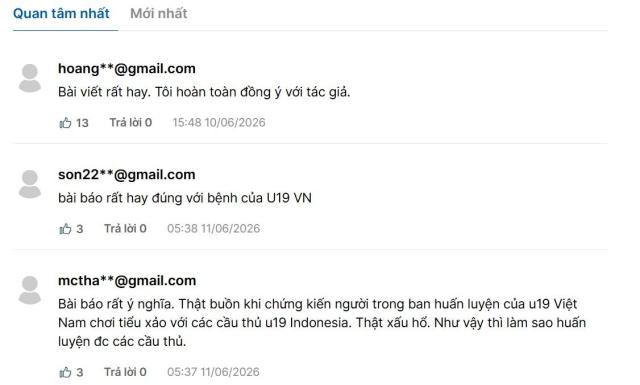
Meanwhile, online discussions have continued to reflect on the situation. One netizen expressed full agreement with an article addressing the issues in football, while another praised it as an accurate assessment of the problems faced by the Vietnam U19 team.
In particular, one commenter stated, "It is shameful that the Vietnam U19 coaching staff engaged in unsportsmanlike behavior against Indonesia U19. How can they train players with such conduct?"
Additionally, some online commentators have suggested that this group stage exit serves as a turning point for the direction of youth football in Vietnam, indicating that the Vietnam U19 team has left behind significant challenges following this tournament.
* This article has been translated by AI.
Copyright ⓒ Aju Press All rights reserved.