
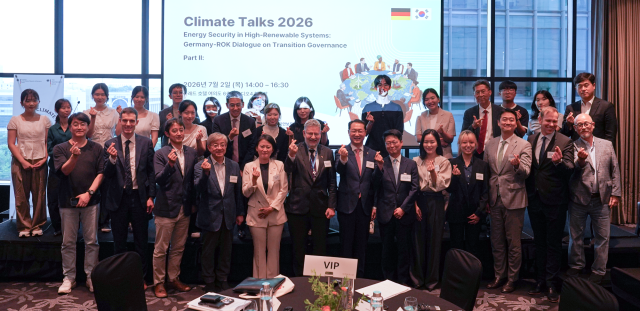
SEOUL, July 02 (AJP) - South Korean lawmakers, German diplomats and climate experts on Thursday framed the transition to clean energy as no longer just an environmental issue, but a matter of national security, industrial competitiveness and global trade strategy.
The remarks came at 2026 Climate Talks Seoul, held at the Conrad Seoul hotel in Yeouido and co-hosted by the German Embassy in Seoul, Rep. Kim Gunn’s office and the National Assembly Global Diplomacy and Security Forum.
Kyun Jong-ho, Korea’s climate change ambassador at the Ministry of Foreign Affairs, said the clean energy transition should be understood as a national security issue. The Foreign Ministry lists an ambassador and deputy minister for climate change among its senior posts, and Kyun has represented Korea in recent climate diplomacy discussions with other governments.
“Germany is a very valuable partner to Korea,” Kyun said, citing bilateral climate cooperation and the need to expand renewable energy. He said the transition to clean energy required participation from a wide range of stakeholders, not only governments.
The main panel, titled “National Strategy and Policy: Carbon Neutrality and Renewable Energy Roadmap,” was moderated by Yoo Yeon-chul, secretary-general of the U.N. Global Compact Network Korea.
Rep. Park Ji-hye of the Democratic Party said the most urgent task was a major expansion of renewable energy. Park, who serves as a lawmaker involved in the National Assembly’s special committee on the climate crisis, said carbon neutrality had become one of the most important issues in her legislative work.
Fossil fuels still dominate Korea’s energy system. The International Energy Agency says Korea’s energy sector is characterized by a dominance of fossil fuels, heavy dependence on energy imports and a high share of industrial energy use. The IEA also notes that Korea faces distinct challenges in expanding renewables because of limited land, high population density and a lack of electricity interconnections with neighboring countries.
Rep. Kim Gunn of the People Power Party said Korea needed to ask why renewable energy had struggled to rise more quickly in the country’s power mix. The central challenge, he said, was infrastructure.
“We need to build the infrastructure,” Kim said.
Rep. Lee Joo-young of the Reform Party said Korea and Germany faced different structural conditions. Korea, she said, is effectively an island when it comes to electricity, with no major cross-border grid connections to rely on in times of stress.
Lee cautioned against setting one-sided targets before the country had a clearer picture of future electricity demand and industrial needs. The wars in Ukraine and the threat of disruptions around the Strait of Hormuz, she said, showed that energy had expanded into the realm of defense.
“We need to find stable energy sources that can support all of our industries,” Lee said. “To do that, we first need to understand how much power we will need.”
Kim also referred to the shock that the Ukraine war had delivered to European households, saying his own apartment maintenance fees in Korea reached 500,000 won ($323) in winter and that some Europeans had seen heating bills rise sharply after the war. The example, he said, showed how deeply energy insecurity can affect ordinary citizens.
Lee, who previously served on the National Assembly’s Health and Welfare Committee, said climate-related health threats would not stop at national borders.
“The next pandemic will come,” Lee said. “If Korea and Germany do not prepare in advance, a future pandemic will become a matter of enormous cost and even survival.”
Asked by AJP what specific preparations were needed, Lee said no single city or country could prepare for a pandemic alone. She called for broad research into how pathogens evolve or disappear under changing climate conditions.
She also warned that the next pandemic could begin in a developing country or refugee camp before spreading globally. That possibility, she said, meant Korea should not treat distant health crises as unrelated to its own security.
“We must take part in vaccine development and international cooperation,” Lee said.
“Joint work is essential, just as multinational companies participated in vaccine development during Covid.”
Park said Korea should legislate a date for ending coal-fired power generation, while Kim pointed to his proposed climate diplomacy legislation, which he described as a “diplomacy law to save the Earth.” Kim introduced a climate diplomacy bill in February aimed at strengthening Korea’s diplomatic capacity to respond to the climate crisis, according to local reports.
The forum ended with a broad consensus that energy transition had moved beyond the boundaries of environmental policy.
The government approved a 2035 target last year to cut greenhouse gas emissions by 53 percent to 61 percent from 2018 levels, a step that has put new pressure on policymakers to align energy infrastructure, industrial policy and diplomacy.
Copyright ⓒ Aju Press All rights reserved.
