
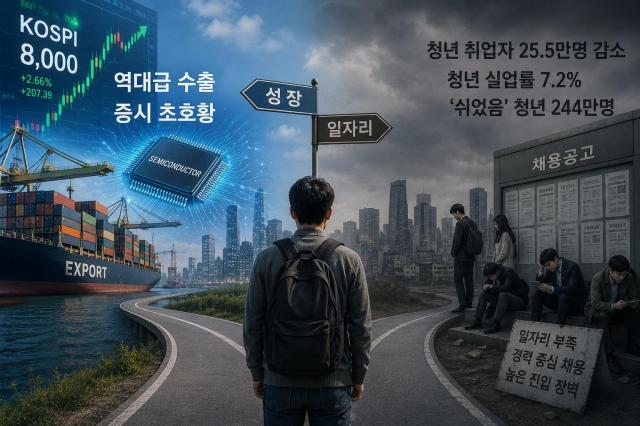
The number of employed individuals in South Korea decreased by 40,000 in May compared to the same month last year, according to a report released by the National Data Agency on June 11. This marks the first decline in employment since the state of emergency declared in December 2024. Employment in the manufacturing sector fell by 140,000, the largest drop in over seven years. Most concerning is the significant decline of 255,000 in employment among young people aged 15 to 29, highlighting the severity of the issue.
Ironically, the economy is not in a recession. Semiconductor exports are reaching record highs, the KOSPI index continues to rise, and corporate earnings are improving. Growth forecasts are also being revised upward.
However, the reality for young people is starkly different. While the economy appears to be improving, job opportunities are becoming increasingly scarce. This creates a perplexing situation where the benefits of economic growth are not reaching the youth.
The government attributes the situation to the prolonged conflict in the Middle East and high oil prices. While these factors are valid, they do not fully explain the current youth employment crisis, which is more a structural issue than a cyclical one.
The South Korean economy is rapidly restructuring, with a few advanced industries driving growth. The semiconductor sector, while crucial for the national economy, does not generate a large number of jobs. Even with investments amounting to tens of trillions of won, automated production facilities and AI systems perform most tasks, leading to increased production without a corresponding rise in employment.
A more significant concern is that the pace of job losses is outstripping the rate at which the benefits of growth are being distributed. While semiconductor companies report record profits and the stock market thrives, manufacturing jobs are declining, and youth employment is vanishing. This indicates a fundamental shift in the growth model of the South Korean economy rather than a simple economic cycle.
The challenges faced by young people also stem from the structure of the labor market. Companies prefer to hire experienced workers through ongoing recruitment rather than open hiring processes. While those with experience gain better opportunities, young people entering the job market find it increasingly difficult to even get a foot in the door. The system protects those already within the labor market while leaving those outside, particularly the youth, vulnerable.
Therefore, what is needed now is not another youth support fund or short-term job program. The government must move away from treating youth employment as a separate policy area and instead examine the overall structure of the labor market.
South Korean society has long focused on protecting existing jobs. While protections for regular employees, seniority-based wage systems, and rigid employment structures provide stability for those within the labor market, the costs are largely borne by the youth. When new hiring decreases, young people are the first to lose opportunities.
If the government is genuinely concerned about youth employment, it should focus on how much it has expanded pathways for young people to enter the labor market rather than how much budget has been allocated for youth support. Whether through labor market flexibility, wage system reform, or addressing the gap between regular and non-regular workers, the approach must now be from the perspective of the youth.
Businesses also cannot escape responsibility. Profits gained from increased productivity through AI and automation should not only be distributed to shareholders and employee bonuses but also invested in hiring future generations. Expanding the hiring of experienced workers solely for short-term efficiency could ultimately undermine the foundation for nurturing talent within companies.
The decline in youth employment is not merely a worsening employment indicator; it signals a weakening of the nation’s future growth potential. A society where young people cannot find work will see declines in consumption, marriage, and childbirth, ultimately undermining its growth potential.
No matter how much semiconductor exports increase or how high the stock market rises, if young people are losing hope, that is not a successful economy. What is needed now is not to boast about the achievements of growth but to pay attention to the youth left behind in its shadows.
There is no future in growth without youth.
* This article has been translated by AI.
Copyright ⓒ Aju Press All rights reserved.