
As the second year of the Yoon Suk-yeol administration begins, the Ministry of Health and Welfare has defined the past year as a period of preparation for normalizing social welfare and restructuring the system. Starting in the second half of the year, the ministry plans to focus its administrative efforts on building a comprehensive 'basic safety net' to address polarization and welfare crises. Additionally, it has unveiled a blueprint to cultivate the biohealth industry as a leading national technology to drive potential growth.
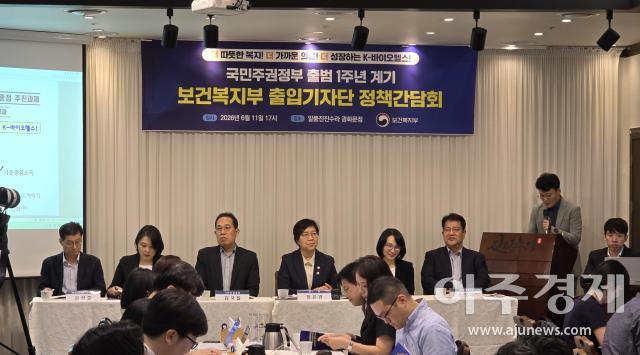
Minister Jeong Eun-kyeong presented these key points during a policy briefing for reporters held near Gwanghwamun in Seoul on June 11, outlining the ministry's core achievements and key initiatives for the second half of 2026.
In her opening remarks, Minister Jeong noted, "There have been many changes over the past six months, and the government has now entered its second year. We have been tirelessly pursuing four policy goals: establishing a nationwide basic living safety net, expanding the foundation for regional, essential, and public healthcare, strengthening national responsibility for care, and promoting the biohealth sector to create a robust society that ensures a dignified life for all citizens."
She highlighted the ministry's significant achievements over the past year, particularly in addressing welfare gaps and enhancing basic living security for low-income individuals. According to the ministry, the government has raised the median income standard for welfare programs by 6.51%, the highest increase ever for a four-person household, and increased living benefits to a maximum of 2.078 million won per month to support vulnerable groups.
Minister Jeong stated, "We have abolished the caregiver requirement for medical assistance for the first time in 26 years, effectively enhancing medical coverage for over 5,000 individuals. We have focused on connecting social support networks for 110,000 individuals who were previously in welfare gaps, going beyond simple material support."
The government has also made visible progress in structural reforms to strengthen national responsibility for care. Since March, the 'Integrated Care Project' has been implemented nationwide, with efforts underway to expand the system. Minister Jeong explained, "As integrated care is still in its early stages, we plan to further solidify the system and expand its reach to include individuals with disabilities and mental health issues in the future. We have also broadened the age range for child allowances and enhanced priority support to create a more favorable environment for raising children, while expanding care services for individuals with severe developmental disabilities."
The roadmap for pension reform and addressing gaps in essential medical care has also been clarified for the second half of the year. Regarding the highly anticipated basic pension reform plan, Minister Jeong acknowledged concerns about the inefficiency of providing the same pension to the bottom 70% of seniors, stating, "We agree that this structure is inefficient. We are currently conducting comprehensive research on various scenarios, including differentiated benefit payments and addressing welfare gaps. We aim to present a concrete outline and reform direction to the public within the second half of the year, facilitating social discourse and legislative review."
Furthermore, the ministry has identified 'regional and essential medical care' as the top priority for healthcare reform in the second half of the year. Minister Jeong emphasized, "In the medical sector, we will concentrate our efforts on establishing regional and essential medical infrastructure, while in the welfare sector, we will ensure that identification and intervention processes are robust to solidify the safety net." She also mentioned plans to promote public discussions on end-of-life medical decision-making and the introduction of hospice rooms in care facilities to uphold dignity in the face of an aging population.
Finally, the strategy to secure growth momentum through the development of the biohealth industry was outlined. The ministry plans to select '30 National Representative Technologies in Healthcare' in the second half of the year and will fully support R&D budgets. In July, it aims to complete the reform of the certification system for innovative pharmaceutical companies and establish specialized funds for Phase 3 clinical trials.
Minister Jeong concluded, "Our ministry's policy principle is communication with the field. We will strive to produce visible administrative results that the public can feel, in line with the principle of growth for all and a foundation for everyone."
Minister Jeong Eun-kyeong presented these key points during a policy briefing for reporters held near Gwanghwamun in Seoul on June 11, outlining the ministry's core achievements and key initiatives for the second half of 2026.
In her opening remarks, Minister Jeong noted, "There have been many changes over the past six months, and the government has now entered its second year. We have been tirelessly pursuing four policy goals: establishing a nationwide basic living safety net, expanding the foundation for regional, essential, and public healthcare, strengthening national responsibility for care, and promoting the biohealth sector to create a robust society that ensures a dignified life for all citizens."
She highlighted the ministry's significant achievements over the past year, particularly in addressing welfare gaps and enhancing basic living security for low-income individuals. According to the ministry, the government has raised the median income standard for welfare programs by 6.51%, the highest increase ever for a four-person household, and increased living benefits to a maximum of 2.078 million won per month to support vulnerable groups.
Minister Jeong stated, "We have abolished the caregiver requirement for medical assistance for the first time in 26 years, effectively enhancing medical coverage for over 5,000 individuals. We have focused on connecting social support networks for 110,000 individuals who were previously in welfare gaps, going beyond simple material support."
The government has also made visible progress in structural reforms to strengthen national responsibility for care. Since March, the 'Integrated Care Project' has been implemented nationwide, with efforts underway to expand the system. Minister Jeong explained, "As integrated care is still in its early stages, we plan to further solidify the system and expand its reach to include individuals with disabilities and mental health issues in the future. We have also broadened the age range for child allowances and enhanced priority support to create a more favorable environment for raising children, while expanding care services for individuals with severe developmental disabilities."
The roadmap for pension reform and addressing gaps in essential medical care has also been clarified for the second half of the year. Regarding the highly anticipated basic pension reform plan, Minister Jeong acknowledged concerns about the inefficiency of providing the same pension to the bottom 70% of seniors, stating, "We agree that this structure is inefficient. We are currently conducting comprehensive research on various scenarios, including differentiated benefit payments and addressing welfare gaps. We aim to present a concrete outline and reform direction to the public within the second half of the year, facilitating social discourse and legislative review."
Furthermore, the ministry has identified 'regional and essential medical care' as the top priority for healthcare reform in the second half of the year. Minister Jeong emphasized, "In the medical sector, we will concentrate our efforts on establishing regional and essential medical infrastructure, while in the welfare sector, we will ensure that identification and intervention processes are robust to solidify the safety net." She also mentioned plans to promote public discussions on end-of-life medical decision-making and the introduction of hospice rooms in care facilities to uphold dignity in the face of an aging population.
Finally, the strategy to secure growth momentum through the development of the biohealth industry was outlined. The ministry plans to select '30 National Representative Technologies in Healthcare' in the second half of the year and will fully support R&D budgets. In July, it aims to complete the reform of the certification system for innovative pharmaceutical companies and establish specialized funds for Phase 3 clinical trials.
Minister Jeong concluded, "Our ministry's policy principle is communication with the field. We will strive to produce visible administrative results that the public can feel, in line with the principle of growth for all and a foundation for everyone."
* This article has been translated by AI.
Copyright ⓒ Aju Press All rights reserved.