
Jung Jae-hwan, Head of the Comprehensive Editorial Department & Deputy Director
Delaying Births and Pushing for Home Ownership
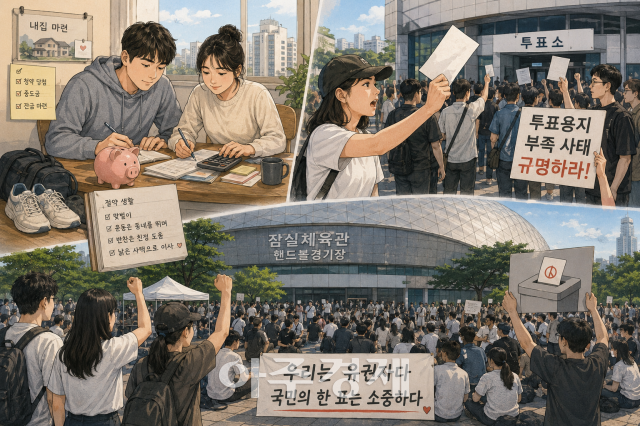
A woman in her early 30s, married for four years, exemplifies the MZ generation. While her parents hope to see her raise a beautiful child and build a harmonious family, her priorities differ. Her primary goal is not childbirth, travel, or a leisurely lifestyle, but rather securing her own home.
Having won a lottery for an apartment a few years ago, she is set to move in next year, but gathering the necessary funds for the down payment and final payment is proving challenging. Plans for childbirth have naturally been postponed. To save on living expenses, she and her husband both work, opting to run in their neighborhood instead of going to the gym. They often rely on her parents for side dishes. To save on rent, they plan to move into an old, inexpensive government housing unit for the remaining year. "Once I have my own home, I want to think about having kids and live a normal life while paying off my debts," she says, reflecting the reality faced by many young people today.
Their struggles are not due to laziness or unrealistic expectations; rather, they are working diligently. They do not expect favors or privileges from the established powers. They simply desire a society where hard work is rewarded according to one’s principles. However, reality often betrays those expectations.
The Call for Fairness in Society
Recent statistics show that nearly half of apartment purchases in Seoul are made by individuals under 30, highlighting the urgency felt by the youth. Unlike the ultra-low interest rates of the past, the current environment features stricter lending regulations and higher rates. Nevertheless, young people are selling stocks and cryptocurrencies to take out first-time homebuyer loans, driven by the fear that missing this opportunity could mean never owning a home.
The Bank of Korea recently reported that rising real estate prices are exacerbating wealth inequality and diminishing opportunities for young people to build assets. Even with hard work and decent incomes, surpassing the wealth accumulated by previous generations is becoming increasingly difficult. This is a key reason why many young people are delaying marriage and childbirth.
However, the challenges facing the MZ generation extend beyond housing prices. Their true anger stems from a belief that the societal systems they rely on are failing to function properly. When the belief that hard work leads to rewards is shaken, and the assurance of fair competition crumbles, frustration turns to anger.
During the June 3 local elections, incidents of ballot shortages in areas like Songpa, Seoul, amplified this distrust. Elections are the cornerstone of democracy, representing the most fundamental process for citizens to express their will, and must be conducted with accuracy and fairness. The fact that voters had to wait long hours only to find a lack of ballots was shocking to many.
Young people did not view this issue as a mere administrative error. For those who took time out of their busy schedules to vote, the ballot shortage felt like a message saying, "Your vote doesn’t matter." Many young voters gathered in the Olympic Park area in Jamsil identified themselves not as supporters of any specific party or political faction, but simply as "voters." Their demands were not for a grand revolution but for the basic principles of popular sovereignty and voting rights in a democracy.
The Impact of Election Irregularities on Trust
This is a crucial point for the older generation to consider. Today’s 2030 generation is the most educated and information-savvy in South Korea's history. They are also the most sensitive to fairness. They demand equitable rules in every aspect, from education and employment to promotions and investments. As a result, they have a strong aversion to privileges and unfair practices.
To this generation, the real estate market no longer appears to be a level playing field. Parental wealth determines the starting line, and rising home prices seem to dictate wealth based on asset ownership rather than effort. Witnessing confusion in the electoral process, a core democratic procedure, only heightens their sense of deprivation, which is likely more profound than the older generation realizes.
The recent protests by young people cannot be interpreted solely as political actions. Underlying these demonstrations are accumulated feelings of loss and distrust. There is frustration over having to delay childbirth to buy a home and the reality of taking out loans against their futures. There is also a sense of powerlessness in the difficulty of social mobility despite hard work, and a feeling of alienation when their voices are not adequately heard in politics.
Of course, some voices of concern have emerged. There are warnings that interpreting the ballot shortage too politically or spreading unverified claims could exacerbate social conflict. This is a valid perspective that deserves attention.
However, this does not mean that we should ignore the anger of young people. It is crucial to understand why they are angry and why they have taken to the streets. Criticizing only the symptoms without addressing the root causes will not solve the problem. What is needed now is a serious acknowledgment of the warning signals they are sending, rather than framing their voices through a lens of political advantage or disadvantage.
The 40 to 60 age group must not view this issue as someone else's problem. Today's youth will be the backbone of South Korea's future. If they abandon marriage, delay childbirth, and lose trust in politics, the entire society will ultimately pay the price. The despair of the youth is, in essence, the despair of the nation.
The Need for Policy Changes to Support Youth
Now, it is time for the political sphere to respond. Above all, a thorough investigation into the ballot shortage during the June 3 local elections and measures to prevent recurrence are essential. The integrity and trustworthiness of elections are the lifeblood of democracy. No doubts, however minor, should be left unaddressed. Clear explanations and responsible actions must follow. Simultaneously, there is a need for a policy shift to expand opportunities for young people to build assets. Simple cash support or one-time measures will not suffice. We must restore the housing ladder, create quality jobs, and restore hope that hard work can lead to a better future.
What my daughter wants is not a privilege. Many in the 2030 generation share this desire. They seek hope that they can secure a home, confidence that they can have children without worrying about the future, and trust that their votes will be fully respected.
These are the minimum rights that every citizen in a democratic society should enjoy. Addressing the tears of the MZ generation is not just about comforting a few young people; it is about safeguarding the future of South Korea. It is now the turn of the older generation and the political sphere to respond. We must restore the belief in the value of hard work and fair rules for the youth. This is the most pressing task our society must undertake today.
* This article has been translated by AI.
Copyright ⓒ Aju Press All rights reserved.