SEOUL, June 14 (AJP) -Every great technological pivot has its symbolic journey.
Columbus crossing the Atlantic opened the age of exploration. Deng Xiaoping's Southern Tour set the course of China's economic reform. Steve Jobs unveiling the iPhone launched the smartphone era.
Nvidia's chief Jensen Huang's late-May to early-June 2026 sweep through Taiwan and South Korea may well be remembered as a similarly defining moment in the history of the AI industry.
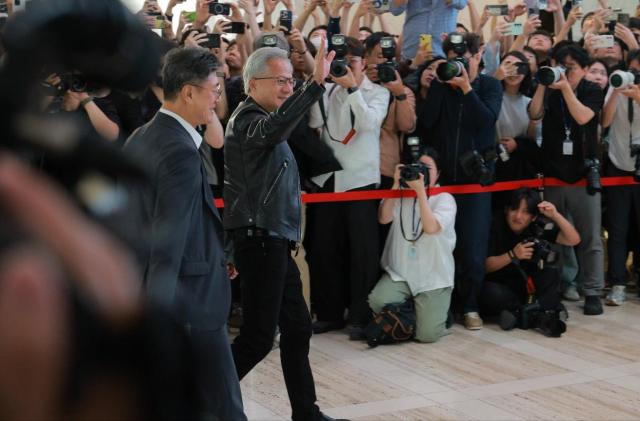
Much of the media coverage focused on the optics — Huang browsing night markets in Taiwan, clinking soju glasses over pork belly in Seoul.
Understandable. He is a compelling figure. But for those watching the structural shifts in global technology, a very different story was unfolding: the supreme commander of the world's AI empire conducting a strategic inspection of his core production bases and logistics chain.
Taiwan: The Manufacturing Empire Behind the AI Revolution
At the center of today's AI industry sits Nvidia. And at the center of Nvidia sits Taiwan.
The cutting-edge GPUs that power the AI boom are almost entirely fabricated by TSMC. Nvidia's Blackwell and Rubin platforms simply could not exist without Taiwan's advanced semiconductor manufacturing capability.
TSMC is not merely a foundry — it is the forge of the global chip economy, serving Apple, AMD, Qualcomm, Broadcom and virtually every major fabless semiconductor company on earth. If Nvidia is the emperor of the AI age, TSMC is the imperial armory.
But Taiwan's role extends well beyond silicon wafers. Foxconn, Quanta, Wistron, Inventec and Pegatron — names unfamiliar to most consumers but foundational to the global data center industry — assemble the AI servers that house Nvidia's GPUs.
The actual manufacturing floor of the AI revolution is not Silicon Valley. It is Taiwan.
Foxconn, notably, has moved far beyond iPhone assembly. It is aggressively expanding into AI servers, robotics and electric vehicles, positioning itself for the physical AI era. Quanta has emerged as one of the world's largest AI server manufacturers. Taiwan, in short, possesses the entire manufacturing ecosystem needed to turn Nvidia's architectural vision into operational hardware.
South Korea: The Memory Backbone of AI
Korea's role in the Nvidia supply chain is different — but no less critical.
If Taiwan supplies the brain, Korea supplies the blood. The country's most strategically vital contribution to the AI stack is High Bandwidth Memory, or HBM — the high-speed interface connecting GPU to data. Without sufficient HBM, even the most powerful GPU cluster cannot function at scale. HBM availability has become one of the most acute bottlenecks in the global AI supply chain.
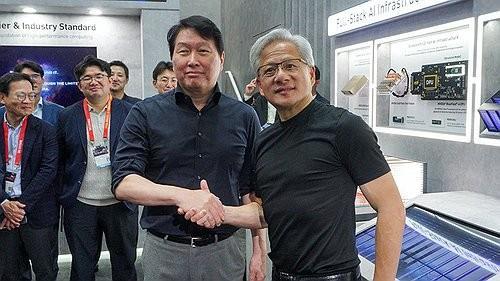
SK hynix currently dominates that market. Huang's visit to SK hynix was not a courtesy call. It was a verification of one of Nvidia's most critical dependencies. As demand for AI data center capacity continues to surge, SK hynix has become among Nvidia's most important strategic partners.
Samsung Electronics was equally significant on the itinerary. As the world's largest memory manufacturer by volume, Samsung is locked in intense competition with SK hynix for the next-generation HBM4 market.
From Nvidia's perspective, supply diversification is not optional — it is essential. Whether Samsung achieves full qualification and meaningful volume for Nvidia's next platforms will have direct implications for the stability of the entire AI supply chain.
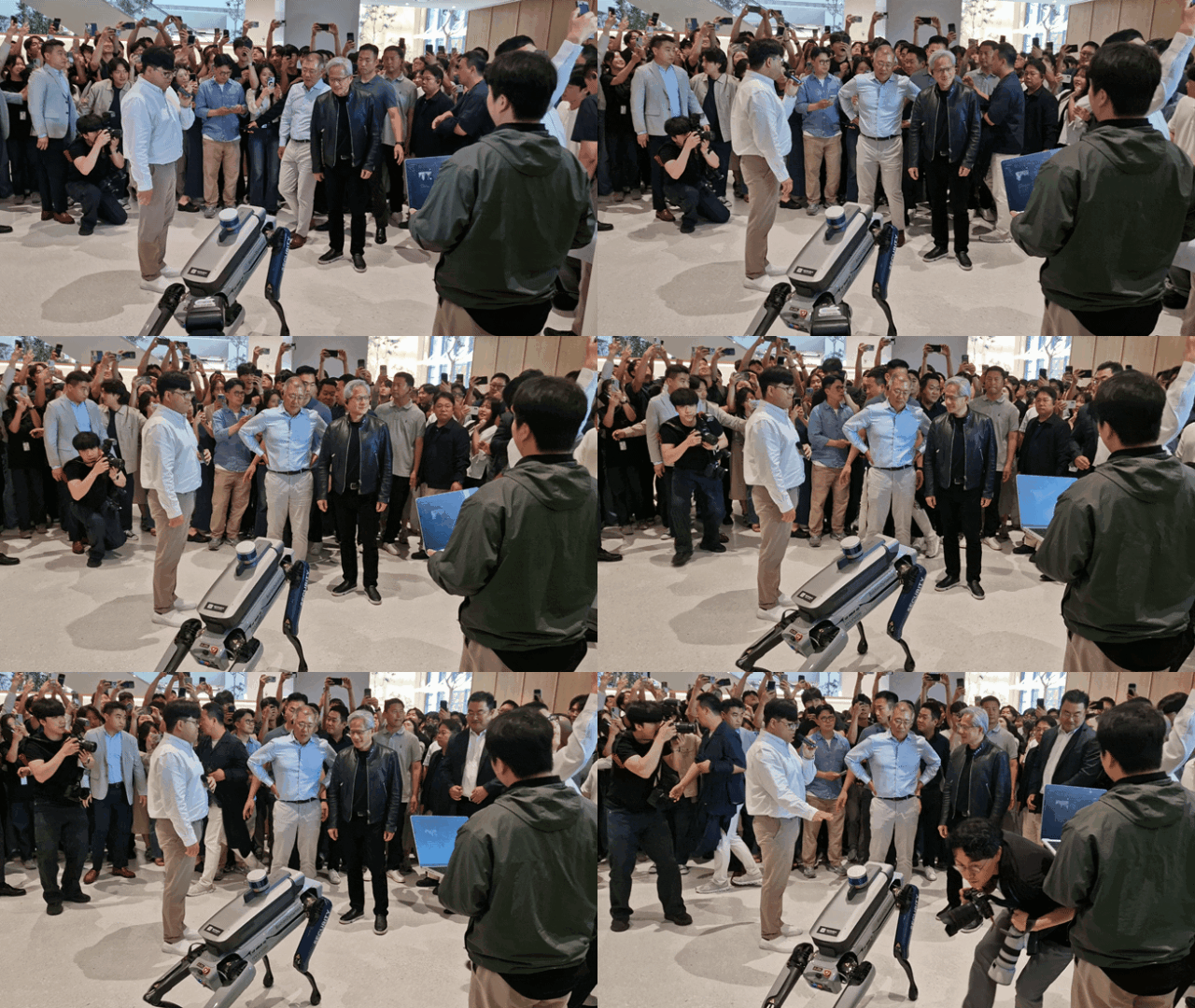
The visit to Hyundai Motor Group carried a different kind of signal. Hyundai is a carmaker, but it is repositioning itself as an AI-driven mobility company.
Autonomous vehicles, robotics and smart factories are all core domains of physical AI — the frontier where artificial intelligence moves out of data centers and into the physical world. Nvidia is deeply invested in exactly this transition, through its automotive AI platform and its Isaac robotics stack.
The Nvidia-Hyundai relationship is less a conventional automotive technology partnership than a joint experiment in building the infrastructure of the next industrial revolution.
LG Group rounds out the picture. Across batteries, automotive electronics, smart manufacturing, and data center cooling technology, LG sits at multiple intersections where AI meets the physical world. As AI systems consume more power and generate more heat, the importance of energy, thermal management and sensing technology will only grow.
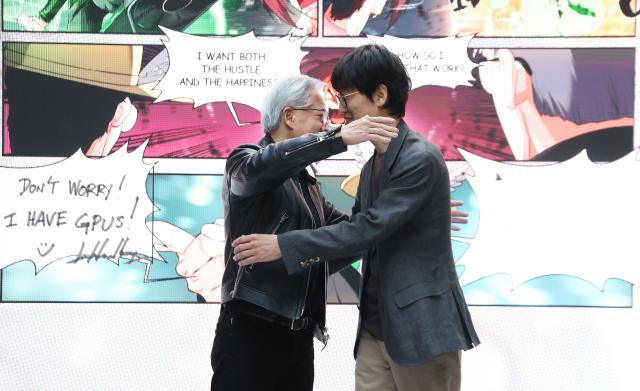
The stop at Naver, Korea's dominant internet platform, added yet another dimension. Korea has established itself as a memory powerhouse, but not yet as an AI platform powerhouse. Naver's HyperCLOVA initiative represents Korea's most serious attempt to build a sovereign large language model capability and compete in cloud and data center infrastructure.
Huang's meeting with Naver was not simply a customer visit — it was an assessment of the potential depth of Korea's broader AI ecosystem.
Two Roles, One Supply Chain
Taiwan and Korea occupy distinct but complementary positions in the Nvidia supply chain. Taiwan is the manufacturing hub; Korea is the memory hub. Taiwan provides the arms and legs of Nvidia's AI infrastructure. Korea provides the circulatory system.
But that framing also surfaces the most important strategic question for Korea: will it remain a component supplier, or will it become a co-architect of AI civilization?
Taiwan has already locked in control of the full manufacturing ecosystem. The United States owns the platform and software layers. China is pursuing aggressive state-directed AI investment backed by the world's largest domestic market. Korea must now define its own next move.
That move, increasingly, points toward physical AI.
This is precisely why Huang's Korean itinerary included Hyundai, LG and Naver alongside the memory giants. The next phase of AI development will not play out primarily inside data centers. It will play out in factories, logistics facilities, hospitals, farms, autonomous vehicles and robots. As a manufacturing nation with deep industrial expertise, Korea is in many respects better positioned than the United States to lead in this domain.
The Real Story Behind the Optics
Jensen Huang's Taiwan-Korea tour in the spring of 2026 was not a celebrity road show. It was a strategic audit — a systematic review of the supply chain architecture that underpins the global AI build-out, combined with an assessment of where the next phase of AI-driven industrial transformation will take root.
The cameras captured the night markets and the soju. But Huang was reading something else entirely: HBM roadmaps, server production capacity, robotics pipelines and the emerging geography of physical AI deployment.
The AI era's genuine competition is only now beginning. This tour was the first formal question posed to South Korea: can it move from supplier to shaper of the AI future? The answer is not yet written.

Copyright ⓒ Aju Press All rights reserved.