
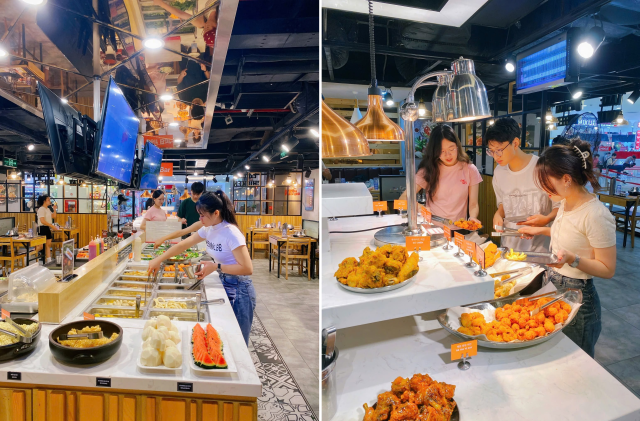
According to a report by the Vietnamese media outlet Tuoi Tre on June 13, Osang-sik, a member of the Vietnamese Korean Association, stated that around 1,200 Korean restaurants are currently operating in the former Ho Chi Minh City area, with 700 of them specializing in Korean barbecue. He predicts that the actual number of Korean restaurants is likely higher based on the expanded boundaries of Ho Chi Minh City.
Osang-sik, who operates the Hanmaum barbecue franchise in Vietnam, explained that he opened his first location in the Phu My Hung area, which was previously part of District 7. This move was strategically aimed not only at the Korean community but also at local Vietnamese consumers. He noted, "Initially, the customer base was about 50% Vietnamese and 50% Korean, but now the proportion of Vietnamese customers has increased to around 80%." This indicates a rapid shift in the consumer base from expatriates to local residents.
He also highlighted the growing demand for dining services as a reason for the active expansion of Korean businesses in Vietnam. "Many Korean restaurant operators see the Vietnamese market as a new growth opportunity," he added.
Korean Wave Transitions from 'Viewing' to 'Eating'
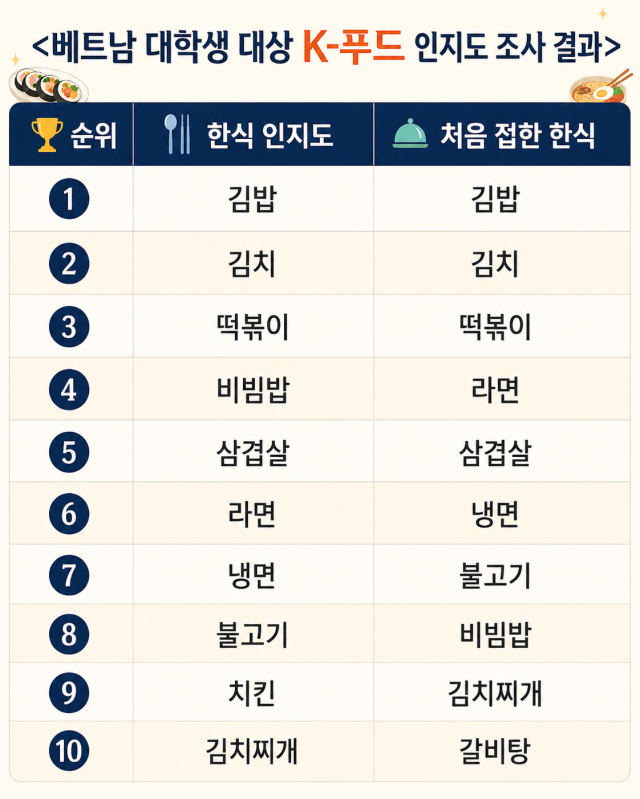
Awareness of Korean cuisine among younger generations is also on the rise. A survey published in the East Asia Food Culture Journal found that the most recognized Korean dishes among Vietnamese university students were kimbap, kimchi, tteokbokki, bibimbap, and samgyeopsal. The dishes they first encountered were also kimbap, kimchi, tteokbokki, ramen, and samgyeopsal, illustrating the connection between K-content and actual consumption.
The growth of dining brands is also notable. Dookki Tteokbokki, which opened its first location in southern Vietnam in 2018, now operates 134 stores nationwide. Lotteria has 222 locations, and Tous Les Jours has 40, while other Korean brands like Bread Factory are expanding their presence in the local market.
In this context, Korean food companies are strengthening their localization strategies. Orion has introduced new flavors, such as lotus seed and roasted corn, for its rice snacks sold in Vietnam. Choco Pie is also launching various flavors, including green tea red bean, watermelon, and lemon cola, to appeal to local consumers.
K-Food Ecosystem Expands Beyond Dining to Distribution
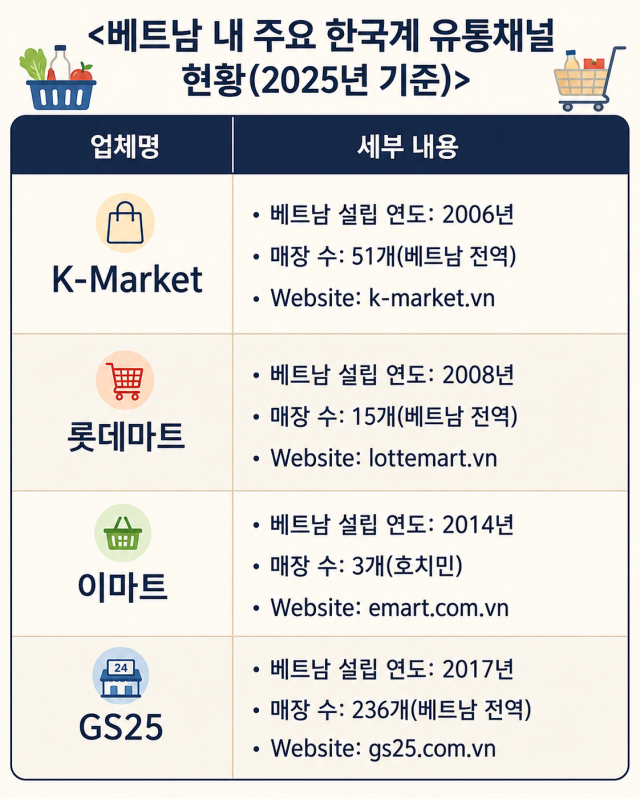
K-Food is also making its mark in the distribution market. In Vietnam, Korean food products can be easily purchased through major supermarkets like Lotte Mart, Win Mart, Mega Market, and Go!, as well as e-commerce platforms such as Shopee, Lazada, and TikTok Shop. Korean distribution networks are steadily expanding. As of 2025, K-Market operates 51 stores across Vietnam, while GS25 has 236, Lotte Mart has 15, and E-Mart has 3 locations. Notably, GS25 opened its first six stores in Hanoi in March of this year, targeting the northern market.
Some Korean distribution companies are introducing instant noodle cooking machines, transforming their spaces into places where consumers can experience Korean shopping culture. This shift is seen as an evolution beyond merely selling Korean products to providing a Korean-style shopping experience. Korean companies are also active in the frozen and ready-to-eat food markets. CJ CheilJedang and Pulmuone supply dumplings, hotteok, and hot dogs through their local subsidiaries, while Paldo is enhancing accessibility with low-cost ramen products. Nongshim and Samyang are targeting the premium market with products like Shin Ramyeon and Buldak Bokkeummyeon.
Industry Calls for Collaborative Framework to Match Market Growth
In light of the rapidly growing Korean food market, industry experts are advocating for the establishment of a collaborative framework. Osang-sik suggested the formation of a Korean restaurant association in Vietnam, citing examples from Korea where such associations connect businesses with the government. He explained, "In Korea, industry-specific organizations like restaurant associations play a role in linking companies and government entities." If an association were established in Vietnam, it could facilitate easier access to policy and regulatory information for restaurants and serve as a channel for industry feedback to administrative bodies.
He also noted that the government and regulatory agencies could effectively communicate new policies and regulations through the association, which could encourage compliance. Osang-sik stated, "If the association participates in management, regulatory bodies could supervise in collaboration with the association rather than managing each restaurant individually."
Meanwhile, K-Food in Vietnam is evolving beyond mere food consumption into a realm of cultural experience. With the rapid increase of Korean restaurants and distribution networks, alongside K-content driving consumption, the influence of K-Food is expanding across the dining and distribution sectors.
* This article has been translated by AI.
Copyright ⓒ Aju Press All rights reserved.