
As the United States, Israel, and Iran are expected to reach a ceasefire agreement, oil prices, which had surged to $166 per barrel, are gradually stabilizing. The reopening of the Strait of Hormuz is anticipated to restore logistics in the Middle East and North Africa (MENA) region. Major domestic companies, which rely heavily on exports, are likely to begin revising their management strategies in response to the changing international landscape.
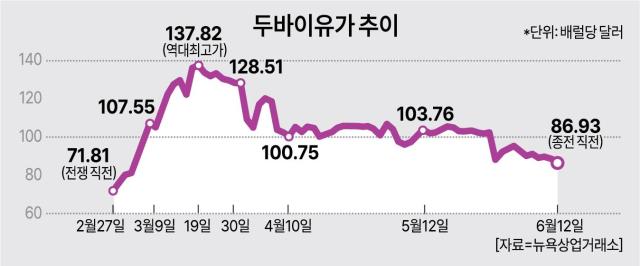
On June 15, industry sources reported that oil prices fell approximately 2% to $86.93 per barrel for Dubai crude, following news that the U.S. and Iran are set to finalize a ceasefire agreement in Switzerland on June 19. This marks the lowest price since the escalation of conflict in March.
The decline in oil prices has led to assessments that the worst energy crisis for the second half of the year may be averted. However, experts predict it will take over six months for prices to return to pre-war levels of around $60.
Major energy institutions and investment banks project that international oil prices will remain elevated through the fourth quarter. Goldman Sachs forecasts Brent crude at $90 per barrel and West Texas Intermediate (WTI) at $83 per barrel for Q4. The Korea Energy Economics Institute also predicts Dubai crude prices will be around $83.
The disruptions in oil production and export facilities in Kuwait and the United Arab Emirates (UAE) due to Iranian attacks have contributed to these price levels. Companies must now reactivate oil fields, refineries, and export terminals that were halted during the conflict, while also addressing issues related to shipping insurance, risk premiums, port congestion, and existing contract volumes.
Despite falling oil prices, concerns remain that the ongoing high exchange rate of around 1,500 won per dollar will limit the relief for companies.
However, Minister of Trade, Industry and Energy Kim Jeong-kwan indicated that the end of the maximum oil price system, which has caused cumulative losses of around 4 trillion won in the domestic refining industry over the past three months, is expected soon. He mentioned that the end would be contingent on the war's conclusion, normalization of the Strait of Hormuz, and oil prices falling below $90.
There is significant optimism regarding the normalization of shipping routes. Approximately 2,000 vessels, including 24 South Korean ships trapped in the Strait of Hormuz, are expected to resume operations. As ships that had been rerouted or waiting return, the recent surge in shipping rates and war risk insurance premiums is expected to gradually ease.
However, domestic shipping companies face challenges in recovering losses incurred due to Iran's blockade of the strait. The 'HMM Namoo', which was damaged by a missile attack believed to be from Iran and is currently undergoing repairs at Dubai Port, is likely to become a focal point in the diplomatic dispute between South Korea and Iran following the war. There are concerns that the container route between Busan and the Middle East, which was recently restored after the bankruptcy of Hanjin Shipping in 2017, may be closed again due to safety concerns.
With expectations for oil prices and maritime logistics to gradually normalize, major domestic companies are anticipated to focus on resolving supply chain uncertainties and restoring logistics efficiency. Currently, KOTRA is providing real-time updates on local logistics conditions to domestic companies through its 13 trade offices in the Middle East, allowing them to plan for the restoration of alternative ports and rerouted supply chains.
Sogang University economics professor Heo Jun-young stated, "Given that oil prices and exchange rates may not drop as quickly as hoped after the ceasefire, companies need to respond swiftly to minimize business uncertainties. Additionally, as we have confirmed the importance of various Middle Eastern raw materials beyond crude oil and LNG, efforts to diversify import sources should be strengthened."
* This article has been translated by AI.
Copyright ⓒ Aju Press All rights reserved.