
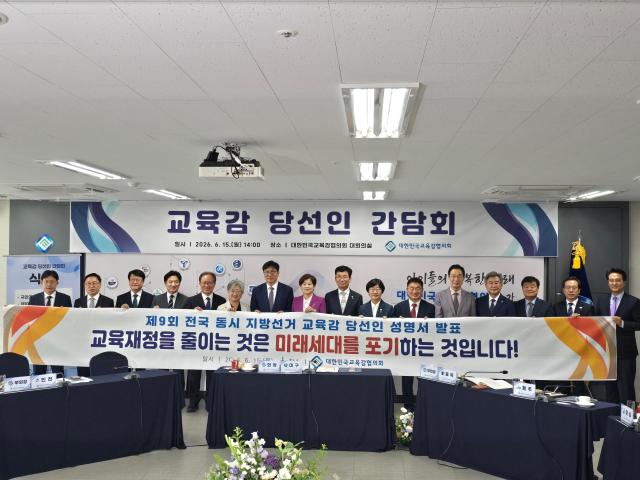
On June 3, newly elected superintendents from across the country gathered ahead of their official terms to voice their unified opposition to the restructuring of local education finance grants being pursued by financial authorities.
The superintendents, regardless of ideological affiliations, unanimously elected Jeong Geun-sik, the Superintendent of Seoul, as the chair of the association, emphasizing, "We cannot accept unilateral budget cuts that disregard on-the-ground data and the unique nature of education." They declared their intent to respond vigorously.
On June 15, the newly elected superintendents convened at the Korea Education Superintendents Association office in Sejong to discuss enhancing communication among local education offices and addressing pressing educational issues.
Kang Eun-hee, the former chair and Superintendent of Daegu, stated, "Korea's education system is facing unprecedented challenges due to a rapid decline in school-age populations, an increase in small schools, and a digital transformation driven by artificial intelligence. In this crisis, securing stable local education finances, firmly establishing local education autonomy, and restoring teachers' rights while ensuring a safe educational environment are urgent collective tasks that require our wisdom."
The superintendents unanimously elected Jeong Geun-sik as the 11th chair of the Korea Education Superintendents Association, representing the voices of 16 local education offices and leading policy negotiations with the central government. As a prominent figure in the capital region, Jeong will be responsible for safeguarding education finances and implementing key educational reforms during the upcoming budget discussions.
A key issue discussed during the meeting was the joint statement issued by the superintendents in response to the financial authorities' proposed restructuring of education grants. They criticized the notion that declining student numbers justify budget cuts, stating, "Local education finance grants have been a systematic mechanism ensuring stable funding for public education since the law was enacted in 1971, representing a social commitment by the state to education. Despite the significance of this issue for the future of education, it is being pursued solely by financial authorities without any prior consultation or adequate explanation to the local education offices responsible for actual educational delivery."
The superintendents specifically targeted the flawed logic presented by the Ministry of Planning and Finance, which argues for budget reductions based on declining student numbers. They asserted, "The claim that education finances should decrease with fewer students reflects a superficial understanding of the realities in education. Many education costs, including staff salaries and basic operational expenses, are fixed costs incurred at the school and classroom level, not variable costs based on the number of students. Even with a decrease in student numbers, essential resources to maintain classrooms and ensure safe school operations cannot be reduced."
Additionally, the superintendents dismissed claims of abundant education finances as misleading, based on distorted figures. They presented evidence that the 2026 budget for the Special Account for Education decreased by approximately 1 trillion won compared to the previous year, with significant cuts of 14.9% in budgets for supporting teaching and learning activities and 22.4% in school facility improvement funds. While new educational responsibilities, such as the introduction of digital textbooks and tailored care infrastructure, are increasing, essential expenses are being cut, worsening the conditions for educational activities.
The Korea Education Superintendents Association plans to strengthen its negotiation stance with the central government and related agencies following this meeting and the joint statement. The association stated, "All newly elected superintendents have voiced a unified opposition to the restructuring of education grants from the outset, demonstrating our strong solidarity. We will actively engage in comprehensive negotiations with the National Assembly and financial authorities to prevent the collapse of the public education ecosystem due to unilateral expenditure restructuring during the government's national reform initiatives."
Meanwhile, during the meeting, the superintendents agreed to recommend Do Seong-hoon, Superintendent of Incheon, as a permanent director of the School Sports Promotion Association, and to delegate the selection of three vice chairs and one auditor to the new chair, to be ratified at the next general meeting.
The superintendents, regardless of ideological affiliations, unanimously elected Jeong Geun-sik, the Superintendent of Seoul, as the chair of the association, emphasizing, "We cannot accept unilateral budget cuts that disregard on-the-ground data and the unique nature of education." They declared their intent to respond vigorously.
On June 15, the newly elected superintendents convened at the Korea Education Superintendents Association office in Sejong to discuss enhancing communication among local education offices and addressing pressing educational issues.
Kang Eun-hee, the former chair and Superintendent of Daegu, stated, "Korea's education system is facing unprecedented challenges due to a rapid decline in school-age populations, an increase in small schools, and a digital transformation driven by artificial intelligence. In this crisis, securing stable local education finances, firmly establishing local education autonomy, and restoring teachers' rights while ensuring a safe educational environment are urgent collective tasks that require our wisdom."
The superintendents unanimously elected Jeong Geun-sik as the 11th chair of the Korea Education Superintendents Association, representing the voices of 16 local education offices and leading policy negotiations with the central government. As a prominent figure in the capital region, Jeong will be responsible for safeguarding education finances and implementing key educational reforms during the upcoming budget discussions.
A key issue discussed during the meeting was the joint statement issued by the superintendents in response to the financial authorities' proposed restructuring of education grants. They criticized the notion that declining student numbers justify budget cuts, stating, "Local education finance grants have been a systematic mechanism ensuring stable funding for public education since the law was enacted in 1971, representing a social commitment by the state to education. Despite the significance of this issue for the future of education, it is being pursued solely by financial authorities without any prior consultation or adequate explanation to the local education offices responsible for actual educational delivery."
The superintendents specifically targeted the flawed logic presented by the Ministry of Planning and Finance, which argues for budget reductions based on declining student numbers. They asserted, "The claim that education finances should decrease with fewer students reflects a superficial understanding of the realities in education. Many education costs, including staff salaries and basic operational expenses, are fixed costs incurred at the school and classroom level, not variable costs based on the number of students. Even with a decrease in student numbers, essential resources to maintain classrooms and ensure safe school operations cannot be reduced."
Additionally, the superintendents dismissed claims of abundant education finances as misleading, based on distorted figures. They presented evidence that the 2026 budget for the Special Account for Education decreased by approximately 1 trillion won compared to the previous year, with significant cuts of 14.9% in budgets for supporting teaching and learning activities and 22.4% in school facility improvement funds. While new educational responsibilities, such as the introduction of digital textbooks and tailored care infrastructure, are increasing, essential expenses are being cut, worsening the conditions for educational activities.
The Korea Education Superintendents Association plans to strengthen its negotiation stance with the central government and related agencies following this meeting and the joint statement. The association stated, "All newly elected superintendents have voiced a unified opposition to the restructuring of education grants from the outset, demonstrating our strong solidarity. We will actively engage in comprehensive negotiations with the National Assembly and financial authorities to prevent the collapse of the public education ecosystem due to unilateral expenditure restructuring during the government's national reform initiatives."
Meanwhile, during the meeting, the superintendents agreed to recommend Do Seong-hoon, Superintendent of Incheon, as a permanent director of the School Sports Promotion Association, and to delegate the selection of three vice chairs and one auditor to the new chair, to be ratified at the next general meeting.
* This article has been translated by AI.
Copyright ⓒ Aju Press All rights reserved.