The Bank of Korea said Tuesday that broad money, or M2, averaged 4,153.9 trillion won ($2.79 trillion) in April on a seasonally adjusted basis, up 25.3 trillion won from the previous month. That translated into a 0.6 percent monthly increase, faster than March's 0.4 percent gain.
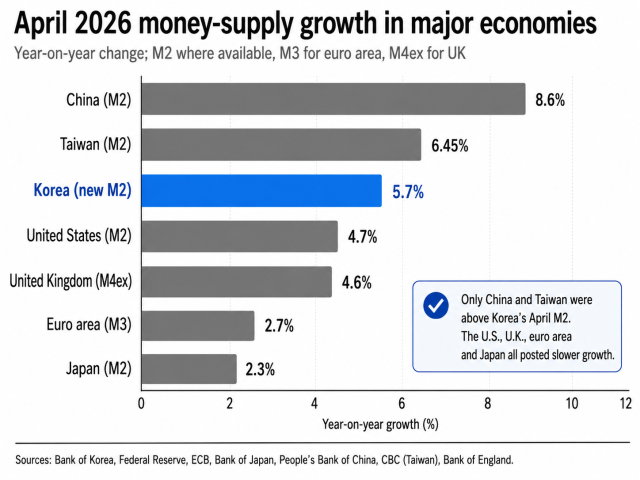
On an annual basis, M2 rose 5.7 percent, accelerating from 5.5 percent in March and 4.9 percent in February.
Under the previous M2 calculation method, however, the increase was far sharper. Old-method M2 averaged 4,684.6 trillion won in April, up 10.3 percent from a year earlier.
It was the first double-digit expansion since March 2022, when the comparable figure stood at 10.8 percent.
The pace was also among the fastest globally. Only China and Taiwan recorded stronger broad money growth in April, while the United States, Japan, the euro area and the United Kingdom all posted slower increases.
The main drivers shifted to deposits with maturities of less than two years and other monetary instruments in April - unlike March when money supply growth was led mainly by money market funds and instant-access savings deposits.
Deposits with maturities of less than two years increased by 13 trillion won from the previous month. Other monetary instruments rose by 8.3 trillion won.
The shift suggests that April's increase was driven more by flows into deposit-type and money-like financial products than by the short-term standby funds that shaped the March data.
By holder, both companies and households increased their money holdings. M2 held by non-financial companies rose by 16.1 trillion won from the previous month, while households and nonprofit organizations added 7 trillion won.
Other sectors, including social security funds and local governments, increased their holdings by 100 billion won, while other financial institutions reduced their holdings by 600 billion won.
Narrow money, or M1, also grew at a faster pace. M1 rose 0.4 percent from the previous month and 8.3 percent from a year earlier, compared with a 7.8 percent annual increase in March.
Liquidity at financial institutions, or Lf, increased 0.5 percent on month and 7.3 percent from a year earlier. The broadest liquidity gauge, L, rose 1.8 percent from the previous month and 8.1 percent from a year earlier.
The continued rise in liquidity could add to policy concerns as interest rates face upward pressure and the won remains weak.
The composition of April's increase, however, suggests caution in reading the data as a direct sign of stronger consumption or overheating in asset markets, as gains were led by time deposits and other monetary instruments
The BOK began including Investment Management Accounts (IMAs) offered by comprehensive financial investment firms in Lf from this release. As IMAs were first issued in December 2025, the data were applied retroactively from that month.
The central bank also revised parts of the M1, M2, Lf and L series from December 2022 onward to reflect changes in source data for external-sector statistics and other underlying data adjustments.

Copyright ⓒ Aju Press All rights reserved.