
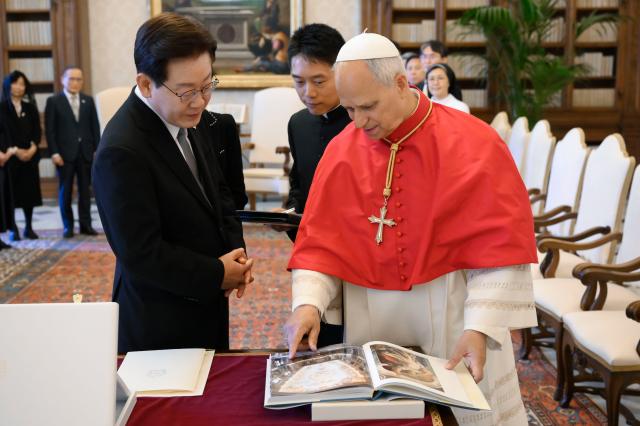
President Lee Jae-myung held a private meeting with Pope Leo XIV at the Vatican, where he requested the Pope to visit South Korea during the World Youth Day (WYD) in Seoul next year. The discussion included topics on peace on the Korean Peninsula and ways to improve inter-Korean relations, with the possibility of a papal visit to North Korea also being mentioned. The Vatican expressed its support for South Korea's peace efforts and promised continued interest and backing.
The Pope's visit to South Korea carries significant meaning. As the leader of 1.4 billion Catholics worldwide, the Pope's presence can send a powerful message to both South Korean society and the international community. The 2027 WYD in Seoul is expected to be a large-scale international event that will showcase South Korea's status and dynamism while conveying values of hope and solidarity to young people around the world.
Particularly noteworthy is the potential for a papal visit to North Korea. President Lee previously discussed the possibility with Cardinal Yu Heung-sik last year. This time, he met with the Pope in his official capacity to explain the national desire for peace on the Korean Peninsula and the government's plans. The Vatican reportedly acknowledged the importance of dialogue, reconciliation, and cooperation, showing interest in playing a role in promoting peace in the region.
A papal visit to Pyongyang would not merely be a religious event; it could symbolize a thaw in tensions and an improvement in inter-Korean relations. Historically, the Pope has often visited sites of conflict and division, transcending politics and ideology. During the Cold War, the Vatican played a crucial role in the democratization of Eastern Europe and has consistently exercised moral authority to foster reconciliation and dialogue in international conflict zones.
However, the current reality is challenging. Discussions about a papal visit to North Korea occurred during the Moon Jae-in administration but did not materialize. At that time, inter-Korean summits were held, and North Korea expressed an invitation, but it ultimately did not happen. The current state of inter-Korean relations is much more strained than it was then. A visit to North Korea is practically difficult unless the North extends an invitation. Cardinal Yu has stated, "Whether the Pope visits North Korea depends on the North," reflecting this reality.
Nonetheless, there is no reason to abandon hope. Diplomacy operates in the realm of reality, but history sometimes opens paths through symbolism. There are numerous instances where what once seemed unimaginable became reality through dialogue and trust. The key is to remain persistent.
During his meeting with the Vatican's Secretary of State, President Lee quoted the biblical phrase, "Knock, and it will be opened to you." The Vatican responded, "Not only patience but also hope is needed." The same applies to peace on the Korean Peninsula. Patience is necessary, and hope is essential. Above all, efforts to maintain the thread of dialogue are crucial.
The new government has identified the restoration of inter-Korean relations and peace on the Korean Peninsula as a key national agenda. This direction is correct, as peace is not merely the responsibility of a specific government but of the entire Republic of Korea. A balanced approach is needed that keeps the door open for dialogue and cooperation while upholding security and principles.
If the 2027 WYD in Seoul is successfully held, and the Pope visits South Korea and potentially Pyongyang, it could become a significant milestone in the history of the Korean Peninsula. There is hope that the Pope's visit to Pyongyang could serve as a new starting point for reconciliation and peace between the North and South.
* This article has been translated by AI.
Copyright ⓒ Aju Press All rights reserved.