
The net assets of exchange-traded funds (ETFs) have surpassed 500 trillion won, establishing them as a central pillar of the domestic investment market. In this thriving ETF sector, NH-Amundi Asset Management's 'HANARO Fn K-Semiconductor ETF' has gained attention, recording a recent one-month return of approximately 39%.
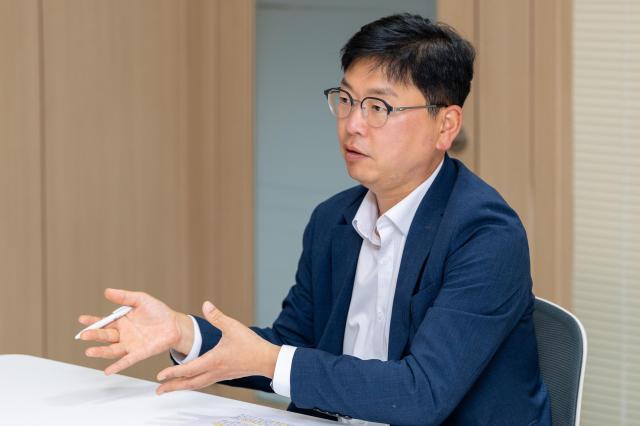
Kim Seung-cheol, head of the ETF investment division at NH-Amundi Asset Management, recently refuted claims of a semiconductor market peak during an interview with Aju Economy on June 8. He argued that as artificial intelligence (AI) evolves from a 'learning' phase to a 'reasoning' phase, and eventually into a physical AI era, the demand for semiconductors will structurally increase. He anticipates that investment opportunities will arise not only in semiconductors but also across AI infrastructure, including power and nuclear energy.
"AI is now in the reasoning era… Memory demand will explode"
Kim characterized the key change in the AI industry as a shift from learning to reasoning. He stated, "To perform reasoning, a significant amount of memory is required. In the past, demand fluctuated with the replacement cycles of mobile phones and PCs, but now big tech companies are continuously investing due to explosive demand."
He noted that while the semiconductor industry has historically experienced cyclical fluctuations, the current situation is different. With big tech firms entering long-term supply contracts and continuing to invest in AI infrastructure, the industry has entered a phase of structural growth.
He highlighted Jensen Huang, CEO of NVIDIA, who recently visited South Korea and mentioned the concept of a 'physical AI factory' as a significant change. Kim remarked, "The issue is that there is much more to come. As the physical AI era arrives, even more memory will be needed. Ultimately, the outlook for our country's semiconductor industry remains positive."
At the same time, he addressed concerns about increased volatility in the semiconductor sector and a slowdown in momentum, asserting that the long-term growth trend remains unchanged. He explained, "Even if it is a robust megatrend, volatility is inevitable. It can be swayed by minor news. When investing in megatrends, especially in AI, one must take a long-term view, as it will fundamentally change our lives."
"Saw Samsung Electro-Mechanics' growth potential early; agile product commercialization"
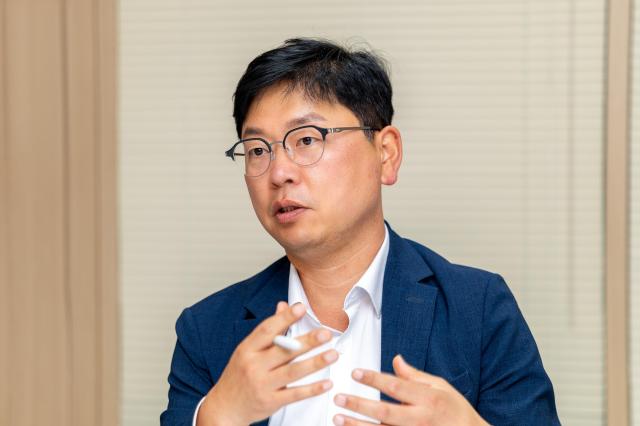
Regarding the competitiveness of the HANARO Fn K-Semiconductor ETF, which recently surpassed 4 trillion won in net assets, Kim described it as a portfolio that most faithfully captures the AI value chain.
He pointed out the early inclusion of Samsung Electro-Mechanics as a differentiating factor. He explained, "I have been paying attention to Samsung Electro-Mechanics' global oligopolistic position and growth potential in high-value substrates (FC-BGA) and MLCC (multi-layer ceramic capacitors), which are key materials for advanced AI servers."
He added, "We aim to reflect the overall growth potential of the domestic semiconductor sector by including a balanced mix of 20 stocks, not only from leading domestic semiconductor companies like SK Hynix and Samsung Electronics but also from competitive semiconductor materials, parts, and equipment firms. The ETF encompasses a wide range of the AI semiconductor value chain, including SK Square, Hanmi Semiconductor, Juseong Engineering, and Wonik IPS."
Furthermore, Kim emphasized that true competitiveness in the ETF market lies in the 'details and completeness of the products.' He stated, "When considering the massive trend of AI, we have not limited ourselves to hardware (GPUs) but have agilely commercialized changes across the value chain, including physical AI, memory, power, and nuclear infrastructure. We have enhanced completeness by evenly incorporating true market leaders and beneficiary sectors rather than mechanically dividing investment proportions."
"Key themes for the second half: infrastructure, energy, and security"
Buoyed by news of a peace agreement between the U.S. and Iran, the KOSPI is on an upward trend, approaching the 9,000 mark. Analysts are even predicting a '10,000 KOSPI era,' heightening expectations for the stock market in the second half of the year. As investors focus on promising investment opportunities for the latter half, Kim identified 'infrastructure, energy, and security' as key themes that will permeate the ETF market.
He remarked, "Power infrastructure and nuclear energy are key areas that can solve the practical bottlenecks of AI data center investments and are also national tasks in terms of global economic security. Traditional infrastructure demands, such as replacing aging power grids, as well as nuclear power generation and small modular reactors (SMRs) capable of providing uninterrupted clean power 24/7, are being reassessed as essential energy infrastructure in the AI era."
He continued, "The trend of reshoring U.S. manufacturing and the expansion of AI data centers by big tech companies are aligning, making these asset classes the most certain performance momentum for the second half. Additionally, the nuclear sector has gained strong expectations due to the Trump administration's nuclear renaissance policies, with key related projects set to enter concrete stages in the latter half of this year and next year."
"Diversification is key in ETF investing; setting goals is important"
Kim stated, "The era has arrived where retail investors prefer buying ETFs over individual stocks," expressing a high evaluation of the growth potential in the domestic ETF market. He anticipates that as the retirement pension market expands and individual investors continue to enter, the ETF market will further evolve. He explained that the market will become more segmented, focusing on theme-based products centered on growth and fundamentals, as well as asset allocation products with sophisticated risk management and income-generating products.
He noted, "These days, individual investors are selling stocks but are buying ETFs in large amounts, even in the hundreds of billions. Their investment tendencies have become very smart. In the past, when we thought of thematic stocks, we first thought of volatile short-term trading, but now there is a strong tendency to select long-term growth themes in areas where changes in the world are being detected, such as AI or robotics, and to endure short-term volatility for long-term investment."
For investors new to ETF investing, he emphasized 'goal setting' and 'diversification' as the most important principles. He advised, "Depending on whether you expect short-term profits or long-term asset formation, the ETFs you choose will differ significantly. It is important to balance your portfolio by mixing index, dividend, and growth ETFs rather than focusing on just one or two themes. There are over 1,100 ETFs listed in the market, so with so many good themes available, do not invest solely in one area."
* This article has been translated by AI.
Copyright ⓒ Aju Press All rights reserved.