
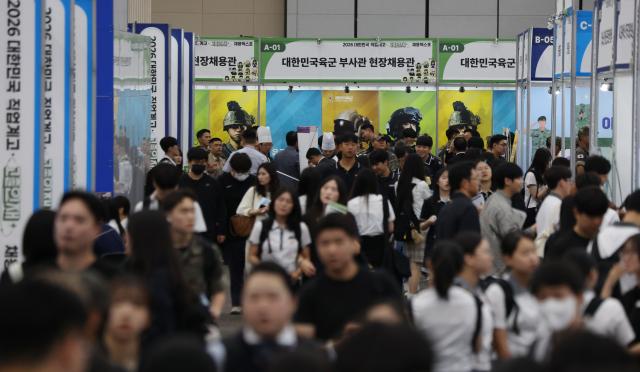
As the number of employed individuals fell for the first time in 17 months last month, the government is seeking to identify additional support measures to address ongoing youth employment instability.
On June 17, Deputy Minister of Finance Lee Hyung-il and Deputy Minister of Employment and Labor Kwon Chang-jun chaired a joint meeting of the government’s job task force in Seoul. They discussed the current employment situation, plans for the task force's future operations, additional measures to support youth employment, and a basic plan for employment stability amid industrial transitions.
According to the National Data Agency's employment trends report for May, the number of employed individuals decreased by 40,000 compared to the same month last year. This marks the first decline since December 2024, when the domestic economy was affected by the emergency measures following the 12·3 martial law. The employment rate also dropped by 0.5 percentage points year-on-year.
Notably, employment among those aged 15 to 29 fell by 255,000, the largest decrease since January 2021. While the youth employment rate decreased by 2.4 percentage points, the unemployment rate increased by 0.6 percentage points.
The government attributes the recent youth employment challenges to changes in population and industrial structures, the rise of mid-career hiring practices, and the impacts of the ongoing conflict in the Middle East. This suggests that the instability in employment has been compounded by the war in the region. The volatility in energy prices and increased uncertainty in exports have negatively affected production and investment sentiment in the manufacturing sector.
In response, the government plans to identify additional support measures. It will advance youth New Deal initiatives and expand successful projects based on demand. The government will analyze trends in key sectors such as manufacturing, construction, and agriculture, which have been significantly impacted by the prolonged conflict in the Middle East, and mobilize all available policy tools. It will also actively seek out medium- to long-term institutional improvements, including enhancing employment-related incentives.
The government aims to proactively respond to changes in labor demand related to industrial transitions, such as artificial intelligence, and provide preemptive support for workers needing to transition to new roles. Additionally, it plans to announce a 'Basic Plan for Employment Stability amid Industrial Transitions,' which will include measures to strengthen workers' transition capabilities, support for job changes, and the establishment of safety nets and policy infrastructure.
The government stated, "Although negotiations for a ceasefire in the Middle East conflict have been concluded, uncertainties remain, and challenges in the livelihood and job market persist." It added, "We will hold weekly meetings of the job task force to discuss sector-specific response strategies and announce them through economic ministers' meetings."
* This article has been translated by AI.
Copyright ⓒ Aju Press All rights reserved.