The Defense Ministry said Wednesday it will move the civilian control line about 2 kilometers northward, opening up swaths of tightly regulated border areas and reducing long-standing restrictions on residents.
The changes will affect an area equivalent to about 240 times the size of Yeouido, Seoul's main financial district.
Defense Minister Ahn Gyu-back announced the plan during a briefing in Seoul, calling it part of a broader effort to modernize military regulations that were established under very different security conditions.
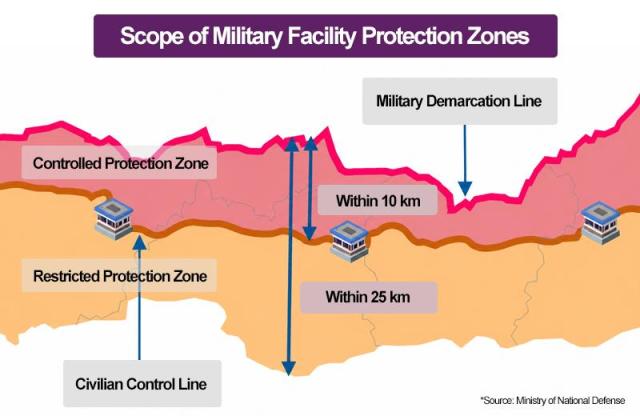
Under the plan, the civilian control line, which currently lies an average of 8 kilometers south of the Military Demarcation Line (MDL), will be shifted to around 6 kilometers south of the border dividing the two Koreas.
The civilian control line is a military access boundary established by the Defense Ministry for operational and security purposes. It runs through parts of Ganghwa Island, Gyeonggi Province and Gangwon Province within 10 kilometers south of the MDL.
As a result of the adjustment, controlled protection zones equivalent to about 90 times the size of Yeouido will be downgraded to restricted protection zones, which are subject to fewer regulations.
The ministry said the change will be implemented in phases beginning next year after military guard posts are relocated and additional surveillance systems, including closed-circuit television cameras, are installed.
The government will also lift restrictions in other military protection zones south of the MDL, saying some areas have remained under strict controls despite having little strategic significance under modern defense systems.
Areas equivalent to about 150 times the size of Yeouido are expected to be released from military restrictions.
The ministry also plans to remove 23 military obstacles whose operational value has diminished, beginning next year, to ease inconveniences for residents living near the border.
In another move aimed at improving daily life, authorities will introduce an online and mobile-based entry system for people entering civilian control zones.
Regulations for agricultural drones will also be relaxed. Currently, farmers in border areas must obtain both flight approval and military authorization every time they operate drones, making timely pest control difficult.
Under the new system, farmers will receive pre-approval twice a year, valid for six months at a time. Once approved, they will only need to notify authorities one day before operating drones within the designated area and period.
Approval zones will also be expanded from individual land parcels to township and village units, while the number of required documents will be reduced from seven to five.
"The Defense Ministry will swiftly and systematically carry out follow-up measures so that regulatory improvements can strengthen security while enhancing public convenience," Ahn said.
"The ministry will continue to actively respond to changes in the security environment and do its utmost to ensure that security and public convenience are balanced," he added.

Copyright ⓒ Aju Press All rights reserved.