
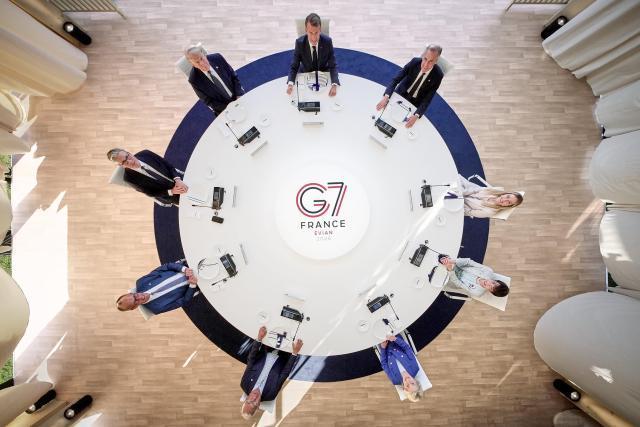
According to a joint statement released on June 17 during the G7 summit in Évian, France, the leaders described the U.S.-Iran agreement as a "historic opportunity" to address security threats stemming from Iran's nuclear ambitions and its regional activities, including its ballistic missile program.
The G7 pledged to support follow-up diplomatic agreements aimed at promoting peace and security in the Middle East, stressing the importance of reducing threats from Iran and preventing its acquisition of nuclear weapons.
Regarding navigation in the Strait of Hormuz, the leaders reiterated that "unrestricted and toll-free passage of vessels is fundamental to international trade." They also agreed to broaden energy supply chains and increase reserves to reduce global dependence on Hormuz.
On Middle Eastern issues, the G7 called for an immediate ceasefire in Lebanon, the disarmament of Hezbollah, and the Lebanese government's control over weapons. They also urged for increased humanitarian aid to Gaza and an end to violence in the West Bank.
The G7 reaffirmed its unwavering solidarity with Ukraine, committing to enhance support for air defense systems, interceptor missiles, and long-range weapons to uphold Ukraine's freedom, sovereignty, and territorial integrity. They also pledged assistance in the energy sector to help Ukraine endure the upcoming winter.
To weaken Russia's capacity to continue the war, the G7 plans to escalate pressure, including expanding sanctions in the oil and gas sectors. They noted that with President Trump having facilitated the reopening of Hormuz, now is an appropriate time to pursue additional measures against Russia.
In addressing Indo-Pacific issues, the G7 targeted China, emphasizing the importance of a "free and open Indo-Pacific based on the rule of law" and opposing attempts to change the status quo through force or coercion in the East China Sea, South China Sea, and Taiwan Strait.
The leaders expressed deep concern over North Korea's nuclear and ballistic missile programs, demanding complete denuclearization in accordance with United Nations Security Council resolutions and immediate resolution of abduction issues. They also agreed to jointly respond to cryptocurrency theft and cybercrime.
This joint statement reflects the G7's commitment to addressing Middle East stability, the war in Ukraine, and security issues in the Indo-Pacific following the U.S.-Iran agreement. However, most of the messages directed at Iran, Russia, China, and North Korea reaffirm existing principles, suggesting that the effectiveness of follow-up actions will depend on each country's compliance.
* This article has been translated by AI.
Copyright ⓒ Aju Press All rights reserved.