

The Personal Information Commission (PIC) is intensifying its investigation and sanctions regarding major data breaches, leading to a heated debate over the scale of these incidents. Following a recent decision to impose a fine of 620 billion won on Coupang, the potential financial burden on companies increases significantly as the scale of breaches expands. Concurrently, users are taking proactive steps to enhance their account security.
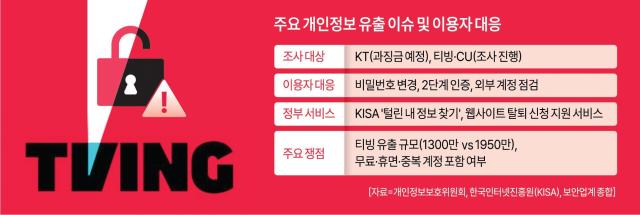
According to the security industry, KT is expected to face penalties next month as part of the ongoing investigation into significant data breaches. Tving and CU, which have recently come under scrutiny, are also classified as major incidents, raising public awareness about data protection.
Particularly contentious is the estimated scale of the data breach at Tving, with figures ranging from 13 million to 19 million affected users. Data obtained by Lee Jung-heon, a member of the Democratic Party, from the PIC indicates that approximately 19.5 million users' information has been compromised. However, as investigations are still underway, the final scale of the breach has yet to be confirmed.
Industry analysts suggest that the method of calculating the breach scale may vary based on criteria such as whether to include free users, dormant accounts, accounts created through bundled services with telecom companies, and duplicate sign-ups. The confirmed scale will likely influence the level of fines imposed.
For users who registered using external accounts like Naver, Kakao, or Apple, there is a possibility that the same individual may manage multiple types of accounts. Thus, establishing accurate criteria during the investigation will be a key issue. The PIC is also examining not only the precise scale of the breach but also the response process from the moment the incident was recognized to the reporting phase, as well as compliance with safety measures.
In light of these incidents, user responses are becoming more rapid. Recently, social media and online communities have seen a surge in posts sharing methods for changing passwords for Naver, Google, and Kakao accounts, setting up two-factor authentication, organizing unused accounts, and disconnecting linked external services. Awareness is growing that data breaches are not limited to specific services but can also impact linked accounts, prompting users to review their overall account security.
Notably, Tving supports easy login through its own membership as well as CJ ONE, Naver, Kakao, and Apple accounts. Consequently, users are being advised to change passwords not only for their Tving accounts but also for the primary accounts used for logging in, and to check login histories and connected devices. There is a growing consensus that using the same password across multiple platforms can lead to broader vulnerabilities, prompting recommendations to set unique passwords for each service and enable two-factor authentication.
The use of government-provided personal information protection services has also surged. According to the PIC, the number of applications for the 'Website Withdrawal Support Service' on the Personal Information Portal reached 80,321 as of 4:40 PM on the 15th. This figure represents a threefold increase compared to 26,851 applications on the 11th.
Interest in services like KISA's 'Find My Leaked Information' and the PIC's 'Website Withdrawal Support Service' is also rising. This increase is attributed to users wanting to verify whether their information has been exposed to other services and to clean up unused accounts following the data breach incidents.
* This article has been translated by AI.
Copyright ⓒ Aju Press All rights reserved.