SEOUL, June 19 (AJP) - Artificial intelligence agents often struggle with generating false information, a major obstacle for corporate adoption. To solve this, researchers have developed next-generation database technology that simultaneously understands documents, data, and their relationships to improve answer accuracy and processing speed. The Korea Advanced Institute of Science and Technology said Friday.
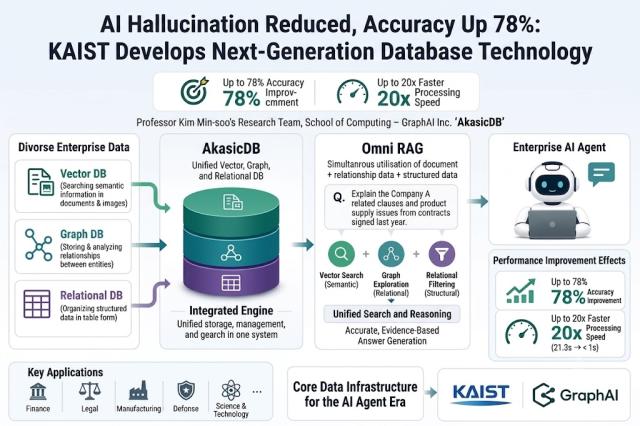
Current artificial intelligence retrieval systems typically rely on vector searches to find relevant text, which limits their ability to handle complex queries requiring an understanding of entity relationships or structured conditions. The newly developed system, AkasicDB, integrates vector, graph, and relational databases into a single engine. This allows the system to process the meaning of texts, connections between entities, and structured data simultaneously, rather than relying on multiple separate systems that cause response delays.
The Korea Advanced Institute of Science and Technology (KAIST) said that the technology was developed by a research team led by Professor Kim Min-soo at the KAIST School of Computing, in collaboration with the faculty-founded startup Graphy.
By combining these database functions, the research team created a new retrieval-augmented generation technique named Omni RAG. Testing showed that this integrated approach reduced the tendency of artificial intelligence to create false information, improving answer accuracy by up to 78 percent compared to existing models. The system also minimized unnecessary data movement, cutting the time required to process complex search queries from 21.3 seconds to under one second, resulting in a 20-fold increase in performance.
Corporate data is often scattered across unstructured documents, knowledge graphs, and traditional data tables. Previously, finding specific information required building separate databases and manually combining the results at the application layer, which caused significant management complexity. AkasicDB simplifies this by using a unified architecture that allows users to perform composite queries through a single command structure.
"A data infrastructure that can integrate and process vector, graph, and relational data in a single system is essential for artificial intelligence agents to accurately understand and utilize vast amounts of corporate data," Professor Kim Min-soo said. "AkasicDB is a next-generation database technology for the artificial intelligence agent era, and we expect it to be used as a core data infrastructure in fields requiring high reliability, such as defense, manufacturing, finance, law, and science and technology."
The research was led by KAIST doctoral student Lee Geon-ho as the first author, alongside co-authors Park Jung-ho and Han Dong-hyung from Graphy. The findings were presented as a demonstration paper at the ACM SIGMOD 2026 conference on June 2, 2026.
(Reference Information)
Journal/Source: ACM SIGMOD 2026
Title: AkasicDB: Demonstrating Omni RAG with a Unified Vector-Graph-Relational DBMS
Link/DOI: https://doi.org/10.1145/3788853.3801609

Copyright ⓒ Aju Press All rights reserved.