
SEOUL, June 19 (AJP) - Self-driving cars and robots must accurately understand their physical surroundings to operate safely, making the development of better spatial recognition systems a key focus in modern engineering. Addressing this need, an undergraduate student has led a research team to publish a new paper on artificial intelligence technology that helps machines see blocked objects, Kookmin University said Friday.
Conventional visual systems for robots often fail to map an area correctly if a large object blocks the view of things behind it. The newly developed technology solves this problem by using mathematical probability models to calculate and fill in the missing spatial data. This allows the system to build a reliable three-dimensional map of an area regardless of visual obstructions, unlike traditional sensors that rely entirely on a clear and direct view.
Kookmin University said that the paper detailing this technology has been accepted for presentation at the 2026 IEEE/RSJ International Conference on Intelligent Robots and Systems (IROS).
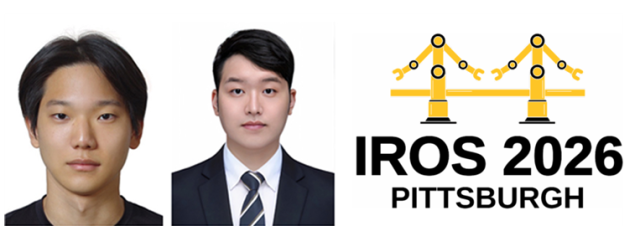
The research was conducted at the university's Computer Intelligence Lab under the guidance of Professor Lee Seong-won from the School of Electrical Engineering. Undergraduate student Kim Jun-ho served as the lead author of the paper, taking charge of the research design, implementation, and experiments.
This marks his second lead-author publication at a major robotics conference. He previously published a paper on visual geometry that was accepted at the IEEE International Conference on Robotics and Automation (ICRA) earlier in 2026. The university noted that having an undergraduate student publish consecutive lead-author papers at major international robotics conferences demonstrates its growing research capabilities in artificial intelligence.
"I find it very meaningful that the research I participated in during my undergraduate studies has been recognized at IROS, following ICRA," Kim said. "Based on the experience of conducting the research from design to implementation and experimentation, I want to continue artificial intelligence research that can contribute to actual robots and autonomous driving systems in the future."
The newly accepted paper will be formally presented when the IROS conference takes place in Pittsburgh in September 2026.
Copyright ⓒ Aju Press All rights reserved.
