
South Korea is the world's fifth-largest manufacturing power, producing semiconductors, automobiles, ships, and batteries. However, the advent of the AI era raises a critical question:
"Can South Korea's manufacturing sector remain among the best in the world?"
China is establishing AI factories, while the United States is focusing its national capabilities on physical AI. Germany, a manufacturing powerhouse, is also investing heavily in AI-driven smart factory transitions. At the center of this monumental shift is Kim Jung-kwan, the Minister of Trade, Industry and Energy.
Kim is not just any minister; he is the commander of the 'M.AX (Manufacturing AI Transformation)' project, which aims to transform South Korea's manufacturing industry into an AI-driven sector.
Kim Jung-kwan has a unique background. He graduated from Gwangju Jeil High School and earned a degree in economics from Seoul National University. He entered public service through the 36th National Civil Service Examination and rose through the ranks at the Ministry of Economy and Finance. He has also served as the head of the Capital Markets and International Economic Departments at the Bank of Korea, and later as the director of the Doosan Business Research Institute and the marketing head of Doosan Enerbility, gaining experience in both government and corporate sectors.
His dual experience allows him to understand both governmental capabilities and corporate needs, which is why President Yoon Suk-yeol appointed him as the Minister of Trade, Industry and Energy. The presidential office has described him as a "key talent experienced in the real economy."
While many discuss AI, Kim emphasizes manufacturing first. His perspective is straightforward: a significant portion of South Korea's GDP comes from manufacturing, which also drives exports and creates quality jobs. However, the workforce is shrinking, and skilled workers are retiring. Meanwhile, China is enhancing its manufacturing competitiveness through AI factories.
Kim believes that failing to transition manufacturing to AI will jeopardize the future of the South Korean economy.
The M.AX initiative represents Kim's vision for a comprehensive transformation of the manufacturing sector. This project is not merely about factory automation; it aims to create an 'AI manufacturing nation' where AI handles production planning, quality inspection, defect detection, and supply chain management. Kim defines this as the "survival strategy for South Korea's manufacturing industry."
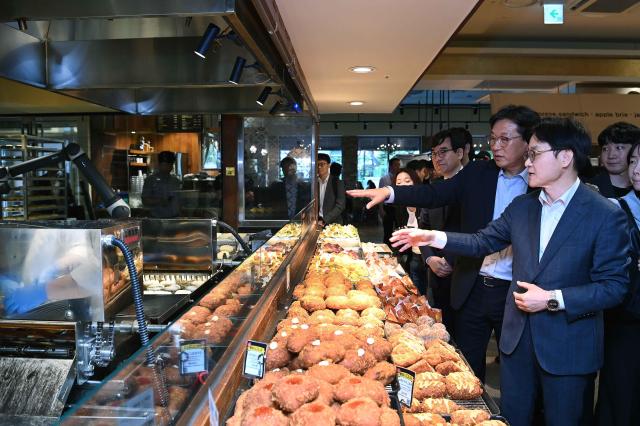
Recently, Kim visited Seongsim Bakery in Daejeon, not for the pastries, but to observe AI technology in action. The bakery has implemented AI vision robots in its production process to automate defect detection and packaging, resulting in a 20% increase in productivity. Kim noted, "The AI that detects defects in semiconductor substrates is fundamentally the same technology as the AI that identifies defects in pastries."
This visit illustrates Kim's philosophy: AI is not just for semiconductor factories; bakeries, breweries, and food factories can also leverage AI. The manufacturing AI he envisions is not limited to large corporations but encompasses the entire industrial ecosystem of South Korea.
One of Kim's frequently used terms is "tacit knowledge," referring to the expertise and know-how accumulated by skilled workers over decades. The challenge is that when these individuals retire, their skills may vanish. Kim argues that the future of manufacturing depends on how effectively this tacit knowledge can be converted into data and learned by AI. This is not merely automation; it is about digitizing the memory of industrial civilization.
While Deputy Prime Minister Bae Kyung-ho is focused on building AI national infrastructure, Kim is dedicated to embedding AI in industrial sites. He is taking AI from laboratories to factories across various locations, including Ulsan shipyards, Changwon machinery complexes, Osong battery factories, and Daesan petrochemical complexes. His consistent message is, "If you don’t adopt AI, you won’t survive." He describes the transition to manufacturing AI as a "war for survival."
Kim's strategy aims to integrate AI across the entire manufacturing sector. In semiconductors, he plans to combine AI semiconductors with manufacturing AI; in shipbuilding, he aims to transition to AI-based smart shipyards; and in batteries, he intends to apply AI throughout research and production. He particularly emphasizes South Korea's strengths: while the U.S. excels in AI and China has vast data resources, South Korea boasts the world's best manufacturing sites. Kim believes that combining this manufacturing capability with AI will pave a unique path for South Korea.
Another critical aspect of Kim's role is industrial security, focusing on rare earth supply chains, energy security, securing essential minerals, and semiconductor supply chains. He established the Industrial Resource Security Office to create a control tower for industrial security, particularly aiming to diversify supply chains and reduce dependence on China. The AI era is not just about technological competition; it is a national competition over resources and supply chains. Kim is redesigning the Ministry of Trade, Industry and Energy as an "economic security ministry."
While Kim is not an AI expert, he has a clear vision of where AI should be headed. He prioritizes industry over technology and factories over algorithms. He believes that while creating AI is important, enhancing productivity through AI is even more crucial.
South Korea has long thrived on manufacturing, and Kim aspires to integrate AI into this sector for another leap forward. His question is not whether South Korea will become an AI powerhouse, but whether its manufacturing sector can remain the best in the world in the AI era. M.AX is his answer to that question.
The future of South Korea's national AI transformation ultimately lies in its factories, and the person designing that future is Kim Jung-kwan.
* This article has been translated by AI.
Copyright ⓒ Aju Press All rights reserved.