
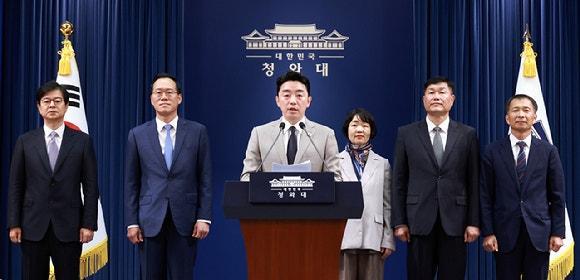
President Lee Jae-myung has reshuffled his senior aides as he enters the second year of his term. The most notable appointment is Han Chan-sik as Chief of the Civil Affairs Office. Han is a former prosecutor who has held positions including Director of the Human Rights Bureau at the Ministry of Justice and Chief Prosecutor of the Seoul Eastern District Prosecutors' Office. This marks a continuation of the trend of appointing individuals with prosecutorial backgrounds to key positions, as his predecessor, Bong Wook, was also a former prosecutor. Both have worked at the law firm Kim & Chang after leaving the prosecution.
Since taking office, the Lee Jae-myung administration has prioritized judicial reform as a key national agenda. Major reform initiatives include the separation of investigation and prosecution, the establishment of a Serious Crimes Investigation Agency, and the creation of a Public Prosecution Agency. Appointing a former prosecutor to oversee the Civil Affairs Office, which is responsible for implementing these reforms, may seem contradictory at first glance.
However, politics is often about pragmatism. Reform cannot be achieved solely through external criticism. To change an organization, one must understand how it operates. It is essential to grasp the power dynamics within the prosecution, the issues within the investigation and prosecution systems, and the sources of internal resistance. This is why individuals with prosecutorial experience are often favored in the reform process.
Historically, reforms have frequently been led by those familiar with the institutions involved. Military reforms have been conducted by those knowledgeable about the military, and financial reforms have been led by individuals who understand the financial system. The same principle applies to judicial reform; having someone well-versed in the prosecution's workings is not inherently problematic.
What the public is concerned about is not whether the Chief of the Civil Affairs Office is a former prosecutor, but whether judicial reform can genuinely enhance safety and fairness in citizens' lives. The restructuring of power agencies should not serve the interests of a specific faction but should protect the fundamental rights of the people. The adjustments in authority among investigative agencies should lead to strengthened rule of law rather than becoming a source of political controversy.
This appointment signals the Lee Jae-myung administration's commitment to accelerating reform as it enters its second year. Chief of Staff Kang Hoon-sik stated, "This reflects our determination to push for further reforms and not to become complacent." The success of a government is determined not by personnel announcements but by outcomes. Judicial reform has been one of the most contentious issues in South Korean society in recent years. The public is no longer willing to applaud merely in the name of reform; they will critically assess whether reforms have genuinely improved fairness and accountability.
The Lee Jae-myung administration has once again entrusted judicial reform to a former prosecutor. This could be seen as a gamble or a practical choice. The results will ultimately reveal the wisdom of this decision. What matters is not Han Chan-sik's background, but whether judicial reform can be completed in a way that serves the public. The fundamentals, principles, and common sense will ultimately be proven by the results.
* This article has been translated by AI.
Copyright ⓒ Aju Press All rights reserved.