
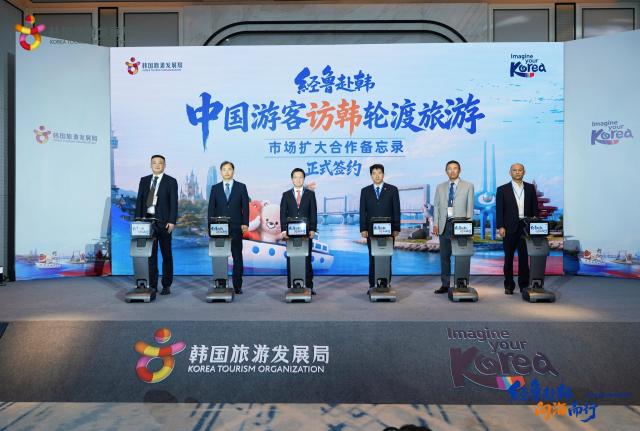
The organization announced on June 22 that it conducted tourism sales activities targeting local ferry operators and major travel agencies in Qingdao, China, from June 16 to 18. This initiative aims to expand maritime tourism demand as a way to adapt to changing conditions in the air travel-focused inbound tourism market ahead of the summer vacation season.
On June 17, during a seminar on expanding the ferry tourism market at the St. Regis Hotel in Qingdao, the organization signed a Memorandum of Understanding (MOU) with five ferry companies from Shandong Province. Shandong is a key market, accounting for approximately 76% of all ferry passenger routes between Korea and China, with eight routes currently operating connecting Incheon, Pyeongtaek, and Gunsan ports.
Through the establishment of a collaborative framework with these ferry operators, the Korea Tourism Organization aims to attract 1.5 million tourists from China over the next three years. To achieve this goal, it plans to develop tourism products tailored to various demographics, including youth, seniors, corporate incentives, sports and cultural exchange groups, and individual travelers, while also promoting joint marketing efforts.
Additionally, on the same day, the organization signed an MOU with Zhao Xiaoqian, chairman of the Chinese electronics company Hisense Group, to collaborate on corporate meetings and incentive tourism. Following this, discussions were held with seven major travel agencies regarding the development of group travel products targeting third- and fourth-tier cities and campaigns to expand the ferry tourism market in the second half of the year.
Park Seong-hyeok, president of the Korea Tourism Organization, stated, "This agreement is significant as it leads to collaborative efforts with major ferry operators to revitalize Korea-China ferry tourism and establishes an integrated cooperation system for the first time. We aim to cultivate Korea-China ferries as a new platform for inbound tourism and create new growth engines for Korea-China tourism exchange through the discovery of new demand and market diversification using maritime tourism."
The organization is also actively marketing K-tourism targeting China's high-income class. Previously, the Ministry of Culture, Sports and Tourism and the Korea Tourism Organization held the '2026 K-Tourism Roadshow in Hangzhou' from May 29 to 31. Hangzhou, a representative 'new first-tier city' in China, has a resident population of 12.62 million and an annual disposable income of approximately 16 million won per person, making it a hub for major IT companies like Alibaba.
During the roadshow, a 'Korean Tourism Night' consultation event was held, where 39 organizations, including local governments, travel agencies, duty-free shops, and content companies from Korea, discussed the development of inbound tourism products with over 100 local travel agencies and global travel platforms. Special emphasis was placed on introducing regional tourism content linked to direct flights between Hangzhou and Busan, focusing on dispersing demand from the metropolitan area to regional destinations.
* This article has been translated by AI.
Copyright ⓒ Aju Press All rights reserved.