
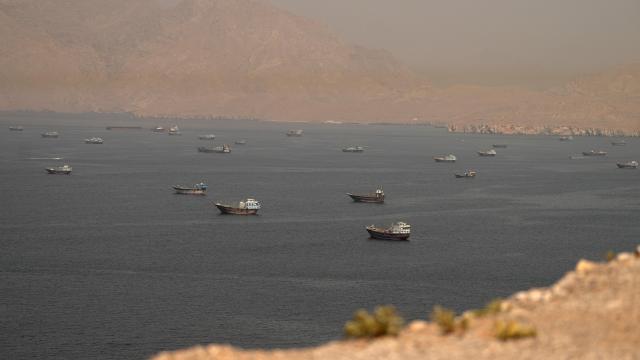
Bloomberg reported on June 21, citing vessel tracking data, that five supertankers entered or navigated through the Hormuz Strait over the weekend, carrying an estimated total of 8 million barrels of oil along the coast of Oman.
According to the tracking data, the 'Gulf Sunrise,' carrying about 2 million barrels of Saudi oil bound for Japan, lost its signal near a narrow section of the Hormuz Strait on June 20 but was later detected in the Gulf of Oman. The 'Angola B,' loaded with oil from the United Arab Emirates, was last seen rounding the tip of Oman’s Musandam Peninsula. The 'Monaco Royalty' lost its signal before reaching the northernmost point of the Hormuz Strait.
Two 1 million-barrel tankers, the 'Nordic Cross' and 'Nordic Pollux,' were also reported moving along the southern route near the Oman coast on the morning of June 21.
Vessel signals continue to be detected off the Iranian coast. The 'Deshi Bibor,' 'Deshi Baibab,' and 'Sanmar Herald' sent signals indicating their intention to pass through the Hormuz Strait on June 19 and were sighted in the Gulf of Oman and the Arabian Sea on June 21. Bloomberg noted that these vessels are carrying a total of 6 million barrels of oil from Iraq and Kuwait, suggesting they may have transited the strait via a route approved by Iran before the blockade announcement.
Two vessels operated by South Korean shipping companies have also exited the Hormuz Strait. The Ministry of Oceans and Fisheries stated on June 22 that "two vessels operated by our shipping companies, which were waiting inside the Hormuz Strait, have passed through the strait and are navigating normally." However, it was noted that there are no South Korean crew members on board, and their destinations are not in South Korea.
The United States emphasizes that transit through the Hormuz Strait continues. U.S. Secretary of Energy Chris Wright stated that as of June 20, 67 vessels had passed through the strait, indicating that shipping traffic persists despite Iran's threats of a renewed blockade.
Bloomberg suggested that if these vessels continue to transit as planned, it could bolster U.S. claims of defending the southern route near the Oman coast.
However, uncertainty surrounding the Hormuz Strait remains. Iran has pressured that the safety of vessels approaching the strait could be threatened due to the failure to comply with a previous memorandum of understanding (MOU). President Donald Trump has warned Iran not to block the strait, stating that "if you close it, your country will disappear."
* This article has been translated by AI.
Copyright ⓒ Aju Press All rights reserved.