
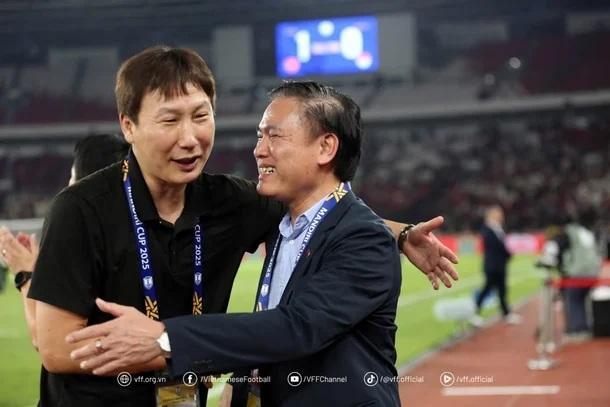
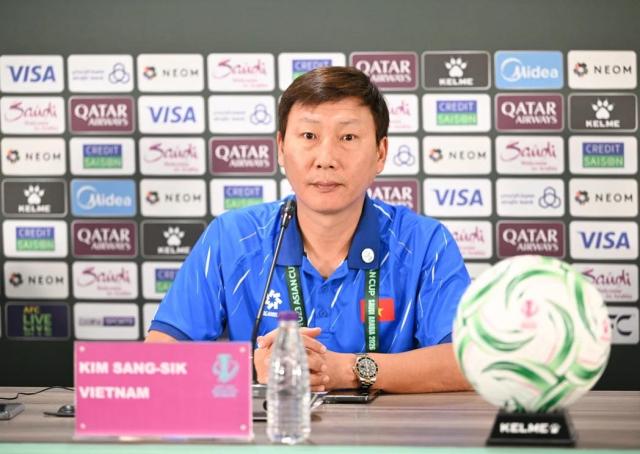
The Vietnam soccer team, led by coach Kim Sang-sik, is at a pivotal moment as it implements a restructuring of its national team operations while simultaneously enhancing its competitive strength. The Vietnam Football Federation (VFF) has announced a separation of roles between the national team and the Olympic team, allowing the national team to focus on training in South Korea ahead of the ASEAN Cup. This shift has drawn attention to improvements in players' physical conditions and the integration of new talent, raising interest in the evolving competitiveness of Vietnamese soccer.
According to local reports from Vietnamnet and others on June 21, the most notable change in Vietnamese soccer is the adjustment in the management of the national team. The VFF revealed that coach Kim Sang-sik will not directly lead the Olympic team at the Asian Games in Japan this year, instead dedicating his efforts to the national team. This decision allows him to concentrate fully on preparations for the ASEAN Cup and the Asian Cup qualifiers, which are considered key challenges for Vietnamese soccer.
This strategy marks a departure from the previous model where one coach managed multiple teams simultaneously. The VFF aims to establish a preparation system tailored to the characteristics of each tournament and age group, thereby enhancing competitiveness and fostering systematic player development.
The Vietnam national team will gather on June 22 for a two-week training camp in South Korea in preparation for the 2026 ASEAN Cup. Following this, they are scheduled to play a friendly match against Myanmar in mid-July. However, concerns have been raised about the lack of strong opponents during this preparation phase. While the team plans to focus on physical conditioning and tactical training during their stay in South Korea, experts argue that high-level match experience is crucial for assessing tactical completeness, adapting new players, and improving team cohesion. Particularly, Myanmar has been viewed as less challenging in recent years, leading fans and local soccer circles to express worries about the lack of competitive testing.
Nonetheless, there is a prevailing view that coach Kim Sang-sik must make the best choices given the current circumstances. Securing high-quality opponents for friendly matches within a specific timeframe is complicated due to scheduling conflicts and logistical issues. On the positive side, the training camp in South Korea is seen as an opportunity to enhance the team's physical fitness, tactical proficiency, and overall cohesion. Additionally, with the Vietnamese national team becoming a focal point for analysis by opponents in international competitions, avoiding excessive tactical exposure in friendly matches against strong teams is considered advantageous.
Looking ahead, while there is a need to secure more competitive opponents during future FIFA A-match periods, thorough preparation tailored to the current environment is expected to be crucial for the success of the ASEAN Cup.
Changes are also evident in the composition of the national team. The roster for the 2026 ASEAN Cup has attracted attention in Southeast Asian soccer circles. Notably, Indonesian media have highlighted improvements in the physical conditions of Vietnamese players. According to Indonesian sports outlet Bola Sports, the physical stature of the players included in this roster has significantly improved compared to the past. Among the 28 players called up, 15 are over 180 cm tall, a rare statistic among Southeast Asian national teams. This change is attributed to improvements in youth development systems, systematic nutrition management, and player management programs.
Height is considered a significant advantage in terms of performance, as it can provide an edge in aerial duels and enhance defensive competitiveness against teams that utilize long balls. Additionally, height is valuable in both offensive and defensive set-piece situations. The inclusion of goalkeeper Patrick Le Giang has also garnered significant interest. A player of Vietnamese descent, he has long aspired to represent the national team and will finally don the Vietnam jersey.
Born in 1992, Patrick Le Giang expressed his excitement about joining the national team in a previous interview, stating, "It is difficult to express how meaningful this is to me. I want to give my best for the country and repay the love from the fans."
Meanwhile, Indonesia, considered Vietnam's strongest rival, continues to pursue aggressive strengthening policies. Eric Thohir, president of the Indonesian Football Association (PSSI), has publicly stated his goal of elevating the national team into the top 50 in FIFA rankings and among the top 10 in Asia. Indonesia is actively pursuing naturalization policies to achieve this goal, recently incorporating players Luke Beasley and Mitchell Baker into their national squad.
As both Vietnam and Indonesia embark on team restructuring and strengthening efforts, the competition for dominance in Southeast Asian soccer is expected to intensify. Attention is focused on the outcomes both teams will achieve in major tournaments such as the ASEAN Cup and Asian Cup qualifiers.
* This article has been translated by AI.
Copyright ⓒ Aju Press All rights reserved.