
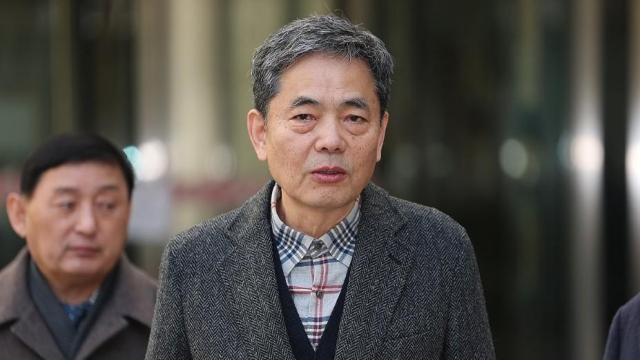
The appeal trial for Kwak Sang-do, a former lawmaker accused of receiving a 5 billion won bribe from the Daejang-dong group under the guise of his son's severance pay, will officially begin on September 1.
On June 23, the Seoul High Court's Criminal Division 3, led by Chief Judge Lee Seung-han, held a preparatory hearing for Kwak's appeal regarding charges of violating the Act on the Aggravated Punishment of Specific Crimes (bribery). The preparatory hearing is a procedure where the court gathers both the prosecution and defense to clarify the issues at hand and discuss evidence submission plans to ensure a focused and efficient trial.
Although defendants are not required to attend the preparatory hearing, Kwak, his son Byung-chae, and key defendants including Kim Man-bae, the major shareholder of Hwacheon Daeyu, were all present in court.
This trial has been combined with Kwak's appeal regarding charges of violating the Act on the Regulation of Criminal Proceeds, which was dismissed in February. Kwak's son, Byung-chae, who was also indicted on bribery charges, had previously been acquitted. On this day, the prosecution indicated plans to add charges related to violations of the Political Fund Act and submitted a written opinion to the court regarding changes to the indictment.
In court, both sides clashed over the admissibility of additional evidence submitted by the prosecution. Kwak argued that the statements prepared by the prosecution were illegal.
He stated, "My case involves materials collected by prosecutors over a long period through various warrants and procedures. Even the testimony given in court should be excluded as it constitutes secondary testimony." This implies that prosecution statements not agreed upon by the defense cannot be used as evidence.
Kwak's attorney also contended that the statements submitted after the first trial were crafted by the prosecution with the intent to induce a retraction of testimony, thus should be excluded as evidence. Kim Man-bae's attorney requested the court to reject the prosecution's submission of records related to the defamation case against former President Yoon Suk-yeol, deeming them unnecessary.
Ultimately, the court accepted the defense's position, allowing only the evidence adopted in the first trial of the related case and rejecting all other submissions.
The court instructed the prosecution, stating, "The existing submitted evidence is not insufficient. Focus on explaining the unfairness of the original ruling rather than continuously presenting new evidence."
In response, the prosecution applied for witness testimony from the related case, while the defense agreed to organize their stance on the existing testimony evidence and submit an opinion by the next hearing.
Meanwhile, Kwak's side expressed intentions to summon key individuals whose credibility was not adequately challenged in the first trial, including lawyer Nam Wook and accountant Jeong Young-hak, as witnesses.
Kwak is accused of receiving 50 million won from lawyer Nam shortly after the 2016 general election under the pretext of legal fees. The request for these two witnesses aims to clarify discrepancies in their testimonies regarding the timing and nature of the payment.
After concluding the preparatory hearing, the court scheduled the first formal trial for September 1, considering the defendants' schedules and the court's summer recess.
The first trial is expected to address whether to reflect the prosecution's additional charges and decide on the witness selection for Nam and Jeong.
In the previous trial, Kwak was acquitted of bribery and mediation charges. Both he and his son Byung-chae were found not guilty regarding the 5 billion won bribe. However, the court ruled that the 50 million won received from lawyer Nam could not be considered a typical legal fee, finding Kwak guilty of violating the Political Fund Act and imposing a fine of 8 million won along with a forfeiture of 50 million won.
* This article has been translated by AI.
Copyright ⓒ Aju Press All rights reserved.