SEOUL, June 23 (AJP) - More than half of the self-employed felt their business environment worsened from a year earlier and favored a freeze in next year's minimum wage, a survey released on Tuesday shows.
According to a recent survey of about 500 mom-and-pop businesses nationwide by the Korea Enterprises Federation, around 57 percent of respondents said their business environment worsened over the past year, while 8.4 percent said they saw some improvement and 34.6 percent said it remained roughly unchanged.
The deterioration was most pronounced in the wholesale and retail sector, where 66.3 percent of respondents complained of worsening conditions, followed closely by those in the lodging and restaurant sector at 65.8 percent.
When asked about an appropriate minimum wage for next year, 44.6 percent favored a freeze, while 20.6 percent supported an increase of less than 3 percent, 13 percent called for a cut, and 12.6 percent supported an increase of less than 6 percent.
But nearly 60 percent said they had no capacity to hire additional staff, adding that if the minimum wage rises further, they would either stop hiring or reduce their current workforce.
About 34 percent said their average monthly income was below the minimum wage level of 2.16 million won, while about a quarter of them or 25.2 percent said they were in such dire straits that they were already considering closing their business.
"With inflationary pressures amid a prolonged slowdown in private consumption caused by a weakening won and high oil prices, a sharp increase in the minimum wage could further reduce the incomes of the self-employed and lead to job losses," said Lee Sang-ho, a senior researcher at the federation.
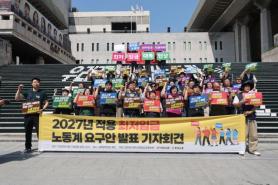
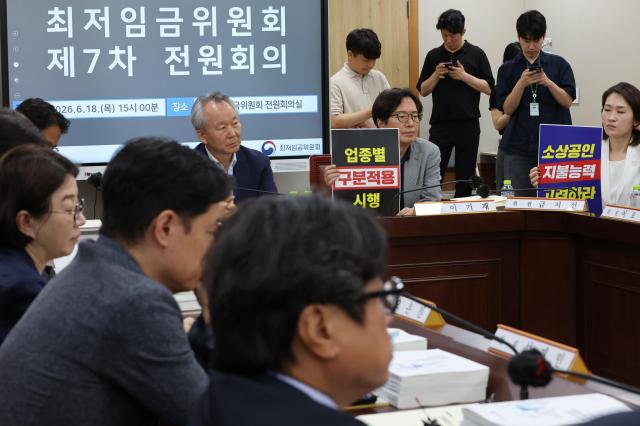
Meanwhile, negotiations over next year's minimum wage have stalled between labor and business groups after their latest meeting last Thursday collapsed due to differences, with labor groups demanding 12,000 won (about US$8) per hour, up from this year's 10,320 won.
They have also been in discussions on whether to apply different minimum wages across industries in a bid to help improve the working conditions of platform workers including delivery workers and riders.
According to a recent survey of about 500 mom-and-pop businesses nationwide by the Korea Enterprises Federation, around 57 percent of respondents said their business environment worsened over the past year, while 8.4 percent said they saw some improvement and 34.6 percent said it remained roughly unchanged.
The deterioration was most pronounced in the wholesale and retail sector, where 66.3 percent of respondents complained of worsening conditions, followed closely by those in the lodging and restaurant sector at 65.8 percent.
When asked about an appropriate minimum wage for next year, 44.6 percent favored a freeze, while 20.6 percent supported an increase of less than 3 percent, 13 percent called for a cut, and 12.6 percent supported an increase of less than 6 percent.
But nearly 60 percent said they had no capacity to hire additional staff, adding that if the minimum wage rises further, they would either stop hiring or reduce their current workforce.
About 34 percent said their average monthly income was below the minimum wage level of 2.16 million won, while about a quarter of them or 25.2 percent said they were in such dire straits that they were already considering closing their business.
"With inflationary pressures amid a prolonged slowdown in private consumption caused by a weakening won and high oil prices, a sharp increase in the minimum wage could further reduce the incomes of the self-employed and lead to job losses," said Lee Sang-ho, a senior researcher at the federation.
Meanwhile, negotiations over next year's minimum wage have stalled between labor and business groups after their latest meeting last Thursday collapsed due to differences, with labor groups demanding 12,000 won (about US$8) per hour, up from this year's 10,320 won.
They have also been in discussions on whether to apply different minimum wages across industries in a bid to help improve the working conditions of platform workers including delivery workers and riders.
Copyright ⓒ Aju Press All rights reserved.