
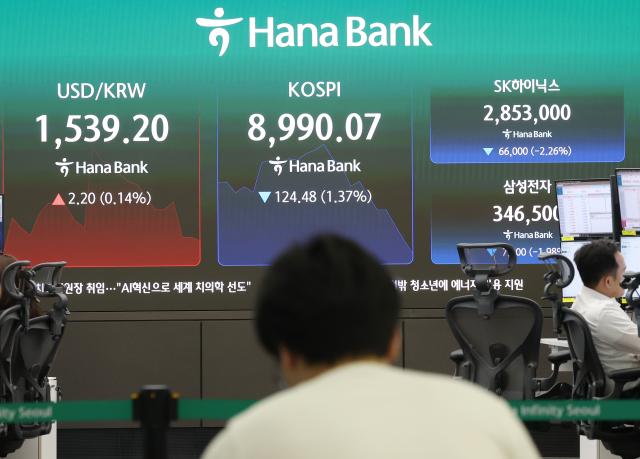
On June 23, South Korea's stock market experienced a sharp decline, with the KOSPI recording its largest drop ever, barely holding above the 8200 mark. The KOSDAQ index fell below 900, dropping to the 800s for the first time in seven months. The sell-off was driven by significant profit-taking, particularly from foreign and institutional investors, following a recent surge in the market. Some analysts suggest that discussions in the political arena regarding taxation on unrealized stock gains may have contributed to the market's downturn.
According to the Korea Exchange, the KOSPI closed at 8203.84, down 910.71 points (9.99%) from the previous session, marking the largest decline in terms of points in history. In percentage terms, this is the biggest drop since March 4, when it fell by 12.06%.
Foreign and institutional investors were the primary sellers, offloading 4.12 trillion won and 4.55 trillion won worth of stocks, respectively. In contrast, individual investors purchased a net 8.58 trillion won. The market capitalization of the KOSPI dropped by approximately 743 trillion won due to the day's decline.
Major stocks also fell sharply, with semiconductor giants SK Hynix and Samsung Electronics dropping by 12.47% and 12.31%, respectively, contributing to the downward pressure. Following the previous day's surge, SK Hynix saw its market capitalization decrease by 260 trillion won to 1820.95 trillion won. Samsung Electronics' market cap (excluding preferred shares) also plummeted from 2066 trillion won to 1812.35 trillion won, failing to reclaim its top position. Seo Sang-young, a researcher at Mirae Asset Securities, noted, "The valuation burden on domestic large-cap semiconductor stocks, which have recently reached all-time highs, has increased."
The KOSDAQ index also faced significant losses, closing at 891.52, down 76.88 points (7.94%). This marks the first time the KOSDAQ has fallen below 900 since November 27 of last year, when it stood at 880.06.
The sharp decline has reignited concerns about market overheating. The timing of the drop, occurring just a day after SK Hynix's market cap surpassed that of Samsung Electronics, has heightened investor caution. Lee Jae-man, a researcher at Hana Securities, stated in a report on May 20, "The signal for the end of the current bull market will be when SK Hynix's market cap surpasses that of Samsung Electronics." He explained that the market's expectations for SK Hynix were excessively ahead of its actual performance, indicating that optimism was overly reflected in the market as a whole.
There are also concerns that discussions about taxation on unrealized gains in the political sphere have dampened investor sentiment. Lee Kyung-min, a researcher at Daishin Securities, commented, "A discussion was held in the political arena about considering unrealized gains from stock and real estate investments as income for comprehensive taxation, which has expanded downward pressure on the stock market alongside weakened investor sentiment."
However, some analysts believe that the day's sharp decline does not necessarily indicate a fundamental deterioration in the AI industry. Han Ji-young, a researcher at Kiwoom Securities, remarked, "The extreme concentration of market capitalization observed the previous day led to increased volatility as profit-taking emerged, primarily from foreign investors. It is excessive to interpret this as a signal of a market peak or bubble collapse."
* This article has been translated by AI.
Copyright ⓒ Aju Press All rights reserved.