The Korean team is targeting a strategic vulnerability.
Canada is the world's fifth-largest natural gas producer in 2025, behind the United States, Russia, Iran and China, with marketed output of about 218.5 billion cubic meters, according to OPEC's 2026 Annual Statistical Bulletin.
Yet its gas exports remain overwhelmingly tied to a single market across the border.
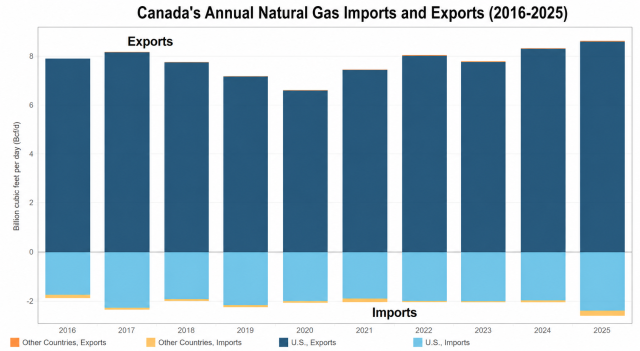
In 2025, Canada exported 8.6 billion cubic feet of natural gas per day, excluding shipments from the newly opened LNG Canada terminal, and "nearly all" of it went to the United States, according to the Canada Energy Regulator.
For decades, Canada had little incentive to spend billions of dollars liquefying gas for overseas shipment because its extensive pipeline network provided direct access to the U.S. market.
That dependence became less advantageous after the U.S. shale boom took off in the mid-2000s, as horizontal drilling and hydraulic fracturing unlocked vast quantities of gas trapped in shale and other tight rock formations.
The resulting surge in U.S. production reduced demand for Canadian gas in some regions and eventually turned the United States into a formidable competitor in global LNG markets.
U.S. dry natural gas production reached a record 39 trillion cubic feet in 2025, while LNG exports surged from 0.5 billion cubic feet per day in 2016 to 15 billion cubic feet per day last year.
The United States is now the world's largest LNG exporter, ahead of Australia and Qatar. Canada therefore remains heavily dependent on the U.S. as a pipeline gas customer while increasingly competing with it for LNG buyers in Europe and Asia.
South Korea has emerged as an attractive market for that diversification.
The country imported 46.7 million tonnes of LNG in 2025, making it one of the world's largest buyers. About 80 percent of those purchases were made under long-term contracts, offering the kind of predictable demand that can underpin financing for multibillion-dollar export projects.
State-run Korea Gas Corp., or KOGAS, accounted for more than 73 percent of the country's LNG imports and operates five receiving terminals with 77 storage tanks and a combined capacity of 12.16 million kiloliters.
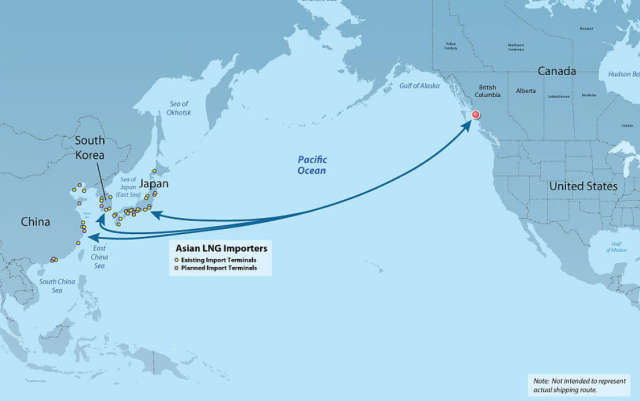
According to KOGAS, cargoes from Kitimat on Canada's Pacific coast can reach Incheon in 12 to 14 days over a distance of roughly 8,500 kilometers.
That compares with about 17 days for shipments from Qatar and 31 days for cargoes departing from the Sabine Pass terminal on the U.S. Gulf Coast.
The Canadian route also bypasses both the Strait of Hormuz and the Panama Canal, reducing exposure to geopolitical disruptions, congestion and canal restrictions.
KOGAS estimates the shorter route could lower transportation costs by 20 to 50 percent compared with some of its existing supply routes.
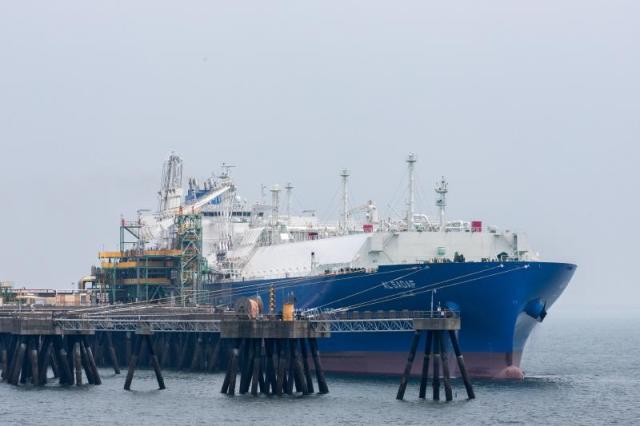
That advantage was demonstrated earlier this month when an LNG Canada cargo arrived at KOGAS' Incheon terminal after departing Kitimat on May 20.
It was the first LNG Canada shipment delivered to the terminal, a critical supply hub serving the Seoul metropolitan area.
The LNG Canada project transports gas produced in western Canada through a 670-kilometer pipeline to its liquefaction plant in Kitimat, where it is processed and loaded onto carriers bound for overseas markets.
KOGAS has been involved in the project since signing a joint feasibility agreement in 2010. It later acquired a 5 percent stake, securing access to about 700,000 tonnes of LNG annually from the project's first phase.
KOGAS is also pursuing participation in a second phase of LNG Canada, which would add another 14 million tonnes of annual production capacity.
Those existing commercial ties illustrate why South Korea could serve as an anchor market for further Canadian LNG development.
Hanwha's proposed floating LNG, or FLNG, project near Prince Rupert is separate from LNG Canada, but it follows the same strategic logic: western Canadian gas could be liquefied on the Pacific coast, shipped to Asia without passing through major maritime chokepoints and sold to established buyers in South Korea.
Unlike LNG, FLNG is not a separate type of fuel. The distinction lies in where the gas is processed.
A conventional LNG project sends natural gas through pipelines to a large terminal on land, where it is cooled to about minus 162 degrees Celsius, stored in tanks and loaded onto carriers.
An FLNG facility places much of that process — gas treatment, liquefaction, storage and loading — aboard a large floating structure moored offshore or near the coast.
That model could prove particularly attractive for Canada.
British Columbia counted 19 proposed LNG export projects in 2017, but Canada did not begin large-scale LNG exports until 2025.
Many projects also require costly pipelines stretching hundreds of kilometers from inland gas fields to the coast. LNG Canada, for example, relies on a 670-kilometer pipeline, in addition to its terminal, environmental approvals and agreements with First Nations communities.
An FLNG facility could reduce the amount of large-scale infrastructure required on land, though it would not eliminate the need for pipelines, permits and Indigenous consultation.
That breadth helps explain why Hanwha has linked the project to its campaign for the Canadian Patrol Submarine Project.
Canada has said the submarine procurement should generate long-term economic benefits and strengthen its domestic marine and defense industries, rather than simply deliver up to 12 vessels.
The proposed FLNG project allows Hanwha to argue that selecting the South Korean bidder could support a wider industrial relationship spanning naval construction, offshore engineering, energy exports and shipbuilding.
The project would not automatically qualify toward Hanwha's obligations under Canada's Industrial and Technological Benefits policy, and the memorandum does not make the investment conditional on a submarine award.
Still, it broadens Hanwha's pitch from the performance and cost of its KSS-III submarine to a larger proposition: South Korea could help Canada build a new Pacific export industry while becoming a customer for the gas it produces.
As Germany leans on NATO interoperability and European defense ties, Team Korea is increasingly making a different argument — that the submarine deal is not merely about replacing an aging fleet but about helping Canada diversify its economy, its export markets and ultimately its strategic dependence on the U.S.

Copyright ⓒ Aju Press All rights reserved.