
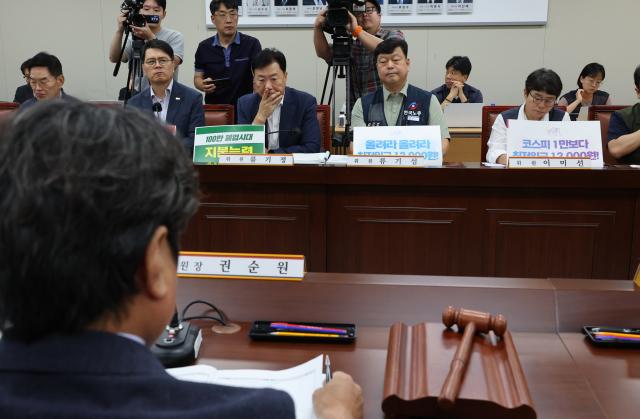
The Minimum Wage Commission is currently discussing the minimum wage for next year, with labor representatives proposing an increase of over 10% compared to this year, while employer representatives are advocating for a freeze.
During the 8th plenary meeting held on June 23 at the Government Sejong Center, worker representatives suggested a minimum wage of 12,000 won per hour, which is 16.3% higher than this year's minimum wage of 10,320 won. This translates to a monthly wage of 2,508,000 won.
In contrast, employer representatives proposed maintaining the current minimum wage of 10,320 won, which amounts to a monthly wage of 2,156,880 won.
Prior to the minimum wage discussions, both sides engaged in a heated exchange. Ryu Gi-seop, Secretary-General of the Korean Confederation of Trade Unions (KCTU), stated, "The minimum wage is a system designed to ensure workers' livelihoods. It must reflect the significant decline in real wages for low-income workers due to rising inflation and energy prices."
Lee Mi-sun, Deputy Chair of the Korean Federation of Trade Unions (KFTU), added, "The current minimum wage is insufficient to cope with soaring grocery prices and public utility costs. The demand for a minimum wage of 12,000 won is not a luxury but a necessity for survival."
On the other hand, the business community argued that increasing the minimum wage could burden the job market and small businesses. Ryu Gi-jung, Executive Director of the Korea Employers Federation (KEF), claimed, "Over the past decade, the minimum wage has risen by 79.7%, significantly outpacing nominal wage increases and consumer price inflation. It has already reached a relatively high level."
Yang Ok-seok, Head of the Human Resources Policy Division at the Korea Federation of Small and Medium Enterprises, warned that if the minimum wage increases beyond productivity, it could lead to job reductions, automation, and decreased investment, emphasizing the need for decisions that consider the realities of small businesses.
The legal deadline for minimum wage deliberations is June 29, 90 days after the Minister of Employment and Labor requested the review. While this deadline is a guideline rather than a strict requirement, there are expectations that the minimum wage level may be determined in early July.
* This article has been translated by AI.
Copyright ⓒ Aju Press All rights reserved.