
The rise in national bond yields has sparked discussions about the possibility of entering a "4% era" across all maturities. Concerns over inflation, expectations of further interest rate hikes by the Bank of Korea, and the hawkish stance of the U.S. Federal Reserve are contributing to persistent upward pressure on bond yields.
According to the Korea Financial Investment Association on June 23, only the 2-year and 3-year bonds remain below 4%. Yields on bonds with maturities of five years and longer have already surpassed 4%, with 30-year bonds rising to around 4.3%. Despite significant foreign investment following the inclusion in the World Government Bond Index (WGBI), bond yields continue to climb, leading to forecasts that all national bonds could soon reach the 4% level.
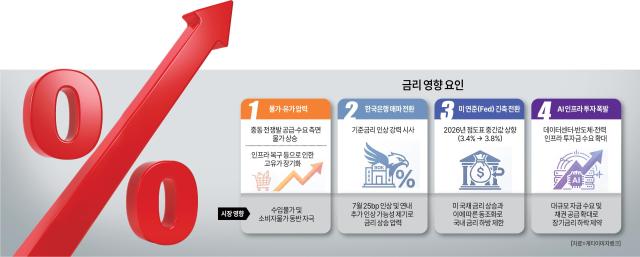
Market analysts attribute the recent rise in bond yields to inflationary pressures, expectations of additional rate hikes from the Bank of Korea, and the Federal Reserve's hawkish stance. Notably, geopolitical risks in the Middle East have kept international oil prices high, further exacerbating inflationary pressures that weigh on the bond market.
The Bank of Korea has recently indicated that inflation may remain elevated for a longer period than previously expected, raising concerns about price stability. In its revised economic outlook from May, the bank raised its forecasts for both consumer price inflation and economic growth. The market is now anticipating a 25 basis point (1 basis point = 0.01 percentage point) increase in the benchmark interest rate at the upcoming July monetary policy meeting, with the possibility of further hikes later in the year not ruled out.
The strong indication from the Bank of Korea regarding potential interest rate hikes adds to the burden on the bond market. Although the interest rate was held steady at the May monetary policy meeting, two members of the Monetary Policy Committee expressed dissenting opinions favoring a rate increase. The statement on monetary policy direction also included new language suggesting the possibility of a rate hike, which the market has interpreted as a signal to resume tightening. The simultaneous upward revision of economic and inflation forecasts is also seen as a factor driving interest rates higher.
The Federal Reserve's unexpectedly strong hawkish tone has also had a significant impact. In its recent dot plot, the Fed projected a higher future path for policy rates than previously anticipated. The median policy rate for 2026 was raised from 3.4% to 3.8%, and for 2027 from 3.1% to 3.6%. If the U.S. tightens its monetary policy, domestic interest rates are unlikely to experience downward pressure alongside rising U.S. Treasury yields.
Additionally, beyond monetary policy and inflation, the expansion of artificial intelligence (AI) investment is being highlighted as a structural factor contributing to rising long-term rates. Major global tech companies are aggressively increasing investments in data centers, semiconductors, and power infrastructure, creating significant demand for capital. Analysts believe this investment demand could exacerbate supply pressures in the bond market, limiting declines in long-term rates.
Yoon Yeo-sam, a researcher at Meritz Securities, stated, "The spread of AI is enhancing productivity and driving large-scale infrastructure investments, which is raising global economic growth rates while simultaneously increasing pressure on long-term rates. The expansion of investments in AI-related data centers, semiconductors, and power infrastructure will create structural burdens in the bond market due to increased capital demand and expanded bond supply."
However, some analysts predict that the current trend of rising rates may not persist for an extended period. If geopolitical risks in the Middle East ease and oil prices stabilize, inflationary pressures could gradually diminish.
Yoon noted, "The domestic bond market will be significantly influenced by the growth of the semiconductor industry. If stability in oil prices due to reduced geopolitical risks in the Middle East and a cooling of AI investment fervor are confirmed, both U.S. and domestic national bond yields may reach a peak in the second half of the year before entering a stabilization phase."
Market analysts suggest that if the 3-year national bond yield surpasses 4%, the "4% era" could become a reality. This would indicate a shift not just in interest rates but also a potential elevation in the medium- to long-term interest rate levels for the South Korean economy.
Kim Myung-sil, a researcher at iM Securities, explained, "If the 2- to 3-year national bonds stabilize at around 4%, it signifies that this is not merely a result of temporary supply-demand imbalances or short-term monetary tightening. It indicates that market participants are beginning to reassess the new equilibrium levels for growth rates, inflation, and benchmark interest rates, accepting a higher interest rate environment as the new standard."
* This article has been translated by AI.
Copyright ⓒ Aju Press All rights reserved.