
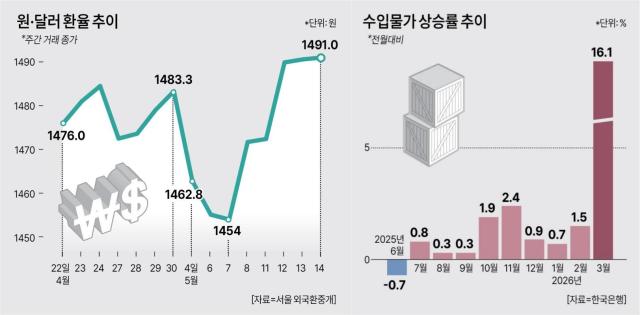
Concerns about inflation are rising in the market as international oil prices and the won-dollar exchange rate increase, coupled with the government's expansionary fiscal policy. The combination of supply shocks and fiscal expansion is raising fears of renewed inflationary pressures in the second half of the year.
According to financial sources, international oil prices have remained elevated, surpassing $100 per barrel, due to prolonged tensions in the Middle East. As of the morning of June 14, Brent crude was priced at $105.72 per barrel, while West Texas Intermediate (WTI) was at $101.04.
The won-dollar exchange rate has also fluctuated above 1,490 won, increasing the burden of import prices. The exchange rate closed at 1,491.0 won, up 0.4 won from the previous trading day. On the previous day, it briefly soared to 1,499.9 won, threatening to breach the 1,500 won mark.
The burden of import prices is already expanding rapidly. According to the Bank of Korea, the import price index surged by 16.1% in March compared to the previous month, marking the highest increase since January 1998, during the foreign exchange crisis. The rising prices of oil, gas, and raw materials are likely to push up producer and consumer prices with a time lag.
As the supply shock from the Middle East is reflected in the economy, producer prices are also rising quickly. The producer price index increased by 1.6% in March compared to the previous month, the highest rate since April 2022, following the Russia-Ukraine war. The growing burden of raw material prices is also increasing pressure on consumer prices, which rose by 2.6% last month, up from 2.2% in the previous month.
In the bond market, there are concerns that the consumer price inflation rate could return to the 3% range as early as May or June. Analysts suggest that the shock from rising international oil prices and exchange rates will be reflected in public utility fees, dining, and processed food prices, potentially intensifying inflation in the second half of the year. Choi Ji-wook, a researcher at Korea Investment & Securities, stated, "The consumer price inflation rate is expected to stabilize at the upper end of the 3% range until July, with core inflation gradually rising."
Lim Jae-kyun, a researcher at KB Securities, noted, "The peace negotiations between the U.S. and Iran are not progressing easily. Even if the Strait of Hormuz is opened, it will take considerable time for oil supply to normalize to pre-war levels, so the inflationary burden from high oil prices is likely to persist for a long time."
In this context, the government's expansionary fiscal policy is further heightening market concerns. The government is actively pursuing fiscal measures, including a supplementary budget of 26 trillion won to defend the economy. However, there are worries that increased government bond issuance and rising liquidity in the market could stimulate inflation expectations again.
Indeed, liquidity is on the rise. According to the Bank of Korea's "March Monetary and Liquidity" report, the broad money supply (M2) increased by 18.5 trillion won from the previous month, marking five consecutive months of growth. The financial market is also detecting a trend of increasing idle investment funds and short-term liquidity.
The recent rapid rise in long-term government bond yields is interpreted as a reflection of these expectations. When long-term rates rise, the interest rates on corporate bonds and loans from financial institutions also increase. This raises the cost of capital for businesses and the burden of interest, which could ultimately lead to increased prices for goods and services.
The rise in government bond yields also raises concerns about the potential for increased fiscal burdens on the government. If rising interest costs lead to additional government bond issuance, it could create a cycle where interest rates and prices push each other higher.
Shin Seong-hwan, a former member of the Bank of Korea's Monetary Policy Committee, stated on June 11, "The pressure on prices is significant, and uncertainty about future prices is also high. It appears that concerns about inflation expectations and fiscal inflation are being partially reflected, along with the impact of rising long-term U.S. interest rates."
* This article has been translated by AI.
Copyright ⓒ Aju Press All rights reserved.