
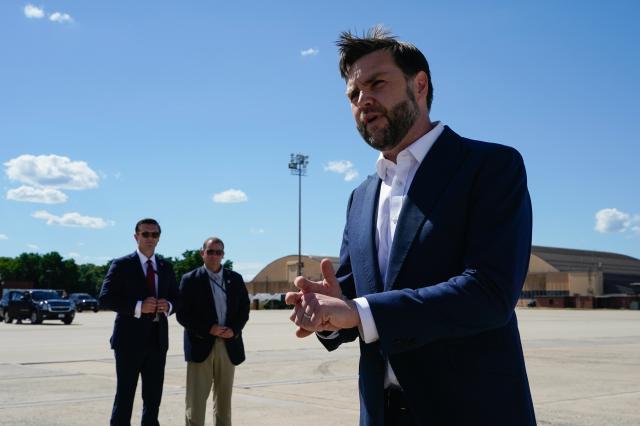
U.S. Vice President JD Vance is drawing international attention after leading negotiations in Switzerland regarding post-war discussions with Iran. His role is seen as a potential boost to his political standing as a leading candidate for the next presidential election following Donald Trump.
On June 22, Fox News reported that Vance achieved "great progress" during the weekend talks involving representatives from Iran, Pakistan, Qatar, and other nations. Although a final agreement has not yet been reached between the U.S. and Iran, the outlook for a peace accord appears promising.
This marks Vance's second time leading a U.S. delegation in negotiations with Iran, following a previous round that ended in April. That meeting also included Special Envoy Steve Witkoff and Jared Kushner, President Trump's son-in-law and peace envoy.
However, not all Republican supporters are satisfied with Vance's approach to the Iran negotiations. Critics have voiced strong objections, suggesting that Vance has capitulated to Iran, allowing the country to gain more from the peace talks than the U.S.
Conservative commentator Tucker Carlson has stated that he will not support the Republican Party in the upcoming November midterm elections, despite having backed the party for 35 years. He criticized the negotiations, claiming they sacrifice American lives at the behest of Israel, and argued that the Republican Party is failing to represent its voters, citizens, and the nation effectively. Carlson has also expressed that he will not support the Democratic Party.
The New York Times noted that how Vance proceeds with the Iran negotiations could significantly impact Republican voter turnout in the upcoming midterms and may also affect his political future as a potential successor to Trump. Karim Sadjadpour, a senior fellow at the Carnegie Endowment for International Peace, warned in an interview with the Times that Vance could be perceived as someone who designed negotiations that concede billions to adversaries while humiliating the U.S. He also pointed out that Vance may face challenges relying on cooperation from commanders of Iran's Islamic Revolutionary Guard Corps. Nevertheless, Fox News suggested that Vance's leadership in these peace talks could enhance his chances of winning in the next presidential election.
Despite the criticisms, it is clear that Vance's negotiations in Switzerland are contributing to a stabilization of the Middle East situation. CNN reported, citing maritime traffic site MarineTraffic, that while ship traffic in the Strait has not yet returned to pre-war levels, it is on the rise. Additionally, the U.S. is facilitating talks between the Lebanese militant group Hezbollah and Israel, with plans to establish a monitoring body to oversee any ceasefire violations.
However, tensions remain regarding Iran's nuclear inspections, as the U.S. and Iran continue to disagree. According to The Hill, Vance announced that the Iranian government would allow International Atomic Energy Agency (IAEA) inspectors to enter, but Iranian authorities have denied this claim.
Meanwhile, Secretary of State Marco Rubio, another prominent candidate for the next presidential election, is scheduled to visit Gulf countries, including the United Arab Emirates, Kuwait, and Bahrain, from June 23 to 25 to discuss the Iran negotiations. The U.S. State Department will also meet with representatives from Gulf Cooperation Council (GCC) member states, including Saudi Arabia, Qatar, and Oman, in Bahrain.
* This article has been translated by AI.
Copyright ⓒ Aju Press All rights reserved.