
[Editor’s Note] The special sacrifices of veterans deserve appropriate compensation and respect. In June, the month dedicated to national defense and veterans, Aju Business Daily has prepared a three-part series on the treatment of veterans. As of May, there are 25,040 surviving veterans of the Korean War and 159,540 veterans of the Vietnam War. Given that many of these veterans are in their 80s and 90s, strengthening veterans' policies is an urgent issue.
The treatment of veterans extends beyond individual compensation; it reflects a societal responsibility towards those who sacrificed for the nation and their families.
Professor Noh Seung-yong of Seoul Women's University stated on the 23rd, "Countries like the U.S., U.K., Canada, and Australia operate various family support programs in areas such as healthcare, caregiving, education, housing, and employment, beyond just veterans' benefits. South Korea also needs to prioritize expanding medical support and long-term care services for spouses of veterans."
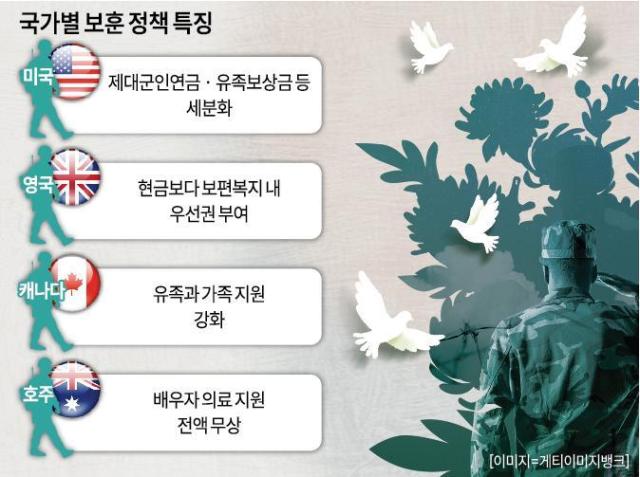
In the U.S., veterans' compensation benefits are comprehensive, including disability compensation, survivor benefits, retirement pensions, and special monthly compensation for severe disabilities.
The U.K. emphasizes universal welfare over cash compensation, while Canada has strengthened support for survivors and families. Australia issues a lifetime 'Gold Card' for medical support to spouses, and all survivor benefits are tax-exempt.
The South Korean government is also expanding healthcare, welfare, and housing support for a healthy retirement. Veterans over 65 without dependents can receive support at the Suwon Veterans Affairs Center, while those assessed for long-term care can access services at eight veterans' nursing homes nationwide (Suwon, Gwangju, Gimhae, Daegu, Daejeon, Namyangju, Wonju, Jeonju). For veterans using facilities or home care services, the government covers 60% of their out-of-pocket expenses.
Additionally, tailored care services are provided to over 3,200 veterans aged 65 and older, as well as their spouses, who have difficulty with daily activities due to age-related illnesses or disabilities. Care workers visit these veterans 1 to 3 times a week to offer health and household support, as well as dementia prevention services.
To assist homeless veterans, the government operates a housing priority supply system, ensuring that a certain number of newly constructed homes are allocated to them. In 2024, 110 veterans benefited from this program, followed by 108 in 2025. Furthermore, through the 'Honor House' initiative launched in 2023 in collaboration with the Korea Housing Finance Corporation, housing improvements were made for 20 veteran families (7 billion won), with plans to support 10 more families this year at a cost of 300 million won for a healthier living environment.
Ensuring the sustainability of veterans' organizations is also crucial. Following the approval of amendments to the National Veterans Organization Act and the Veterans Affairs Act in February, which took effect in May, the membership criteria for the Korean War Veterans Association and the Vietnam War Veterans Association have been expanded to include one family member of each veteran, allowing for the continued legacy of their history and honor.
Since 2014, the government has been conducting a project to identify and register veterans who passed away without being registered. To date, over 84,000 unregistered individuals have been identified, and efforts have been made to register them as veterans, award them certificates from the president, and facilitate their burial in national cemeteries.
The government also ensures that veterans receive proper honors in their final moments. Veterans are buried alongside their spouses at the National Cemetery, while those awarded military honors are interred at the National Memorial Cemetery. Applications for burial at the national cemetery can be submitted through the National Cemetery Burial Application System.
For veterans aged 75 and older with problematic military records or those who have received a prison sentence of one year or more, as well as veterans with health-related issues, the government provides pre-approval for burial at the national cemetery through a living burial review process, facilitating their funeral arrangements.
Additionally, upon the death of a veteran, a permanent flag and a condolence flag signed by the president are presented, along with a certificate of merit and a funeral assistance payment of 200,000 won. For those who qualify as basic livelihood recipients or have no relatives, funeral services, including personnel and supplies, are provided.
Balancing policies for 'livelihood security' and 'honor promotion' is also essential.
Ryu Hyun-sook, a senior researcher at the Korea Institute of Public Administration, noted, "While the honorarium and veterans' benefits for veterans are not insignificant compared to advanced countries, support for spouses in terms of medical and livelihood assistance is only 5-8% of what is offered in those countries. A culture of respect for veterans and their families needs to be fostered throughout society."
* This article has been translated by AI.
Copyright ⓒ Aju Press All rights reserved.