This is the seventeenth installment of AJP's Spiritual Asia series exploring the religious traditions, philosophical ideas and moral foundations that have shaped Asia's civilizations. This chapter turns to Zoroastrianism, one of the world's oldest living faiths, and examines how its teachings on truth, free will and moral responsibility continue to resonate in an age increasingly shaped by artificial intelligence.
Analects, Doctrine of the Mean, and Management and Leadership in the AI Era
Looking back at the history of human civilization, whenever an era falls into chaos, people have always asked the same questions. How should one live? What is right? Why do humans fight one another, and why do communities collapse? And where does the power to rebuild a broken order come from?
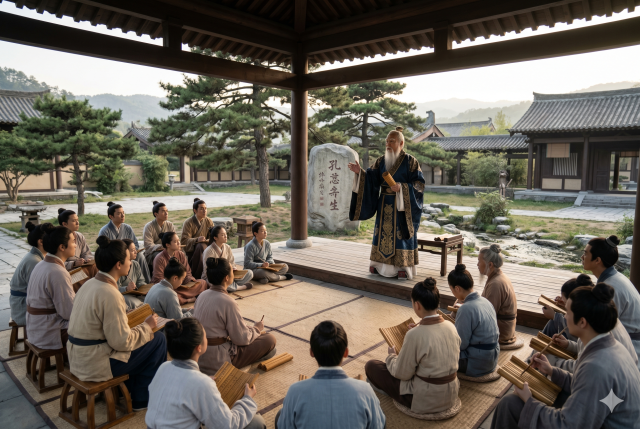
In India, Shakyamuni answered that question; in Persia, Zoroaster answered it; and in China, Confucius answered it. If Shakyamuni explored inner human suffering, Confucius explored the relationships between humans. If Laozi spoke of the order of nature and the universe, Confucius spoke of the order of human society. In that sense, Confucius was closer to an architect of civilization than the founder of a religion.
The year 551 BC, when Confucius was born, was one of the most chaotic periods in Chinese history. The authority of the Zhou Dynasty fell, and feudal lords vied for hegemony. Wars were incessant, and the people lost their livelihoods. Law became a tool of the powerful, and power belonged to those holding swords. Looking at this era, Confucius judged that the way to save the country lay not in increasing military might, but in uprighting humanity.
Today's world is not significantly different. The Russia-Ukraine war, conflicts in the Middle East, US-China strategic competition, global polarization, political division, and the spread of fake news and hatred show essentially similar chaos, differing only in appearance from the Spring and Autumn and Warring States periods. Technology has advanced the most in human history, but human wisdom fails to keep pace with its speed. This is why we read Confucius again in this era.
The starting point of Confucian thought is Ren (benevolence). Ren is not a simple charity or kindness. It is the mindset of treating people humanely. It is an attitude of respecting humans and the mental foundation for maintaining a community. Describing Ren, Confucius said it is "loving people." Translating it into modern language, it can be called the philosophy of human dignity.
Confucius especially emphasized "Zi suo bu yu, wu shi yu ren." It means what you do not wish for yourself, do not do to others. Remarkably, this single sentence connects to almost all ethical systems of human civilization. This is true for the Golden Rule of Christianity, the compassion of Buddhism, and the brotherhood of Islam. It shows that although civilizations differ, human conscience ultimately flows toward the same place.
The teachings of Confucius are concentrated in the Analects. The Analects is not a simple philosophy book. It is a textbook of human studies, a leadership manual, and a dialogue containing life wisdom. This is why global business schools still study the Analects today.
The first sentence of the first chapter of the Analects is famous.
"Xue er shi xi zhi, bu yi yue hu."
To learn and practice it at times. Is it not a pleasure?
Confucius viewed learning as the essence of life. Humans are not born complete but grow throughout their lives. Indeed, the common denominator of the world's top companies lies in continuous learning. The reason Apple, Microsoft, Amazon, and Nvidia in the United States are strong is not just because of technology. It is because they are learning and changing organizations.
Satya Nadella, who revived Microsoft as one of the world's top companies, said first upon taking office, "Let's change from a 'know-it-all' culture to a 'learn-it-all' culture." An organization that thinks it knows everything declines, but a learning organization grows. It is no exaggeration to say that this is a modern expression of "Xue er shi xi zhi" emphasized by Confucius 2,500 years ago.
Confucius also emphasized the Junzi (exemplary person). A Junzi is not a person with power. Not a person with a lot of money. Not a person in a high position. A Junzi is a person who can govern oneself. Confucius said, "The Junzi thinks of righteousness, while the small person thinks of profit." This does not mean denying profit. It means thinking of principles before profit.
Indeed, great companies usually stuck to principles. Kazuo Inamori, known as Japan's god of management, emphasized the philosophy of "doing the right thing in the right way" throughout his life. He viewed management not as a money-making technique but as a process of self-cultivation to grow human beings. His management philosophy closely resembles the self-cultivation (Xiushen) of Confucianism.
Similar examples can be found in South Korea. Numerous companies grew during the early stages of industrialization, but the ones that survived long were not simply those with superior technology. Companies that valued trust and talent cultivation ultimately secured sustainability. Conversely, companies obsessed only with short-term profits disappeared into history. Confucius's theory of Junzi applies directly to corporations.
However, to properly understand Confucianism, the Analects alone is insufficient. One must encounter the Doctrine of the Mean.
Many people think of the Mean (Zhongyong) as compromising moderately. However, that is the biggest misunderstanding of the Mean. The Mean is not a gray zone. The Mean is not losing one's center. It is not running to extremes. It is maintaining balance.
The Doctrine of the Mean states:
"When joy, anger, sorrow, and pleasure have not yet arisen, it is called the Mean; when they arise and all hit the proper measure, it is called Harmony."
This does not mean suppressing human emotions. It means do not become a slave to emotions. Do not lose principles even when angry, do not be arrogant even when successful, and do not despair even when failing.
In fact, one of the common traits of global business leaders is a sense of balance. An excellent CEO possesses both optimism and realism simultaneously. They pursue innovation while managing risk. They trust employees while maintaining principles. This is precisely the management of the Mean.
Today, the world lives in an era of extremes. Politics is also becoming polarized. Social media grows by feeding on anger. Algorithms push people further into biased information. Generative AI also contributes to human progress if utilized well, but can cause massive chaos if misused. The virtue most needed at this time is the Mean.
The Mean does not mean standing in the exact middle. It does not mean turning away from truth and justice. Rather, it means controlling emotions, desires, prejudices, and self-righteousness to realize truth and justice. The Mean is not weakness but the power of moderation.
Confucius, talking about the process of human growth, emphasized "Xiushen Qijia Chiguo Pingtianxia." It means cultivating oneself, regulating one's family, governing the state, and bringing peace to the world. The order is important. Confucius emphasized self-reform before state reform.
Today, many leaders say they will change the world. However, there are not a few cases where they fail to govern themselves. Attaining power is difficult, but moderating power is even more difficult. This is why the philosophy of self-cultivation emphasized by Confucius 2,500 years ago remains alive today.
With the beginning of the AI era, humanity stands before a new question. Artificial intelligence can remember more information than humans. It can calculate faster. However, AI cannot have a conscience. AI cannot replace human dignity. As technology advances, the value of humanity becomes even more important.
The greatest legacy left by Confucius is neither a massive empire nor a splendid building. It was faith in humanity. It was faith in education. And it was faith in human potential to cultivate oneself.
If the Analects showed the Tao of humanity, the Doctrine of the Mean shows how to walk that path without wavering. One speaks of human dignity, and the other speaks of human balance. And where the two meet, we finally discover the figure of the Junzi that Confucius dreamed of.
The reason Confucius is alive today, even after 2,500 years, is because he is not a sage of China alone but a teacher of human civilization. His teachings—to ask for the Tao of humanity all the more in an era of chaos, to find balance all the more in an era of extremes, and to protect humanity all the more in an era of technology—remain a work in progress.
Copyright ⓒ Aju Press All rights reserved.