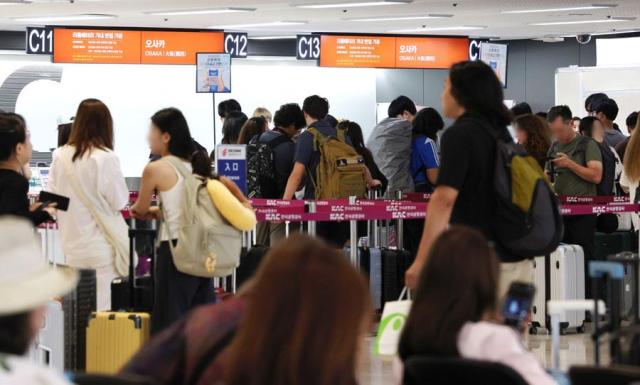
SEOUL, June 24 (AJP) - More South Koreans have been traveling to Japan amid the weak yen, while far fewer Japanese tourists are visiting Seoul.
According to entry and departure records from the Ministry of Justice, nearly 9.46 million South Koreans headed to Japan last year, compared with about 3.65 million Japanese travelers who visited South Korea during the same period.
Japan also remained the most popular overseas destination for South Koreans this year. In April alone, more than 850,000 people flew to Japan, accounting for 37.2 percent of all outbound travelers from South Korea. Combined with China, the two destinations made up more than half of all South Korean travelers leaving the country that month.
Industry watchers attribute the trend largely to the weak yen, which has made travel and shopping in Japan more affordable for South Koreans. Short flight times and expanded air routes to smaller Japanese cities have also boosted demand.
But that pushed their spending in the neighboring country to a record high last year, widening South Korea's travel deficit with Japan to an all-time high as the number of Japanese tourists visiting Seoul remained comparatively low.
According to data from the Bank of Korea (BOK) released earlier this week, South Korea's travel deficit with Japan reached US$5.75 billion last year, the highest since the central bank began compiling relevant figures in 1998.
South Korea's travel balance with Japan recorded a surplus during the coronavirus pandemic in 2020, when it stood at $368.70 million, and in 2021, when it reached $129.90 million, but turned into a deficit of $575.70 million in 2022. The deficit continued to widen in 2023 to $4.07 billion and in 2024 to $4.91 billion.
The deficit with Japan was larger than those recorded with other countries and regions. Last year, South Korea's travel deficits stood at $4.71 billion with the U.S., $2.05 billion with Southeast Asia, $912 million with the European Union, and $23 million with the Middle East.
According to entry and departure records from the Ministry of Justice, nearly 9.46 million South Koreans headed to Japan last year, compared with about 3.65 million Japanese travelers who visited South Korea during the same period.
Japan also remained the most popular overseas destination for South Koreans this year. In April alone, more than 850,000 people flew to Japan, accounting for 37.2 percent of all outbound travelers from South Korea. Combined with China, the two destinations made up more than half of all South Korean travelers leaving the country that month.
Industry watchers attribute the trend largely to the weak yen, which has made travel and shopping in Japan more affordable for South Koreans. Short flight times and expanded air routes to smaller Japanese cities have also boosted demand.
But that pushed their spending in the neighboring country to a record high last year, widening South Korea's travel deficit with Japan to an all-time high as the number of Japanese tourists visiting Seoul remained comparatively low.
According to data from the Bank of Korea (BOK) released earlier this week, South Korea's travel deficit with Japan reached US$5.75 billion last year, the highest since the central bank began compiling relevant figures in 1998.
South Korea's travel balance with Japan recorded a surplus during the coronavirus pandemic in 2020, when it stood at $368.70 million, and in 2021, when it reached $129.90 million, but turned into a deficit of $575.70 million in 2022. The deficit continued to widen in 2023 to $4.07 billion and in 2024 to $4.91 billion.
The deficit with Japan was larger than those recorded with other countries and regions. Last year, South Korea's travel deficits stood at $4.71 billion with the U.S., $2.05 billion with Southeast Asia, $912 million with the European Union, and $23 million with the Middle East.
Copyright ⓒ Aju Press All rights reserved.