
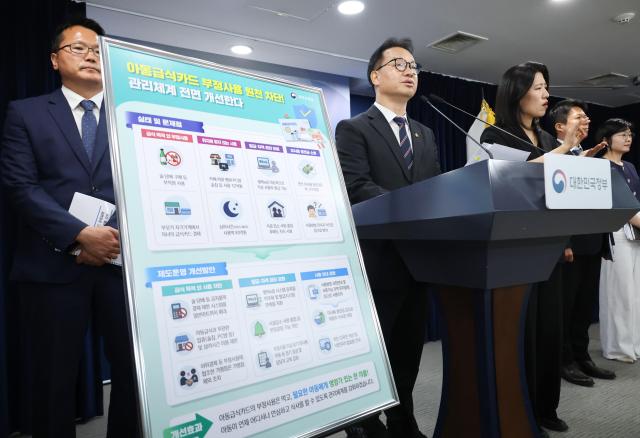
According to Yonhap News on June 24, the Government Coordination Office's Anti-Corruption Task Force, in collaboration with the Ministry of Health and Welfare, released the findings of an investigation into the operation of meal cards for food-insecure children.
The investigation revealed that in 13 out of 17 metropolitan and provincial areas nationwide, there were confirmed cases of alcohol and tobacco purchases using meal cards. While convenience stores have technical barriers to prevent such transactions, some general supermarkets lacked adequate restrictions, allowing misuse to occur.
Additionally, instances were found where parents retained the meal cards issued to their children, making false transactions up to the daily limit and using the funds for purchasing household items.
Moreover, over 14% of all meal cards were used at establishments with little direct relevance to meals, such as private academies, beauty salons, bars, and PC rooms. Payments made during late-night hours, from 10 p.m. to 6 a.m., accounted for approximately 4.4% of total transactions, amounting to 9.3 billion won.
The investigation also uncovered poor management practices. Some local governments failed to register card information in the integrated welfare information management system, 'Happiness e-Um,' or did not properly reflect changes in eligibility due to children's deaths or admissions to facilities.
In some cases, parents continued to use meal cards belonging to children who had died or were under protective measures due to abuse.
To prevent misuse, the government plans to implement item-specific payment restrictions in general supermarkets and limit transactions at establishments like bars and during late-night hours. Additionally, local governments will be required to register information in the Happiness e-Um system, and regular checks will be conducted for changes in eligibility and suspected misuse. To reduce the issue of unspent funds, the government also plans to enhance the convenience of meal card usage by providing notifications of available balances via text messages.
* This article has been translated by AI.
Copyright ⓒ Aju Press All rights reserved.