
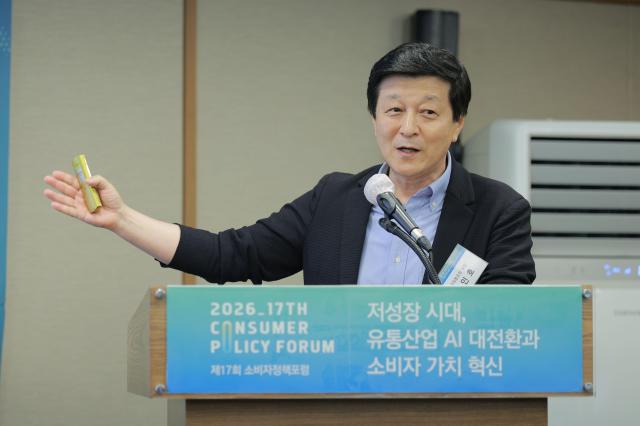
Kim In-ho, chairman of the Korea Retail Forum, delivers a keynote speech on 'The Era of Creative Retail' at the 17th Consumer Policy Forum in Seoul on June 25, 2026. [Photo by Yu Dae-gil]
"In the future, artificial intelligence (AI) will suggest and recommend the optimal products to consumers," said Kim In-ho, chairman of the Korea Retail Forum, during the first keynote speech at the 17th Consumer Policy Forum held at the Korea Press Center in Jung-gu, Seoul, on June 25. Kim addressed the themes of expanding consumer value, the era of hyper-personalization, and the paradigm shift in retail driven by AI.
Despite concerns about consumer contraction due to low growth, high inflation, and demographic changes, Kim noted that the recovery in the semiconductor market, strong exports, rising stock prices, and an increase in foreign visitors to South Korea have led to unexpectedly robust performance in some retail channels, such as department stores. He stated, "Since the second half of last year, we have seen trends that differ from expectations. The recovery in the semiconductor market, strong exports, rising stock prices, increased luxury consumption, and a rise in foreign visitors have quickly improved market sentiment." He added that this shift is also reflected in the recent rise in department store stock prices.
Kim explained that while the growth factors for department stores in 2011 included asset effects, growth of large manufacturing companies, and enhanced promotions, this year, key variables include rising stock prices, semiconductor and export performance, and demand from foreign tourists.
However, he diagnosed that the retail industry has entered a phase of polarization. Kim remarked, "Economically, we are experiencing a mix of low growth, high inflation, and a semiconductor boom, while socially, we are facing declining populations, aging, an increase in single-person households, and deepening polarization." He continued, "Politically and institutionally, income redistribution, retail regulations, and labor-related legislation are influencing the sector, while technologically, AI, agentic commerce, and AX (AI transformation) management technologies are reshaping the retail landscape."
Kim also highlighted the changing nature of consumer value. He noted that while past consumption focused on 'ownership' related to basic needs, it has expanded to include experiences and activities such as hobbies, relaxation, and knowledge during periods of growth. He emphasized, "Retail must go beyond merely selling products to enhance its capabilities in information delivery, recommendations, and suggestions. Consumers express their tastes and identities through shopping, making emotional value and self-expression key drivers of consumption."
Looking ahead, Kim predicted that AI will alter the competitive dynamics of the retail industry. He explained, "AI 1.0 automated and optimized existing tasks like demand forecasting, inventory placement, and delivery efficiency. AI 2.0 will involve consumers delegating purchasing decisions to AI agents without direct exploration. AI 3.0 could lead to on-demand retail, where production begins immediately upon order placement."
Kim stressed that the focus of next-generation retail competitiveness will shift from location and store openings to understanding customers and data asset management. He stated, "While traditional retail relied on good locations and product inventory, future success will depend on understanding individual customers, personalized product suggestions, demand forecasting, and flexible delivery based on living areas. The retail industry must transition to enhance customer lifetime value and increase loyalty and usage frequency."
* This article has been translated by AI.
Copyright ⓒ Aju Press All rights reserved.