
The telecom market has struggled with stagnant growth in recent years, as the number of wireless subscribers has not increased as it once did. Last year, a hacking incident further worsened the situation. SK Telecom, KT, and LG Uplus are seeking new opportunities through AI transformation. Perhaps due to this, despite the recent stock market boom, the stock price increases for the three telecom companies have been relatively modest. Nonetheless, there are winners and losers. Over the past year, SK Telecom emerged as the winner in the telecom sector based on stock price growth, while LG Uplus remained stagnant and KT experienced a decline.
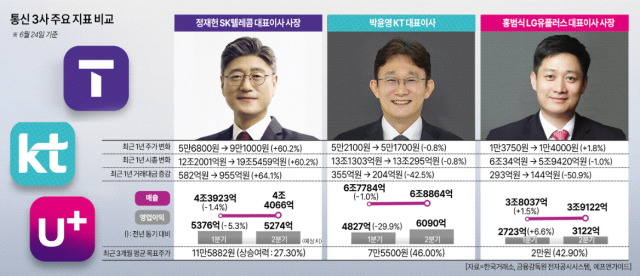
According to the Korea Exchange and the Financial Supervisory Service's electronic disclosure system, as of June 24, SK Telecom's stock price rose 60.2% over the past year, from 56,800 won to 91,000 won. In contrast, KT's stock price fell 0.8%, from 52,100 won to 51,700 won, while LG Uplus saw a modest increase of 1.8%, from 13,750 won to 14,000 won. SK Telecom also leads in market capitalization, valued at 19.5459 trillion won, significantly larger than KT's 13.3029 trillion won and more than three times LG Uplus's 5.942 trillion won. Investor interest has centered on SK Telecom, with trading volume increasing by 64.1% to 95.5 billion won, while KT and LG Uplus saw declines of 42.5% and 50.9%, respectively.
Supply and demand varied among the stocks. From June 24 of last year to June 24 of this year, institutional investors actively purchased SK Telecom shares, with a net buy of 198.6 billion won. Foreign investors showed a preference for LG Uplus, with a net buy of 222.5 billion won, marking the only net buying advantage. KT experienced a relatively stable supply and demand situation, with institutional buying balanced by foreign and individual selling.
In terms of earnings, the rankings among the three companies differ. In the first quarter of this year, LG Uplus demonstrated the most stability, with operating profit increasing by 6.6% from 255.4 billion won to 272.3 billion won, and revenue rising by 1.5% from 3.7481 trillion won to 3.8037 trillion won, making it the only company among the three to see growth in both revenue and operating profit. This growth is partly attributed to the influx of subscribers following last year's hacking incident at SK Telecom. Conversely, SK Telecom reported a decrease in operating profit of 5.3% and a 1.4% drop in revenue. KT also saw a decline, with operating profit down 29.9% and revenue down 1.0%.
However, the outlook for the second quarter is mixed. According to FnGuide, KT's operating profit is expected to rise by 26.2% to 609 billion won compared to the first quarter. LG Uplus is projected to see its operating profit increase by 14.7% to 312.2 billion won. In contrast, SK Telecom's consensus for second-quarter operating profit is estimated at 527.4 billion won, a 1.9% decrease from the first quarter.
Analysts maintain a positive outlook for the telecom sector. The average target stock prices over the past three months are 115,882 won for SK Telecom, 75,500 won for KT, and 20,000 won for LG Uplus. In terms of potential for stock price increases, KT leads with 46.0%, followed by LG Uplus at 42.9% and SK Telecom at 27.3%.
Kim Hong-seok, a researcher at Hana Securities, stated, "Overall, we expect there will not be much negative news, and investor interest will likely focus on increased shareholder returns due to improved earnings and the impact of AI radio access network (AI RAN) implementation on tariff restructuring."
* This article has been translated by AI.
Copyright ⓒ Aju Press All rights reserved.