
SEOUL, August 18 (AJP) - Patients with the deadliest form of brain cancer usually learn whether a drug works by taking it and waiting for the next scan. A South Korean research team has built a chip that can run that test first, outside the body, using cells taken from the patient's own tumor.
The waiting is not free. Glioblastoma kills most patients within 15 months of diagnosis even after surgery, radiation and chemotherapy, and fewer than five percent live five years. Four months spent on a drug that never reaches the tumor is a third of what a patient has left.
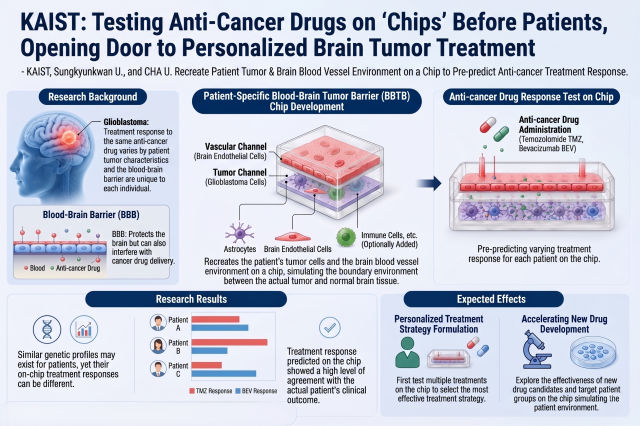
KAIST said Tuesday that a team led by mechanical engineering professor Ahn Song-ih built a patient-specific chip that predicted how three glioblastoma patients would respond to treatment, and that those predictions closely tracked how the patients actually fared. The work was done with Sungkyunkwan University's Ahn Jung-ho, neurosurgeon Lim Jae-joon at Bundang CHA Medical Center and CHA University's Kang Youn-jung, and appeared June 27 in the journal Small.
Glioblastoma is the most common malignant brain tumor in adults and among the hardest to treat. It does not sit as a neat lump a surgeon can lift out. Its cells crawl outward into healthy brain tissue, and that ragged edge, called the tumor margin, is where the disease resists treatment most stubbornly and where it comes back. The KAIST chip models the margin rather than the center of the tumor.
Getting a drug to that edge is the second problem. The brain is walled off from the bloodstream by the blood-brain barrier, a lining of tightly sealed vessel cells that keeps harmful substances out of brain tissue. It keeps most cancer drugs out as well.
When a tumor takes hold, it remodels the vessels around it. The wall turns leaky in some places and stays shut in others, and how leaky it gets, and where, differs from one patient to the next.
That variation has been largely invisible to the tests doctors use now. Predictions about who will respond to what rest mostly on the tumor's genes and biomarkers, which describe the cancer cells and say nothing about the road a drug has to travel to reach them.
The chip closes that gap by building the road. Inside a small transparent device threaded with fluid channels, the researchers grew tumor cells taken from newly diagnosed patients alongside human brain vessel cells and astrocytes, the star-shaped support cells that make up much of normal brain tissue.
The vessel cells line an upper channel and stand in for a blood vessel. The tumor cells and astrocytes sit below in a three-dimensional network and stand in for the brain the tumor is invading. A porous membrane separates the two, so a drug delivered into the vessel channel has to cross the barrier the way it would in a patient. The design leaves room to add immune cells and the cells that wrap around blood vessels.
The team made three chips, one from each of three patients, and dosed them with two drugs. Temozolomide is the standard chemotherapy given after surgery and attacks the cancer cells directly. Bevacizumab goes after the supply line, blocking the growth of the new blood vessels a tumor needs to keep expanding.
Gene testing had suggested the three patients would respond in much the same way. On the chips, they did not. Each barrier behaved differently, and so did the response to each drug. Set against the treatment records of the patients the chips were built from, the chip results lined up.
Three patients make a signal rather than a proven test. The comparison was also made against outcomes already recorded, not in a study designed to put the chip's predictions on the line before treatment began. Nothing here has yet shown that a chip can safely steer a real treatment decision, and the researchers said the platform has to be checked against a far larger group of patients first.
Ahn said Tuesday in a statement released by KAIST that growing patient tumor cells together with the barrier makes it possible to "evaluate treatment responses that differ from patient to patient in a way that is close to reality." She said the team hopes to develop the work into a preclinical platform for personalized treatment strategies and drug development.
The first authors are Ryoo Min-su, a doctoral student in KAIST's mechanical engineering department, and Lee Ga-eun, a doctoral student at Sungkyunkwan University. Small selected the paper for its front cover.
The second use is further from the clinic and potentially larger. Brain cancer drugs fail for two separate reasons, either because they cannot kill the cells or because they never arrive. A candidate that looks powerful against tumor cells in a dish can be worthless in a person, and that failure usually surfaces late, after years and hundreds of millions of dollars.
Regulators have begun pushing toward exactly this kind of testing. The U.S. Food and Drug Administration's roadmap for reducing animal testing, released in April 2025, named organ-on-a-chip systems among the methods it wants to see take the place of animal studies. The agency put its reasoning in one line. More than 90 percent of drugs that clear animal safety testing go on to fail in humans.
(Reference Information)
Journal/Source: Small
Title: Human Blood-Brain Tumor Barrier on a Chip to Investigate Personalized Treatment for Glioblastoma Patients
Link/DOI: 10.1002/smll.202506712
Copyright ⓒ Aju Press All rights reserved.
