
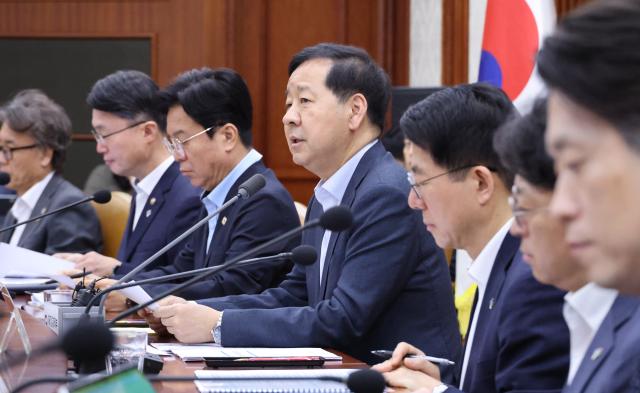
Deputy Prime Minister and Minister of Finance and Economy Koo Yun-cheol announced during a meeting of the Emergency Economic Headquarters and the Economic Relations Ministers' Meeting that the new oil price cap will reflect the drop in international prices and the economic pressures faced by citizens. He stated, "We will lower the 7th oil price cap considering the decrease in international oil prices, the burden on the public, and fiscal conditions," adding that detailed information will be released at 7 p.m. today.
The government assessed that external uncertainties have gradually eased since the signing of a memorandum of understanding following the end of the Middle Eastern conflict. After a significant rise, international oil prices have begun to fall, leading to a decrease in the average domestic diesel price, which has dropped below 2,000 won per liter for the first time in about two months.
The average domestic diesel price rose to 2,006.1 won per liter on May 7 but fell to 1,998.4 won on June 25. The average gasoline price was recorded at 2,006.6 won per liter on the same day.
However, the government pointed out that uncertainties remain in the negotiations following the Middle Eastern conflict. With ongoing challenges such as high inflation, high exchange rates, high interest rates, and slowing employment, the government plans to adjust emergency response measures gradually.
Koo noted, "Considering the uncertainties in the Middle East, we have maintained the 6th oil price cap this week," and emphasized that the government is committed to stabilizing and recovering the economy while preparing for economic normalization and significant growth following the conflict.
During the meeting, strategies for stabilizing living costs and alleviating burdens on the public were discussed. The government aims to manage the consumer price inflation rate within 3% in the second half of the year by injecting 1 trillion won into measures such as discounts on agricultural, livestock, and fishery products, reducing essential living costs, and supporting small businesses affected by high oil prices.
As part of this initiative, the government plans to implement the largest discount event ever for all items eligible for support in July and August. To stabilize egg prices, it will also increase the import volume of fresh eggs by more than six times, adding 200 million eggs.
To ease energy burdens, the government will freeze major public utility rates, including electricity and gas, in the second half of the year and temporarily exempt the LPG butane sales tax until the end of the year. Additionally, households receiving energy vouchers for kerosene and LPG will receive an extra 147,000 won.
For small businesses affected by high oil prices, the government will double the scale of the "Small Business Hope Dream" loan from 1.5 trillion won to 3 trillion won. Incentives such as additional discount cashbacks will be strengthened for businesses offering fair prices.
Koo concluded, "Following today's announcement of measures to address high inflation, we will swiftly prepare and announce support plans for small and medium-sized enterprises affected by high exchange rates."
* This article has been translated by AI.
Copyright ⓒ Aju Press All rights reserved.