
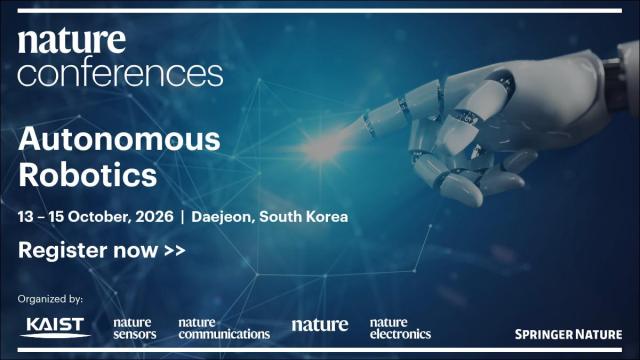
SEOUL, June 26 (AJP) - Nature will hold its first conference dedicated to autonomous robotics at the Korea Advanced Institute of Science and Technology in the central city of Daejeon, South Korea, this October, bringing together some of the world's leading researchers to debate the future of intelligent machines, the prominent institute said Friday.
The three-day event, titled "2026 Nature Conference: Autonomous Robotics," runs from October 13 to 15 on the Korea Advanced Institute of Science and Technology (KAIST) campus. According to KAIST, which co-hosts the conference alongside Nature, the journal has held more than 50 academic events on topics ranging from artificial intelligence to biotechnology and energy, with institutions including Princeton University and Tsinghua University. A conference centered solely on autonomous robotics is a first.
KAIST is not an arbitrary venue. The institution developed South Korea's first robotic arm, known as KAISEM, as well as an early intelligent service robot called AMI and HUBO, the humanoid robot that became a symbol of the country's robotics ambitions. The choice of Daejeon signals that the conference is as much about showcasing where the field stands as it is about deciding where it should go.
Four keynote speakers will anchor the program. Sami Haddadin, vice president for research at Mohamed bin Zayed University of Artificial Intelligence in Abu Dhabi, developed the Franka Emika Panda, a seven-axis collaborative robot capable of fluid, human-like arm movement. Kwon In-so, head of the Physical AI Research Division at the Korea Institute of Science and Technology (KIST) and a professor in KAIST's Department of Electrical and Electronics Engineering, has led domestic research in computer vision and robot intelligence and was named among the world's top 100 AI talents. Aude Billard, a professor at the Swiss Federal Institute of Technology Lausanne (EPFL), is a leading authority on robot manipulation control and machine learning algorithms. Steven H. Collins of Stanford University specialises in exoskeleton systems and wearable robotics.
The programme covers robot intelligence, autonomous field operation, and human-centered robotics across two days of sessions. Topics include neuromorphic artificial intelligence for autonomous drones, multimodal robotics, next-generation tactile sensor design, and advances in physical AI. Attendees will have access to one-on-one meetings with Nature editors and structured sessions on international research collaboration and academic publishing.
KAIST will use the conference to put several of its flagship projects on display. Kong Kyoung-chul's WalkON Suit, an exoskeleton robot that won the Cybathlon international competition twice in succession, will be among the exhibits. The Cybathlon, held every four years in Switzerland, challenges teams to develop assistive technologies for people with disabilities and is sometimes called the Cyborg Olympics. Park Hae-won's quadruped robot Hound, which set a Guinness World Record for a 100-meter run, is also scheduled for demonstration, as are Sim Hyun-chul's PIBOT, a humanoid robot designed to operate aircraft, and DreamWaQ, a vision-based quadruped locomotion system developed by Myung Hyun.
"Robot intelligence and autonomous operation technologies are the key technologies that will transform future industries and society," said Yoo Seung-hyeop, head of KAIST's Department of Electrical and Electronics Engineering. "We hope this conference will become a starting point for expanding global research collaboration and accelerating innovation in autonomous robotics."
KAIST President Lee Kwang-hyung framed the event in broader terms. "The next stage of AI is the physical world, and autonomous robotics is the key technology that will lead that change," he said. "Through this conference, KAIST will work with world-class researchers to present the direction of future robot technology and lead the establishment of a global innovation ecosystem."
The conference will be conducted in English and is open to researchers, students, and industry professionals working in autonomous robotics. Early registration closes on July 31. General registration runs until October 6.
Copyright ⓒ Aju Press All rights reserved.
