
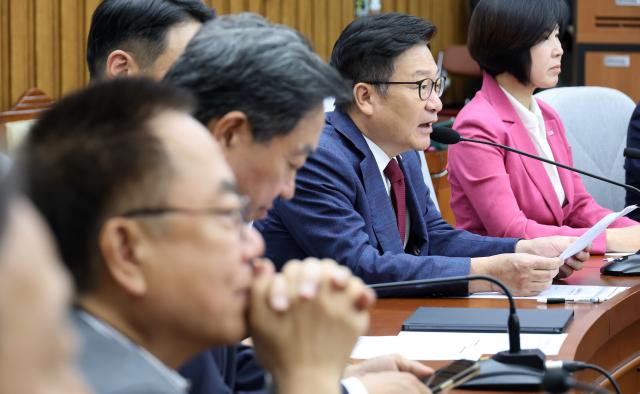
Jung Jeom-sik, leader of the People Power Party, speaks at a National Assembly countermeasure meeting on June 26. [Photo=Yonhap News]
Jung Jeom-sik, the leader of the People Power Party, criticized the government on June 26, stating that its decision not to submit a proposal on supplementary investigation authority represents a relinquishment of its responsibility for governance.
During a countermeasure meeting at the National Assembly, Jung noted, "President Lee Jae-myung has previously emphasized the need for partial retention of supplementary investigation authority," adding, "The government has decided to forgo this authority solely to secure victory in the upcoming Democratic Party convention."
He further stated, "Since the government has abandoned its role, it falls to the National Assembly's Judiciary Committee to take charge. Can we trust that role to the hardliners of the Democratic Party?" He emphasized that the need for the People Power Party to take the chair of the Judiciary Committee has increased.
Earlier, Prime Minister Kim Min-seok explained in a briefing that the government finalized its stance on abolishing supplementary investigation authority after considering various opinions. He stated, "We believe it is preferable not to submit a separate government proposal to allow for free discussion in the National Assembly."
As a result, the discussion on amending the Criminal Procedure Act, including the fate of supplementary investigation authority, has shifted to the National Assembly. Jung raised concerns, stating, "Without a control mechanism like a 'Chair of the Opposition Judiciary Committee,' the hardliners in the Democratic Party's Judiciary Committee could hastily legislate and irreversibly damage the investigative functions related to public safety."
Additionally, concerns were raised during the meeting regarding the soaring won-dollar exchange rate. Jung Hee-yong, the party's secretary general, pointed out that the exchange rate has remained above 1,540 won for two consecutive days based on weekly trading closing prices and has exceeded 1,500 won for 40 trading days.
He continued, "Despite the Middle East conflict entering a ceasefire phase and international oil prices dropping, there are no signs of stabilization in the prices felt by ordinary citizens," urging the government to focus on resolving the 'triple crisis' of high exchange rates, high prices, and high interest rates."
During a countermeasure meeting at the National Assembly, Jung noted, "President Lee Jae-myung has previously emphasized the need for partial retention of supplementary investigation authority," adding, "The government has decided to forgo this authority solely to secure victory in the upcoming Democratic Party convention."
He further stated, "Since the government has abandoned its role, it falls to the National Assembly's Judiciary Committee to take charge. Can we trust that role to the hardliners of the Democratic Party?" He emphasized that the need for the People Power Party to take the chair of the Judiciary Committee has increased.
Earlier, Prime Minister Kim Min-seok explained in a briefing that the government finalized its stance on abolishing supplementary investigation authority after considering various opinions. He stated, "We believe it is preferable not to submit a separate government proposal to allow for free discussion in the National Assembly."
As a result, the discussion on amending the Criminal Procedure Act, including the fate of supplementary investigation authority, has shifted to the National Assembly. Jung raised concerns, stating, "Without a control mechanism like a 'Chair of the Opposition Judiciary Committee,' the hardliners in the Democratic Party's Judiciary Committee could hastily legislate and irreversibly damage the investigative functions related to public safety."
Additionally, concerns were raised during the meeting regarding the soaring won-dollar exchange rate. Jung Hee-yong, the party's secretary general, pointed out that the exchange rate has remained above 1,540 won for two consecutive days based on weekly trading closing prices and has exceeded 1,500 won for 40 trading days.
He continued, "Despite the Middle East conflict entering a ceasefire phase and international oil prices dropping, there are no signs of stabilization in the prices felt by ordinary citizens," urging the government to focus on resolving the 'triple crisis' of high exchange rates, high prices, and high interest rates."
* This article has been translated by AI.
Copyright ⓒ Aju Press All rights reserved.