
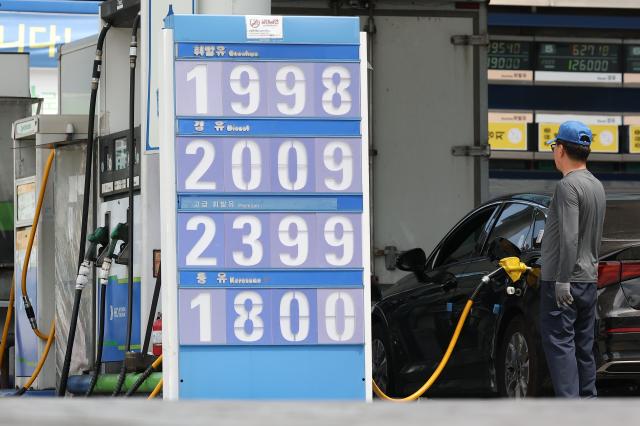
According to relevant government departments on June 26, officials are reviewing the extent of the price reduction to ensure that the drop in international oil prices is reflected more swiftly in domestic retail prices. The plan is to encourage a decrease in gas station prices to maintain stability in living costs.
President Lee Jae-myung emphasized the need for swift and bold measures, including adjustments to the maximum price system, during a senior secretary meeting the previous day, reiterating the government's commitment to stabilizing living conditions.
Similarly, Minister of Trade, Industry and Energy Kim Jeong-kwan stated at a press conference on June 22 that the current oil price levels have decreased in anticipation of potential conflicts, indicating that there is a rationale to lower the maximum prices.
The government's consideration of adjusting the maximum oil prices comes as international oil prices have stabilized rapidly, yet domestic consumers are still experiencing high fuel costs.
Recently, international oil prices have largely reversed the sharp increases seen immediately after the outbreak of conflict, thanks to easing tensions in the Middle East and alleviating concerns over crude oil supply. However, on June 25, the UK Maritime Trade Operations (UKMTO) reported receiving a report of an attack on a cargo ship near the Strait of Hormuz, highlighting renewed geopolitical risks.
On the New York Mercantile Exchange, West Texas Intermediate (WTI) for August delivery closed at $71.92 per barrel, up $1.58 (2.25%) from the previous trading day. Meanwhile, Brent crude for August delivery rose $1.52 (2.06%) to $75.26 per barrel, marking a rebound after five consecutive trading days of decline.
However, market analysts suggest that this increase may be a short-term rebound due to geopolitical factors, and the overall trend of stability in international oil prices is expected to continue.
In contrast, domestic gas station prices remain high. According to the Korea National Oil Corporation's Opinet, as of 9 a.m. on June 26, the national average gasoline price was 2,006.19 won per liter, and diesel was 1,997.26 won, still hovering around the 2,000 won mark.
The reluctance of consumer prices to decrease despite falling international oil prices is attributed to the lag in inventory adjustments. Refineries and gas stations typically receive supplies every 2 to 3 weeks, meaning they must first sell off existing high-priced stock. Additionally, the government's established maximum oil prices are seen as a factor that constrains the speed of price reductions.
Currently, the maximum oil prices, which were adjusted on March 27, remain at 1,934 won per liter for gasoline, 1,923 won for diesel, and 1,530 won for kerosene, unchanged for about three months. While this system initially served as a safety net to prevent soaring prices, it is now viewed as a benchmark that limits the pace of domestic price declines as international prices stabilize.
In response, the government plans to announce the seventh maximum oil price system later today, which will include the extent of the price reductions. Deputy Prime Minister and Minister of Economy and Finance Ku Yun-cheol stated at a price-related ministerial meeting that the maximum oil prices will be lowered from their current levels but will be maintained until consumer prices stabilize.
* This article has been translated by AI.
Copyright ⓒ Aju Press All rights reserved.