
The dynamics of warfare are changing. The era where victory depended solely on troop size and firepower is fading. Recent conflicts in Ukraine and the Middle East have demonstrated that drones, AI, unmanned systems, and data-driven command and control are fundamentally altering modern warfare. Even smaller forces can leverage AI to make quicker assessments and execute more precise strikes.
To adapt to these changes, Minister of National Defense An Gyu-baek has proposed an 'AI and advanced science and technology-based smart elite military' as the core vision for defense reform. This involves redesigning troop structures and capabilities around AI, establishing a combined combat system of manned and unmanned forces, and promoting an overall transition to AI in defense (AX). He views AI not just as a new technology but as a strategic asset essential for South Korea's security.
The question is clear.
Can South Korea truly rise to become a world leader in AI defense?
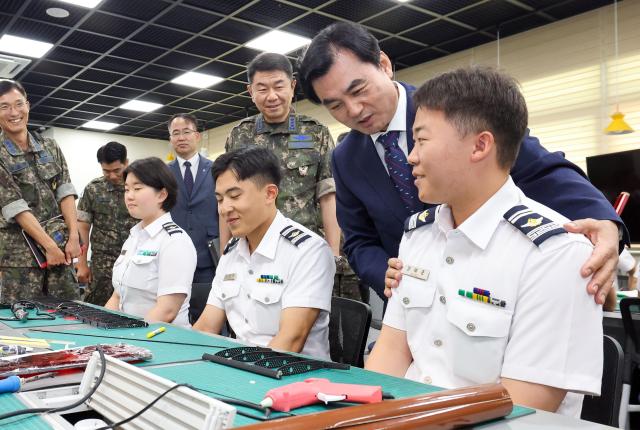
Transitioning from a troop-centric military to an AI-centric one
South Korea's defense faces a new reality.
The threat from North Korea's nuclear and missile capabilities continues to evolve, while the pool of military personnel is rapidly diminishing due to population decline.
The traditional approach of increasing troop numbers to ensure security has reached its limits.
Minister An acknowledges this reality and emphasizes the need to shift the direction of defense reform toward AI and advanced technologies. He stated, "To win in future warfare, we must comprehensively redesign troop structures and capabilities." This is not merely about introducing new weapons.
It represents a paradigm shift in defense, redesigning military organization, operational concepts, education, and command systems to align with AI.
AI is not an option but a necessity.
Minister An defines AI as "an essential element of military power, not a choice." In an era of declining military resources, the key is not to replace personnel with AI but to enable each soldier's capabilities to perform multiple roles through AI.
AI can analyze surveillance and reconnaissance footage in real-time, predict enemy movements, and assist in operational planning.
It can analyze vast amounts of data simultaneously and present optimal choices to commanders.
The outcome of future battles may hinge more on how effectively AI is utilized than on troop numbers.
The era of AI policy advisors and combat commanders
Among the AI innovations being pursued by the Ministry of National Defense, the most notable is the AI-based decision-making system.
AI will be utilized in administrative areas such as policy formulation, budget analysis, and logistics management, while on the battlefield, a system will be established to analyze vast amounts of information in real-time to support commanders' decisions. This aligns with the core direction of defense AX (AI Transformation).
In the past, staff roles referred only to humans.
In the future, AI may take on the roles of policy advisors and combat commanders.
AI will not exercise command but will serve as a strategic partner that enhances human judgment, making it faster and more accurate.
Unmanned combined forces will dominate future battlefields
The war in Ukraine has shown that drones can change the dynamics of warfare.
Future battlefields are likely to center around a combined system of manned and unmanned weapons operating together.
Minister An has identified the establishment of such unmanned combined forces as a key task within the vision of an AI-based smart elite military.
Drones, unmanned surface vessels, and unmanned vehicles will only realize their true combat potential when integrated with AI.
AI can identify targets, optimize movement paths, and simultaneously operate multiple unmanned systems.
Future defense competitiveness is likely to depend more on how organically weapons and AI systems are connected than on the sheer number of weapons.
AI will also protect the GOP
Minister An stated that the GOP and coastal defense operations must also transition to AI-based systems.
A system where AI analyzes footage from surveillance equipment in real-time and detects anomalies immediately can enhance surveillance capabilities while reducing personnel burdens.
AI can analyze data faster than humans, even in nighttime and adverse weather conditions.
The AI-based coastal defense system being promoted by the Ministry of National Defense symbolically illustrates this future direction of defense.
An AI military makes humans more important
Minister An emphasized that "technology alone is not enough."
It is essential to cultivate officers, non-commissioned officers, research and development personnel, and data experts who can operate AI.
The core of defense in the AI era lies in the combination of people and technology.
AI supports decisions, but the ultimate responsibility rests with humans.
Thus, the success of defense AI depends more on how many talented individuals can understand and utilize the technology than on the technology itself.
Defense reform is a test of the national transition to AI
AI is not just a technology that changes defense.
It is a national strategic technology that can grow alongside industries such as semiconductors, robotics, communications, satellites, cybersecurity, and drones.
AI technologies developed in defense will spread to civilian industries, and innovations in the civilian sector will, in turn, enhance defense capabilities.
The AI defense revolution promoted by Minister An is not merely a military reform but also a national project aimed at boosting South Korea's advanced industrial competitiveness.
Creating a structure where defense and industry develop together is key to national competitiveness in the AI era.
Minister An's AI strategy is not just a technological policy to compensate for troop reductions.
It is a defense revolution that aims to transform the South Korean military from a troop-centric force to an AI-centric future military.
AI-based smart elite military, defense AX, unmanned combined forces, and AI surveillance systems all aim toward a single goal: establishing a new deterrent based on technological superiority rather than troop size.
The winner of future battles is likely to be the nation that can make the fastest assessments and the most accurate responses, not the one with the largest number of troops.
South Korea already possesses world-class ICT and AI capabilities.
Now, how these technologies are integrated into defense will mark a new turning point for national security.
Minister An Gyu-baek has long been active in the National Assembly's Defense Committee, dealing broadly with defense policy and the defense industry. Since taking office, he has proposed an 'AI and advanced science and technology-based smart elite military' as the core vision for defense reform. He is focused on redesigning troop structures and capabilities around AI, promoting defense AX (AI transformation), establishing unmanned combined forces, expanding AI-based surveillance systems, and cultivating specialized personnel in defense AI.
His goal is to elevate South Korea's defense competitiveness by transforming a troop-centric military into an AI-centric future military.
* This article has been translated by AI.
Copyright ⓒ Aju Press All rights reserved.